AdaDelta: an apparent two-cycle and the effect of positive epsilon
A close prior-art check reveals a material distinction between a zero-epsilon family of exact cycles and a positive-epsilon trajectory that slowly drifts. For the scalar quadratic AdaDelta recurrence printed below, a nontrivial period-two orbit with a positive denominator regularizer exists if and only if alpha*curvature=2. At that critical product it is a family of symmetric cycles. This is an exact algebraic statement about the full three-variable map, not a numerical inference from a long trace.
The check concerns Sebastian Bock's dissertation, DOI 10.5283/epub.58326, equation 5.2 and Section 5.2.3, including Theorem 5.4 and Figure 52. Typeset printed pages 91 and 101-102 were inspected. The displayed recurrence and the source's nonzero-epsilon example were read directly. This audit is narrow: it does not provide a global convergence theorem for AdaDelta or change the separate evidence for Adam and Yogi chaos.
Exact recurrence and conventions
Let the objective be f(x)=k*x^2/2, with k>0. Let alpha>0, 0<=beta<1, and E>0. The source writes its regularizer as epsilon^2; we write E to distinguish it from the epsilon conventions used by other optimizers. Let v>=0 be the squared-gradient memory and d>=0 the squared-update memory. One update is
The update-memory recurrence uses delta^2, before multiplication by alpha. Replacing it with (alpha*delta)^2 would define a different algorithm and invalidate the following parameter condition. The inspected actual PyTorch AdaDelta implementation uses the stated convention, with its eps equal to E.
Classification of all nontrivial period-two orbits for positive E
Suppose a full-state period-two orbit exists. If its two positions are equal, the position update forces both to be zero; the two memory recurrences then force both memories to zero. This is the fixed point, not a nontrivial two-cycle.
Otherwise the two positions must have opposite signs. An update from a positive position decreases it, and an update from a negative position increases it, because the square-root ratio is positive. Write the positions as a and -b, where a,b>0.
Both unscaled updates have the same magnitude, (a+b)/alpha. The two-step update-memory recurrence consequently forces
The squared-gradient memories used in the two updates are
Squaring the two position-update equations and cancelling their common positive factors gives
Substitution factors this equation as
The bracket is strictly positive. Thus a=b: symmetry is a consequence, not an assumed restriction on the possible cycles. The two memories reduce to
The remaining position equation becomes
or E*(4-alpha^2*k^2)=0. Since E>0, alpha>0 and k>0, this proves necessity of alpha*k=2.
Conversely, if alpha*k=2, every a>0 gives the exact orbit
where the coordinates are (x,d,v). Direct substitution proves sufficiency. This completes the classification for the stated positive-regularizer recurrence. When E=0, the familiar symmetric family with d=4a^2/alpha^2 exists for arbitrary positive alpha,k; the positive-E conclusion must not be transferred to that singular case.
Replaying the source's example
The displayed example uses alpha=0.1, beta=0.9, k=1, source epsilon=1e-4 and initial (x,d,v)=(1,400,1). Thus E=1e-8 and alpha*k=0.1, outside the exact period-two condition.
After two ordinary binary64 updates, the displacement from the initial full state is approximately
(-1.89525e-8, -1.51620e-6, -1.99500e-9).
Independent 70- and 90-digit evaluations using the exact rational parameters agree that, after 5,000 updates,
x = 0.999975037252175489...
d = 399.980067955994009...
v = 0.999950174877484781...
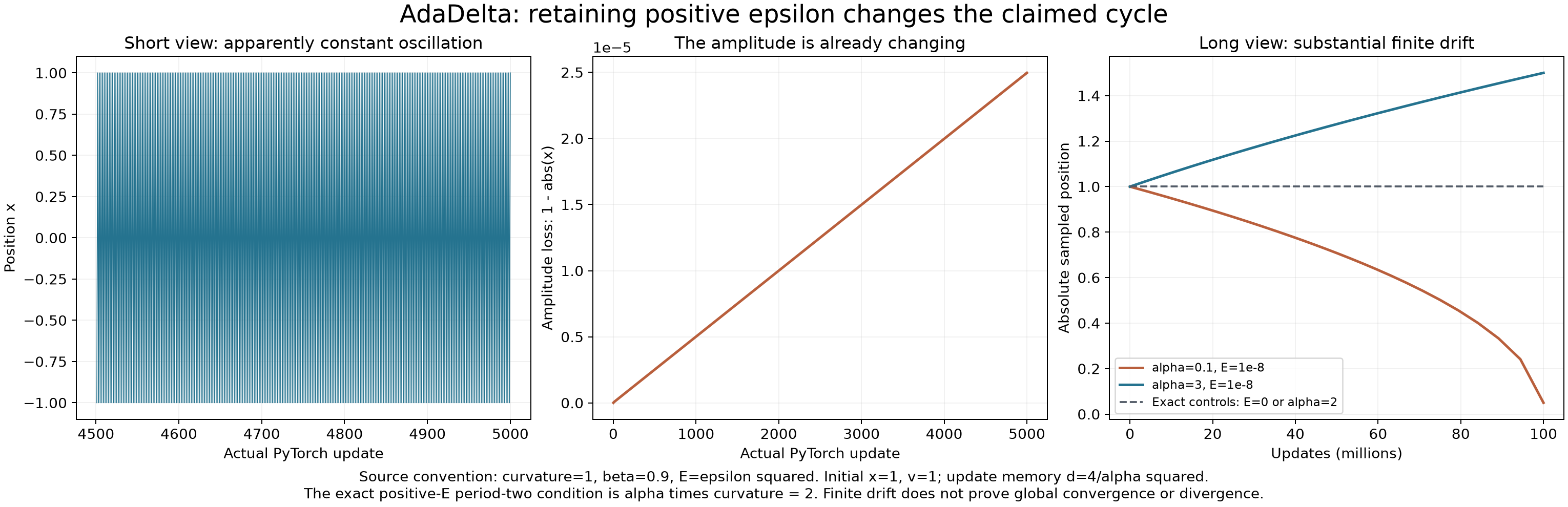
The actual PyTorch 2.15.0 CPU optimizer, with these memories explicitly initialized and eps=1e-8, agrees at that endpoint to a maximum state discrepancy of 4.84e-12. Its complete 5,000-step output is retained. A source-like short plot cannot visually resolve the small amplitude change.
A separate binary64 continuation to 100,000,000 updates reaches x≈0.05000248, d≈1.00013717, v≈0.00250035. The oscillation amplitude has substantially changed. Controls retain the exact zero-E cycle, retain the positive-E critical-product cycle, show outward finite drift at alpha=3, and reach the floating-point underflow scale with the larger E=1e-6 at alpha=0.1. That last numerical outcome is not presented as an exact-real stopping or convergence proof. Every declared control is retained.
Consequence for the literature comparison
The source's zero-epsilon cycle family is reproduced. Its continuation argument treats the squared-gradient memory as a fixed parameter in a reduced system. A root of that reduced system must still satisfy the omitted memory return equation to be a cycle of the full map. The classification above shows that a nontrivial positive-E cycle cannot satisfy all three return equations away from alpha*k=2.
Accordingly, this repository credits the zero-epsilon family as prior work but does not rely on the quoted positive-epsilon extension as evidence of an exact full-state cycle. The stated source example is a slowly changing oscillation in the reproduced recurrence. This correction concerns that claim and convention; absence of a two-cycle does not rule out other forms of nonconvergence.
The audit was motivated by the search for unusual attractors: a nearly closed portrait and a long flat-looking amplitude trace are insufficient. The Yogi report keeps its separate long-run, precision, library and initial-state checks. No new attractor is claimed from the AdaDelta replay.
The frozen audit retains all five long continuations, both high-precision replays, the complete actual-library history, source fingerprints and 512 exact rational checks of the factorization. The algebra above supplies the period-two classification; those finite checks validate the calculation and implementation. Run python research/verify_optimizer_followups.py --results results to check both this packet and the separate Yogi attraction packet.