A four-state enzyme gel: negative and unresolved results
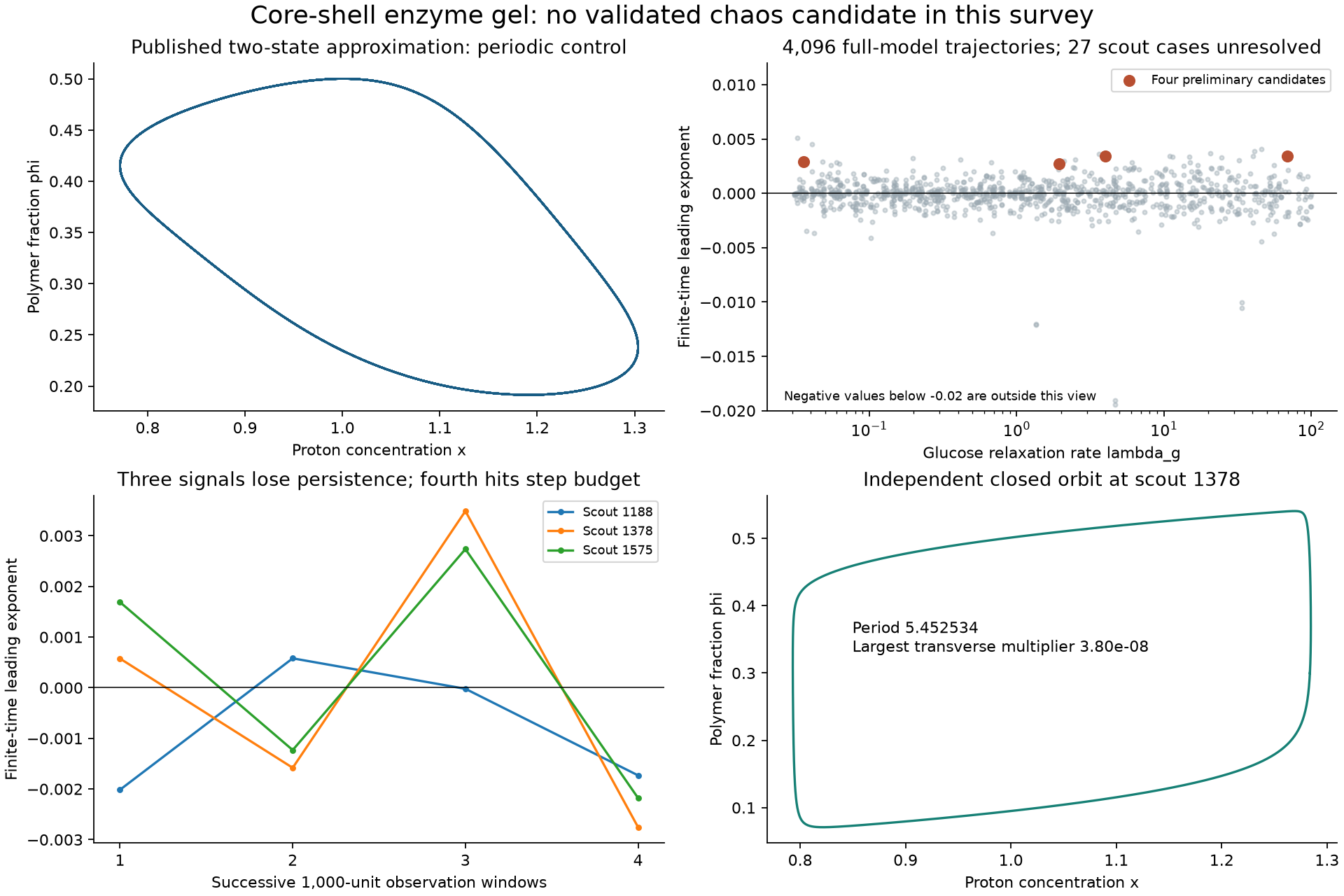
Research note, 30 October 2026. No validated chaotic candidate emerged from this survey. Three of four preliminary signals lost persistence on longer integration; the fourth became too stiff for the GPU step budget. An independent closed-orbit calculation identifies one apparently positive case as a strongly stable periodic orbit. Unresolved cases remain open.
Later single-case check: an implicit CPU continuation and periodic closure now identify the fourth preliminary signal, source 2882, as a strongly stable cycle at its saved endpoint. Its original GPU interval remains incomplete, and other stiff cases remain unclassified. The original survey counts below are preserved.
Model and scope
Shinbo et al. [1] specify four chemical/mechanical states, then study a two-state quasi-steady approximation. We implement their full Eqs. 1–5 with constant external substrates. The Hill permeability and urease activity are retained literally. The surrounding bath is an effectively infinite reservoir; finite-fuel depletion and experimental calibration are separate issues. The article's two-state approximation is planar and cannot contain a classical autonomous strange attractor on a compact regular branch.
With time scaled by the proton relaxation time, define scaled glucose and urea concentrations
Our exact change of variables gives
Here lambda_g=(k_D^g+k_R^g)/k_D^h, gamma=k_D^u/k_D^h, rho=k_R^u/k_D^h; A=K_g*g0/h_c and C=2*K_u*u0/h_c use the paper's definitions. Its effective response is
Constants are h_c=5.62e-5 M, K_ES1=5e-6 M, K_ES2=2e-9 M, K_A=1.404e-5 M, P_min=.1992, P_max=.8544, and n=4.568. The source reference uses A=3, C=110, gamma=25, rho=5.68, B=7.2, and epsilon=.5.
The source does not determine lambda_g independently from its reduced parameters. Finite values below are explicit choices of an original-model rate, including regimes outside the quasi-steady assumption. They are not fitted material measurements. Setting the first two derivatives to zero recovers the published reduced equation exactly; this algebraic identity is independently checked.
Domain checks
Positive G,U,x are invariant: their boundary derivatives point inward, with f(0)=0. On a trajectory remaining in 0<phi<1, let
Then G<=G_max, U<=U_max, and x<=max(x(0),1+G_max) by comparison with linear equations. These are bounds conditional on remaining in the physical polymer-fraction interval, not a global trapping theorem. The cubic swelling equation need not preserve that interval for arbitrary parameters; physical exits are rejected throughout the transient and observation. Low-urea first-order kinetics, idealized transport and bath assumptions still require physical validation.
Numerical results
The seeded survey chooses 2,048 parameter tuples and two starts each. Ranges are A=1..12, C=30..600, B=3..14, epsilon=.03..3, and lambda_g=.03..100; positive scale parameters are sampled logarithmically except B, which is uniform. gamma, rho and n remain at source values. One tuple is replaced by the reference above with explicitly chosen lambda_g=25. Initial substrate states are quasi-steady at (x,phi)=(1,.15) or (.9,.5).
| Calculation | Result |
|---|---|
| FP64 GPU, 500 transient + 1,000 observation units | 3,780 complete, 289 physical exits, 27 step-budget cases |
| Preliminary rule: mean LLE > .002 and all four windows > .001 | Four signals, source indices 1188, 1378, 1575, 2882 |
| All four signals plus strongest completed cases, union 25, additional 2,000 + 4,000 units | 17 complete with no retained signal; eight hit step budget |
| Original signals on longer run | 1188, 1378 and 1575 lose window-wise positivity; 2882 unresolved |
| Independent periodic orbit at 1378 | Period 5.4525342115; section closure 4.4e-16; Radau closure 7.3e-12 |
The largest transverse multiplier of the checked cycle is approximately 3.80e-8, well inside the unit circle. Extremely small remaining multipliers are limited by floating-point resolution. This is strong numerical evidence for a stable periodic orbit, not a theorem about every start at that parameter tuple.
The example also shows why finite-time positive exponents need care: a 400-unit CPU window gives leading estimate .00947, despite the independently closed stable cycle. Phase-dependent tangent growth need not average to zero over a finite nonintegral number of periods. Its full QR spectrum passes the integrated-divergence check to 4.7e-11 when QR spacing is .1. An earlier spacing of 1 fails that check by .0468; that file is retained and explicitly marked failed diagnostic, not used as a validated spectrum.
An additional Radau continuation examines all 27 stiff scout endpoints for 100 units each. All complete, but all retain motion and remain unresolved by this equilibrium/exit check. It is a bounded follow-up, not a Lyapunov classification. The saved record lists per-case outcomes and elapsed times. These cases must not be counted as negative chaos results.
Verification and reproduction
Independent analytic-Jacobian differences across 64 states stay below 9e-9 in relative scaled error. GPU/DOP853 state and leading-exponent differences over a short control are below 3e-13; DOP853/Radau state agreement is below 4e-15. These verify implementation, not asymptotic dynamics.
python research/core_shell_gel.py
python research/core_shell_gel.py --source-control
python research/core_shell_gel_gpu.py
python research/core_shell_gel_gpu.py --refine results/core-shell-gel/scout.npz
python research/resolve_core_shell_gel.py
python research/check_core_shell_gel.py --source results/core-shell-gel/scout.npz --index 1378 --transient 200 --duration 400 --qr-interval .1 --output scout-cpu-1378-tightqr
python research/check_core_shell_gel.py --source results/core-shell-gel/scout.npz --index 1378 --cycle
python research/plot_core_shell_gel.py
Data retain sampled parameters, starts, final states, all four Lyapunov windows and failure/budget flags. The optional --broad mode is an unexecuted future experiment, not part of the results above.
Literature limits
The primary HTML and ten-page PDF were read. Direct local downloads and the official supplement returned HTTP 403, so the supplement's fit details are unverified. Targeted identifier/author/chaos searches found no exact full-model chaos result; OpenAlex recorded zero citing works on 29 October 2026. Neither observation establishes novelty. Earlier gel/enzyme oscillators [2] and the related microreactor model [3] already exist; their presence is not a demonstration of chaos in this four-state model.
References
- Shinbo, S., Sukegawa, T., Yamada, Y., and Maeda, S. (2026). Theoretical Model of Chemomechanical Self-Oscillation in a Two-Enzyme Core–Shell Hydrogel With pH-Gated Microcapsules. ChemSystemsChem 8, e70050. DOI.
- Leroux, J.-C., and Siegel, R. A. (1999). Autonomous gel/enzyme oscillator fueled by glucose: Preliminary evidence for oscillations. Chaos 9, 267–275. DOI. Primary abstract inspected; no claim that all original equations were compared.
- Milster, S., Darwish, A., Göth, N., and Dzubiella, J. (2023). Synergistic chemomechanical dynamics of feedback-controlled microreactors. Physical Review E 108, L042601. DOI, preprint.