Two return strips and a closer geometric predecessor
Case 177 has a promising numerical two-strip return configuration near its triangular periodic-orbit candidate. All 578 sampled starts return with positive boundary margins and strong measured expansion. This is a proposal for a future covering proof, not a certified horseshoe or an entropy bound.
The novelty audit also found a closer predecessor: an integrable icosahedral sphere flow has the same directed geometric graph after an explicit coordinate change and time reversal. The graph itself is therefore not a novelty claim.
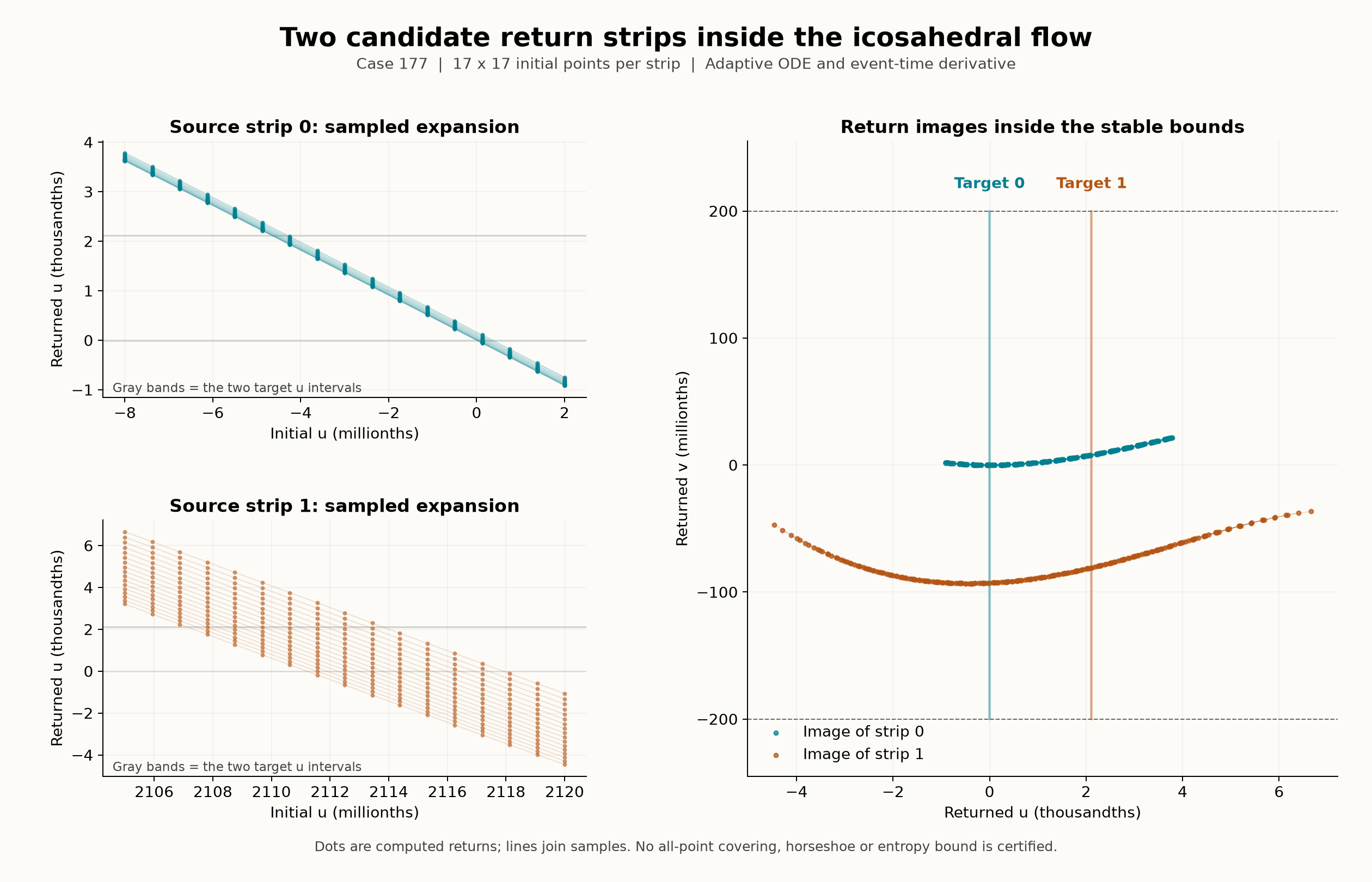
The dots are computed section crossings. Lines only connect samples. The targets are intentionally narrow; neither the displayed lines nor the shaded bands enclose behavior between samples. This is a diagnostic of the existing case 177, not a new attractor portrait.
What was actually computed
The section passes through the approximate triangle-cycle point from the cycle follow-up. Its normal is the normalized vector field there. The two columns of the saved basis are numerical eigenvectors of the event-corrected return derivative, ordered by decreasing multiplier magnitude. They have unit length and need not be orthogonal. The numerical coordinate convention is
x = x0 + B (u,v),             (x-x0) dot n = 0,
x0 = (-1.0776618005076668, 0.04561237206305864, 0.11748519187281951).
The full frame, including all binary64 coefficients, is stored in icosa-return-scout/data.npz. Its small rounding residuals are not an exact interval parametrization of a plane.
We select the first numerically detected positive crossing after time 1 that satisfies |u| < 0.15, |v| < 0.01 and n dot f > 0.05. An earlier spiral crossing lies outside this local patch. These exclusions are part of the definition; this is not a claim about the first crossing of the entire infinite plane. The DOP853 horizon is 25, with rtol=2e-12, atol=2e-14, and maximum step 0.04.
The two source rectangles are:
R0: -0.000008 <= u <= 0.000002,  -0.0002 <= v <= 0.0002
R1:  0.002105 <= u <= 0.002120,  -0.0002 <= v <= 0.0002.
Each has a uniform 17 by 17 grid, including its boundary. Every sampled left edge returns to the right of both target intervals; every sampled right edge returns to their left. All sampled returned v coordinates stay strictly inside the common stable interval.
| Sampled quantity | R0 | R1 |
|---|---|---|
| Number of starts | 289 | 289 |
| Minimum left-edge margin beyond both targets | 0.0015013 | 0.0010865 |
| Minimum right-edge margin beyond both targets | 0.0007426 | 0.0010611 |
| Stable-coordinate margin | 0.0001784 | 0.0001068 |
| Return time range | 13.8674–13.9549 | 19.7989–20.0578 |
| Minimum positive crossing speed | 0.7749 | 0.7514 |
| Minimum unstable-coordinate cone expansion | 447.91 | 499.64 |
| Maximum image cone slope | 0.008953 | 0.024877 |
For a tangent vector with |dv| <= 0.1 |du|, the reported expansion is |J00|-0.1|J01|, and the image slope bound at that point is (|J10|+0.1|J11|)/expansion. These are coordinate quantities evaluated at the sampled points, not uniform bounds on either rectangle. J includes the event-time correction
J = B^+ [Id - f n^T/(n^T f)] D Phi_t B.
The initial 513-point line scout, all three local-patch filters, the preliminary 54-point rectangle grid, the complete 578-point grid and the controls are archived. Failed or missing returns in the broader scout are not silently replaced by successful local samples.
Independent numerical controls
Two separately written field/Jacobian implementations agree to 1.78e-15 on thirty seeded states. Ten corner/center controls use tighter DOP853 tolerances and fixed-step RK4 with event bisection. Tightening the adaptive calculation changes returned coordinates by at most 1.47e-12 and derivatives by 2.28e-8.
Maximum RK4 coordinate discrepancies decrease from 2.61e-8 to 1.44e-9 to 8.41e-11 as the step halves from 0.005 to 0.00125. Every individual refinement ratio exceeds 16.29. Two central-difference checks of the event-time derivative have maximum entry errors below 1.91e-5, compared with expanding entries of magnitude roughly 450–520.
These checks support numerical reliability at tested points. No validated ODE tube, all-point section crossing, interval covering relation, invariant set or asymptotic attraction certificate is supplied. Even a future horseshoe certificate would need to be distinguished from proof that the displayed cloud is an attracting chaotic set.
The graph has a known integrable counterpart
Giedrius Alkauskas's author-uploaded The simplest icosahedral flow on the sphere, dated 2026-06-26, studies
phi = (1+sqrt(5))/2,       rho = x^2+y^2+z^2,
P6 = (phi^2 x^2-y^2)(phi^2 y^2-z^2)(phi^2 z^2-x^2),
F = (5/2-sqrt(5)) grad(rho) cross grad(P6).
Both rho and P6 are conserved. On the unit sphere, the zero level of P6 gives thirty saddle vertices and sixty great-circle arcs bounding twenty triangles and twelve pentagons. Regular levels instead give closed curves. Sections 1–2 were read through the author's full-text upload; PDF retrieval failed, so no figure-level comparison is claimed. This is a preprint, not an independently established peer-review record. DOI.
Our new comparison uses the explicit swap S(x,y,z)=(y,x,z) and pulls back the entire vector field as S^T F(Sx). This handles the orientation change in the cross product. At the spherical midpoint of each of the sixty observed directed edges, its normalized field points opposite the edge tangent: every dot product is -1 to binary64 rounding accuracy. The maximum absolute sextic level at those midpoints is 3.53e-16. Thus the finite directed graph matches the time-reversed known skeleton. It is not evidence that our trajectories are heteroclinic connections.
The same explicit comparison does not identify the full flows. On 10,000 frozen states of our trajectory, the radius ranges from 0.80597 to 1.23859, and the sextic evaluated on normalized states ranges from -0.44452 to 0.08356. This motion does not remain on one of that reference's fixed-radius, fixed-level curves. It is not a general proof against nonlinear equivalence or an exhaustive literature search. Historical uniqueness remains open.
Evidence and reproduction
Frozen packet · Portable stages · Drawing date records
python research/verify_icosahedral_returns.py --scratch D:/Codex/verify-icosahedral-returns
The verifier checks hashes and all sampled margins, repeats selected integrations with the separate NumPy implementation, compares fixed-step returns, and reruns the spherical-reference comparison. Earlier numerical packets and their manifests remain unchanged.