A complex quotient instability of the five-cluster cycle
Numerical continuation of the case-16 five-cluster periodic orbit finds a complex conjugate pair of quotient Floquet multipliers crossing the unit circle near rho = 2.29823502. All nine pair-contrast multipliers remain inside the circle at the 18 sampled branch points. This is a different linear instability from the transverse loss of stability of the four-pair cycle.
The periodic branch reaches the parameter of the one-positive cluster candidate, where it has two unstable quotient directions. This identifies a possible related periodic structure. It does not prove that the chaotic trajectory originates from this branch, that an invariant torus is born, or that a particular sequence of bifurcations connects them.
Fixed model and numerical branch
The starting case-16 periodic result has groups [[0,3],[1,2],[4],[5,6],[7]] and exact cluster weights (2,2,1,2,1)/8. The saved parameters are initially (2.3454545454545457, 4.7551460477513405, 1.0). Only rho changes; the source field, row count, weights, r and b remain fixed.
The continuation follows the 14-dimensional weighted quotient with the same phase section, using the previous periodic solution as the next Newton seed. All three independent 3-dimensional pair-contrast monodromies are computed separately. Together these blocks exhaust the original 23-dimensional tangent space.
All 18 requested points succeeded with steps at most 0.005; there were no failed branch points. The output format nevertheless records every attempted point and preserves failures when they occur.
| rho | Period | Largest quotient nonflow modulus | Largest pair-contrast modulus |
|---|---|---|---|
| 2.345454545 | 25.001684 | 0.075980 | 0.127482 |
| 2.300454545 | 24.600682 | 0.900951 | 0.107804 |
| 2.295454545 | 24.571044 | 1.134521 | 0.106304 |
| 2.261363636 | 24.402771 | 3.809716 | 0.094402 |
At the final parameter, the periodic branch's unstable directions are within the quotient. The nine pair-contrast directions remain numerically contracting. The cluster-size partition is the same as the lane-46 candidate after a row relabeling; the two trajectories are not identified with one another.
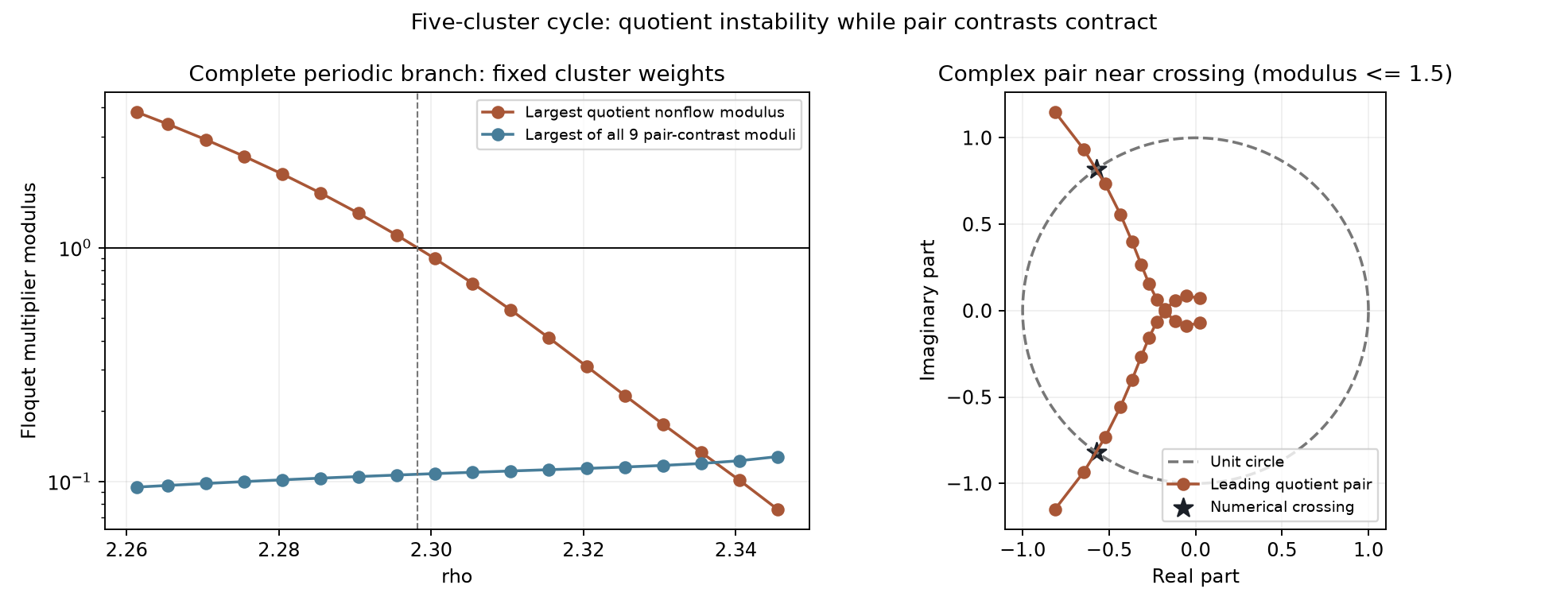
Refined numerical crossing
The refinement record gives
with critical pair
The angle divided by is approximately 0.34709956. The numerical distances from resonances of orders 1 through 4 are nonzero; the smallest is the order-3 distance 0.25876. A centered finite difference with rho increment 1e-5 gives .
At rho_* - 1e-5, the computed modulus minus one is +0.000462870; at rho_* + 1e-5, it is -0.000462720. These are floating-point sign checks, not interval enclosures. They support a complex-pair crossing as rho decreases. No bifurcation normal-form coefficient or invariant torus is computed, so a nondegenerate torus bifurcation is not asserted.
Symmetry and independent controls
Direct strict integration at the initial and final branch points verifies the same sixth-period group permutation
current group j = initial group P[j], P = [3,0,4,1,2].
It cycles the three paired clusters and swaps the two singleton clusters. The maximum component residuals are 1.42e-13 and 3.42e-13. This is a numerical spatiotemporal symmetry check; the full-period Floquet computation above does not depend on replacing the orbit by that shorter relative return.
Every branch point compares the quotient shooting matrix with a tighter independent integration, checks the closure and flow direction, and checks the constant 23-dimensional Jacobian decomposition. The largest closure residual across the 18 points is 1.37e-11; the largest difference between the two quotient matrices is 2.19e-11. The independent audit passes 205 checks of saved hashes, parameter and weight preservation, state chaining, spectra and the refinement. The inventory freezes all 56 evidence files and source snapshots.
Reproduction and scope
Use a fresh output folder and Python with NumPy, SciPy and Matplotlib:
python research/continue_motor_cluster_cycle.py --output outputs/motor-cluster-cycle-branch
The executed source stores the parent seed, each attempted periodic point, all monodromy blocks and every failure. The saved refine.source.py and analyze.source.py expect to be placed beside the newly created analysis.json; copying those two scripts into the new output folder and running them reproduces the refinement and audit without changing the frozen archive.
This package concerns a numerical periodic branch and its linear stability. It does not prove chaos, attraction, a branch connection to the lane-46 trajectory or scientific novelty. The rigorous certificates elsewhere in the repository have their own stated parameter and orbit scopes.