Logarithmic contrast extension of the motor precision diagnostic
Status: both independent histories are complete through tau=150000, with matching departure events and verified source/data hashes. This is a frozen extension of the 40,000-time-unit pair-coordinate audit; later continuations belong to separate output folders and reports.
The experiment retains a nonzero contrast without storing its exponentially small amplitude as an ordinary floating-point number. It tests continued departures from symmetry-related periodic saddles. It does not prove a heteroclinic connection, asymptotic network attraction, or chaos.
Prior work already discusses slow switching and round-off capture in other globally coupled oscillator models: Kori and Kuramoto (2001), Introduction and Sections IV–V, DOI 10.1103/PhysRevE.63.046214. This study makes no general mechanism-priority claim.
Exact equations and gauge freedom
Use the four fixed row pairs (0,1), (2,3), (4,5), (6,7), with the eleven pair-mean coordinates of the preceding audit. For pair a, write its three-component half-difference as
The exact contrast equation is linear and homogeneous conditional on the evolving means:
Set
Then, by direct differentiation,
This identity holds for any positive, constant direction norm. It does not rely on imposing ||u_a||=1 during a run. During integration the code never normalizes, projects, clips, reseeds, or adds noise to a direction. Its initial conversion chooses u_a=delta_a/||delta_a|| and ell_a=log||delta_a|| once. Floating-point norm drift is measured rather than removed.
There are 27 stored variables, comprising eleven means, twelve direction components, and four logarithmic amplitudes. The four transformations
leave the physical state unchanged. Fixing the four positive direction norms gives the original 23 physical dimensions. Auxiliary gauge invariants must not be counted as physical neutral Lyapunov or Floquet directions.
For a continuous finite-time mean trajectory, each contrast equation has an invertible fundamental matrix. Thus a nonzero initial contrast cannot become exactly zero at finite time. The logarithmic chart covers such trajectories without a finite-time zero-amplitude singularity; it does not cover an exactly invariant zero contrast.
Mean feedback and floating-point limits
Write u_a=(u_c,u_s,u_X) and dV_u=-rho u_X+r u_s. The exact mean equations become
The fourth mean displacement is still the negative sum of the first three. No model term has been intentionally removed from these equations. Nevertheless, an FP64 evaluation of exp(2 ell_a) eventually underflows to zero, and even larger but tiny feedback terms may disappear when added to an order-one mean derivative. This experiment explicitly records the former event. It cannot restore arbitrary precision to the mean dynamics.
For each omitted quadratic component, the algebraic bound at a given state is
The code records the logarithm of this full bound at every right-hand-side stage where exp(2 ell_a)==0. It retains the first such evaluation time, counts, and the largest logged bound. Trial and rejected solver stages are included, so the first evaluation time is not a certified first crossing on the accepted numerical trajectory. A bound on instantaneous omitted forcing is not a bound on accumulated or amplified trajectory error.
Physical contrast magnitudes are reported directly as
including the actual numerical direction norm. Reconstructing ordinary row coordinates is reserved for coarse phase/permutation matching and loses tiny contrasts as in the preceding audit.
Initial conditions and validation
Both integrations resume the corresponding saved state at tau=40000 from the independently controlled 23-state chart histories. The parameter vector remains (rho,r,b)=(3.268,4.755146047751339,1). Each source NPZ, source summary, executed program, and imported pair-coordinate program is hashed. The new floating-point logarithm/exponential conversion has its own recorded reconstruction error; the initial physical state is not regenerated from rounded Cartesian rows.
The algebra audit uses 32 random states and random nonunit gauges. The largest scaled pushed-field discrepancy is 4.55e-16; the normalized gauge-invariant derivative discrepancy is 3.11e-15. The mean feedback agrees under the independent gauge rescaling to 3.16e-16.
Each run first compares the logarithmic equations with the full 23-state chart over 200 time units, using DOP853, maximum step 0.025, and relative tolerance 2e-12. Across both initial states, the maximum physical chart discrepancy is 1.36e-13, the maximum log10 magnitude discrepancy is 3.21e-12, and the maximum squared direction-norm drift is 1.41e-11. An explicit 1e-7 acceptance guard makes a failed comparison stop the run. This short check is not a long-time error bound.
Long-run configurations:
| Run | Maximum step | Relative tolerance | Mean/direction/logarithm absolute tolerance | Requested final time |
|---|---|---|---|---|
step-0p1 |
0.1 | 1e-10 |
1e-12 |
150000 |
step-0p05 |
0.05 | 2e-11 |
2e-13 |
150000 |
Every 500 time units the program saves all 27 state coordinates at period-spaced checkpoints and at the block endpoint. It records direction-norm drift, finite logarithmic magnitudes, and upward crossings of the physical halfcontrast norm through 1e-4. As in the frozen audit, only recoveries preceded by a checkpoint below 1e-12 classify departures; raw oscillatory threshold crossings do not.
Results and limits
Both runs reproduce two further departures:
| Departure | Recovering pair | Main time | Strict-control time | Difference |
|---|---|---|---|---|
| Fifth | 6,7 | 72604.73104865011 | 72604.73104929946 | 6.49e-7 |
| Sixth | 2,3 | 141092.6338799517 | 141092.6338841212 | 4.17e-6 |
The observed near-saddle path is L0a -> L1b -> L2a -> L3a -> L0a -> L1b -> L2a. It visits four of the eight candidate graph nodes. Through the complete histories the successive departure-gap ratios are 1.869842, 1.873376, 1.874012, and 1.875101, approaching the local rate ratio about 1.876033. This is finite-time evidence compatible with the proposed network mechanism, without a connection or attraction theorem.
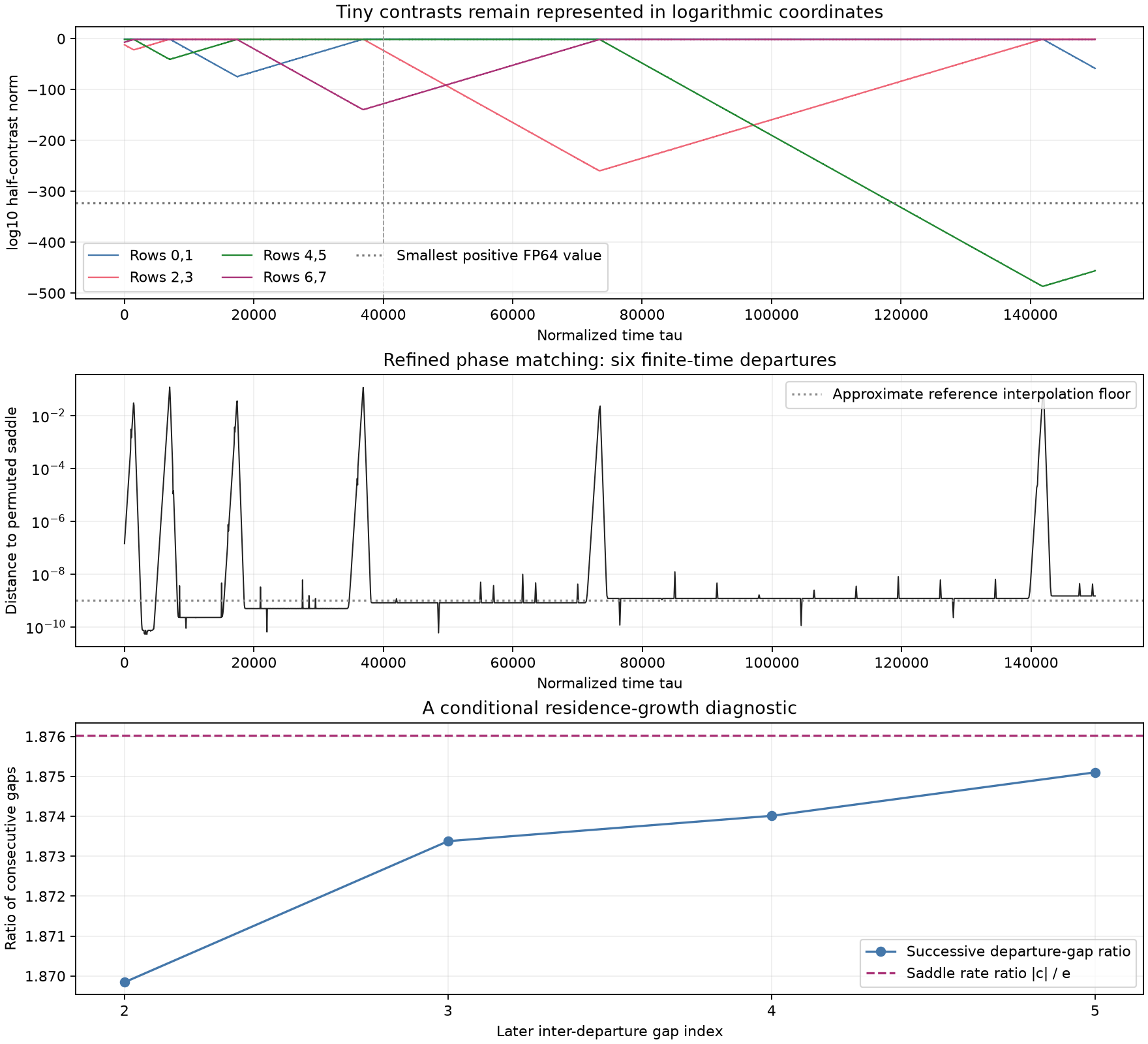
Pair (4,5) first reconstructs as zero in ordinary FP64 at the stored checkpoint tau=118881.03109548356 in both runs, while its logarithmic representation remains finite. Its minimum stored log10 norm is -486.3740103711 in the main run and -486.3740107682 in the strict run. By tau=150000 it has regrown to -455.6469731377 and -455.6469738949. This is partial regrowth by about thirty orders of magnitude while the amplitude remains unrepresentable as an ordinary FP64 number; a seventh threshold departure is not part of this frozen block.
Across common checkpoints from 40k to 150k, the largest mean/representable-chart discrepancy is 1.23e-7, the largest difference in log10 contrast norms is 1.09e-6, and the largest normalized direction-component discrepancy is 3.60e-7. Squared gauge norms drift by at most 6.98e-7 and 1.25e-7 in the two histories, without renormalization. The evidence supports reproducibility of these events and the reported precision diagnostic. It is not a certified error enclosure for the exact distant trajectory.
The separate fixed-phase fits also resolve growth below the amplitude representation limit. Over 145000..150000, pair (4,5) in the strict run has fitted growth rate 0.008696267790887842; pair (0,1) contracts at -0.01631448594126165. Their fitted magnitude ratio is 1.8760330676978874. The local rates are close to the independent certified values below, but these floating-point fits are not claimed to lie inside those much narrower rigorous intervals.
Quadratic mean-feedback underflow begins much earlier than amplitude-reconstruction underflow: the first main-run zero-weight RHS stages occur near 59439.17 for pair (2,3) and 95964.08 for pair (4,5). The largest recorded full omitted-component bound across both runs is approximately 1.97e-323. The manifest retains the logarithmic bounds and high-precision decimal conversions. These are instantaneous bounds at sampled floating-point stages, not bounds on accumulated trajectory error or all roundoff.
Plot review found two false large distance spikes in the original 80-phase nearest-orbit search, at tau=55000 and 85000. The separate review searches all 1,000 reference phases, refines every sampled local minimum, and applies safeguarded Newton phase refinement. It reduces those apparent distances from 0.0463 and 0.0732 to 4.89e-9 and 1.22e-8. The revised figure above was inspected. Original diagnostics and figures remain archived; no trajectory, event time, or node path changed. Residual phase/interpolation errors remain, so this distance plot is not a certified proximity estimate.
The first plotting command saved its artifacts but failed while printing a Unicode Windows path through a CP1252 terminal. Repeating it with python -X utf8 succeeded; the numerical data were unaffected, and the terminal failure is recorded separately.
Audited optional scalar evaluator
motor_log_scalar.py evaluates the same real equations without many small NumPy allocations. It is separate from the NumPy evaluator used for both 150k histories. The final recheck covers 32 random nonunit gauges, the full state Jacobian, the derivative of reconstruction against the original Cartesian analytic Jacobian, and five deep-amplitude underflow cases. The largest scaled derivative discrepancy is 3.73e-16; underflow-bound records agree exactly for the test states.
A 200-time-unit scalar/NumPy control differs by 5.16e-14 in means and 2.59e-12 in logarithmic magnitudes. Its measured full-integrator speedup is 2.82, with tracking enabled. The optional scalar run mode requires a passed audit with matching source hashes. It can resume all 27 stored logarithmic coordinates exactly, without rebuilding tiny contrasts from zero Cartesian differences. This benchmark does not itself establish a later departure.
Conditional residence-growth prediction
The archived numerical saddle has expanding Floquet exponent e=0.008696267790971083 and the relevant contracting exponent -c=-0.01631448594129444, giving kappa=c/e=1.8760330676837005. A local entry-to-exit map near a hyperbolic periodic saddle would give a residence time proportional to -log(epsilon)/e and a departing stable amplitude proportional, up to bounded periodic factors, to epsilon^(c/e). If the global transition maps this amplitude nondegenerately to the next unstable coordinate, and the relevant connections exist, successive residence times would satisfy T_next=kappa*T+O(1). These are additional mathematical assumptions; the exponent ratio alone proves neither a connection nor network attraction.
The frozen four departure times are 621.7836635209453, 6185.783113604954, 16589.582279899285, and 36079.81343168635. Their successive gap ratios are 1.86984187536849 and 1.873376334957567. Before either new run reached the fifth event, pre-event-prediction.json fixed the slope to the independently measured saddle ratio and fitted only an additive gap offset from the last two gaps. This heuristic predicts the fifth and sixth departure times near 72616.49 and 141132.87. Threshold phase and finite transition times can shift them; the prediction is not a validated return map.
The later, independent saddle certificate and leading-rate enclosure give e=0.00869626779094932 +/- 3.79e-18, c=0.0163144859413539 +/- 3.58e-17, and c/e=1.87603306769524 +/- 6.41e-15 at the exact benchmark. They also establish that c is the leading stable rate. These local results strengthen the interpretation of the comparison but do not supply the unproved global transition maps. The pre-event prediction retains its original floating-point coefficient; it has not been recomputed with the later enclosure.
The exact symmetry-coset graph classifies the existing near-saddle matches as L0a -> L1b -> L2a -> L3a -> L0a. This is one four-node path in the eight-node candidate graph. It does not traverse the complete graph or prove its directed connections. The classification is saved separately in frozen-40k-node-visits.json, using only reference distances below 1e-6.
Reproduction
Run from the repository root with the NumPy/SciPy environment:
python research/motor_log_contrasts.py run --resume-from results/motor-pair-coordinates/seed-1e-12-step-0p1-extended --output results/motor-log-contrasts/step-0p1 --horizon 150000 --max-step .1
python research/motor_log_contrasts.py run --resume-from results/motor-pair-coordinates/seed-1e-12-step-0p05-extended --output results/motor-log-contrasts/step-0p05 --horizon 150000 --max-step .05 --rtol 2e-11 --mean-atol 2e-13 --direction-atol 2e-13 --logarithm-atol 2e-13
python research/motor_log_contrasts.py analyze --output results/motor-log-contrasts/step-0p1
python research/motor_log_contrasts.py analyze --output results/motor-log-contrasts/step-0p05
python research/motor_log_contrasts.py compare --output results/motor-log-contrasts/step-0p1 --other results/motor-log-contrasts/step-0p05
python -X utf8 research/motor_log_contrasts.py plot --output results/motor-log-contrasts/step-0p1
python -X utf8 results/motor-log-contrasts/review_orbit_matching.py
python -X utf8 results/motor-log-contrasts/check_manifest.py
These are the recorded output locations; use fresh folder names when repeating integrations. Run outputs refuse to overwrite an existing folder. The program is motor_log_contrasts.py; the 150k manifest verifies 36 files totaling about 5.26 MB, including both 8,289-checkpoint histories and the separate matching review. Its explicit scope excludes future continuation folders.