Exact stability index of the replicated five-cluster cycle
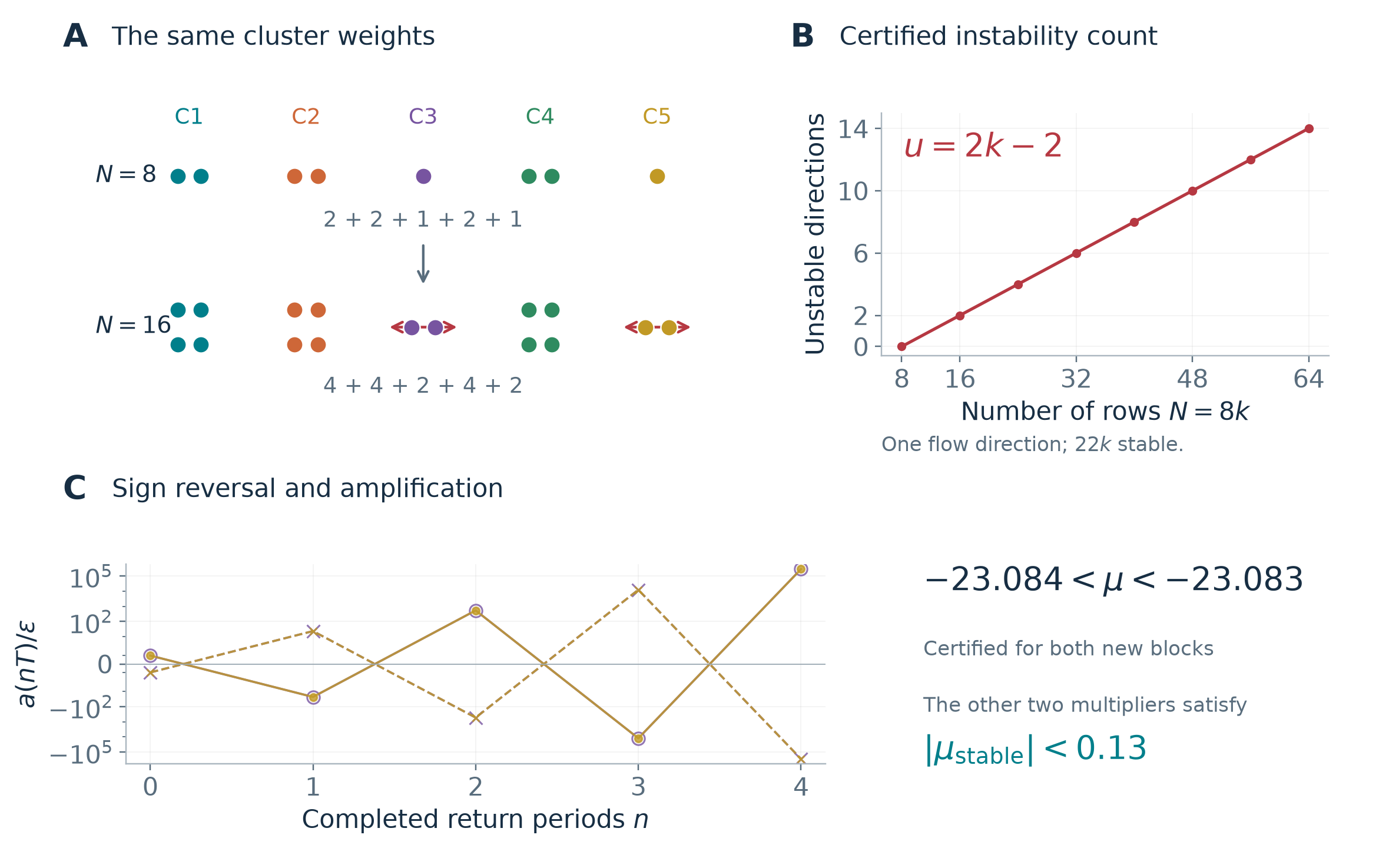
The research manuscript strengthens the earlier replication limit. For every integer k >= 1, the cycle embedded in N=8k rows has exactly
All stable multipliers satisfy |mu|<0.13. Each formerly singleton contrast block has precisely one real multiplier in (-23.084,-23.083) and two multipliers within radius 0.13. Thus the original N=8 orbit attracts locally, while every enlarged replica is a periodic saddle. The parameters and cluster weights remain fixed. The inherited positive period is certified; its least-period status is unchanged.
New proof step
The old sign bracket established at least one unstable root in each new block. The new spectral checker narrows that real-root bracket and encloses synthetic division of the interval characteristic polynomial by the corresponding exact linear factor. Three strict real quadratic Jury inequalities place both remaining roots within radius 0.13. This turns a lower bound into a complete block index.
The calculation is repeated from two separately integrated matrix enclosures: the preserved 512-bit record and a new 640-bit, 192-step, order-54 integration. Both 768-bit replays give the same conclusion. No interval radius is dropped, and floating-point eigenvalues do not enter the proof.
The tangent space is the direct sum of the 14-dimensional quotient and km_a-1 copies of the three-dimensional internal block for each group. Counting its invariant blocks yields 13+9(2k-1)+4(k-1)=22k stable directions, 2(k-1) unstable directions and the single flow direction. The strict spectral separation and invertible shooting Jacobian also imply persistence of the index in a common sufficiently small parameter neighborhood; no numerical radius of that neighborhood is supplied.
Nonlinear interpretation
All eight predeclared N=16 starts are retained: both new blocks, both signs, and perturbation norms 1e-6 and 1e-8. Full47D integrations reproduce amplification and sign reversal. At the first three returns, all smaller-amplitude predictions agree to relative error below 1e-6. Tighter DOP853 histories and an independent Radau control pass. These numerical illustrations do not classify the eventual destinations or establish a nonlinear basin bound.
Earlier proof files, source snapshots and raw data are unchanged. The manuscript's claim map and reproduction guide, literature positioning, vector figures and rotating GIF accompany the new evidence.