Folded wings, chaotic subsystems and their instability in posterior-reflection maps
Computational research article · updated 2026-11-02. A compact invariant subsystem has certified positive entropy, an orientation-reversing period-92 orbit, and a certified failure of Lyapunov stability. A larger chaotic attractor and historical uniqueness remain unproved.
Abstract
An exact Gaussian posterior for three independently quantized coordinates, combined with unit-sphere reflection feedback, produces a spatial network of four folded wings. A declared 1,753-case survey covers binary, ternary and four-level Cartesian alphabets. All 175 initial nonperiodic flags receive longer follow-up; twelve visually selected regimes receive five-million-step observations. The principal binary candidate retains positive leading growth at all 33 tested starts and in independent 70- and 100-digit calculations. A subsequent hundred-million-step observation of both displayed cases retains positive leading growth in every block. The principal case has rare excursions beyond the original portrait envelope; short interval calculations certify three such exits and isolate a nearby normalization singularity. A separate interval certificate proves a compact invariant subsystem with topological entropy above 0.0254 per original iteration for the exact binary parameters. A second, full-eight-site automatic-derivative implementation verifies every covering relation. An orientation audit places an exact least-period-92 orbit with negative return determinant in that subsystem. Local degree excludes ambient-neighborhood topological conjugacy to orientation-constant local diffeomorphisms, including standard three-dimensional Henon maps, and to smooth Euclidean flow return maps. A further unstable-graph certificate proves that this particular compact subsystem is not Lyapunov stable: arbitrarily nearby points leave its complete covering atlas. Six ordinary folds and two preimages of the normalization singularity are also certified. Numerical critical-set images and 1,452 parameter/start cohorts support a switching-and-folding explanation of the geometry, using established noninvertible-map concepts. A validated continuation of an escaping unstable point reaches the numerical wings, and both numerical outgoing branches recover their long-run geometry and occupancy. A fresh hundred-million-step recurrence search does not establish the reverse connection to the certified core. A larger attracting set containing that core remains unproved. A subsequent 256-start search retains positive leading growth throughout 1.024 billion observed updates. A new interval certificate places a 27-step preimage of the normalization singularity within 0.000060 of one saved reference state. This excludes trapping neighborhoods containing that entire ball, but does not exclude every smaller attracting set. A four-level companion produces layered arches but coexists with numerical fixed points. Complete selection records preserve periodic captures and precision-sensitive planar behavior. The contribution is a reproducible geometric study, a positive-entropy certificate and a precisely scoped equivalence obstruction. Posterior means, spin responses, reflection algorithms and feedback-induced chaos are known; neither a new general operator nor historical priority is claimed.
1. Geometry and evidence level
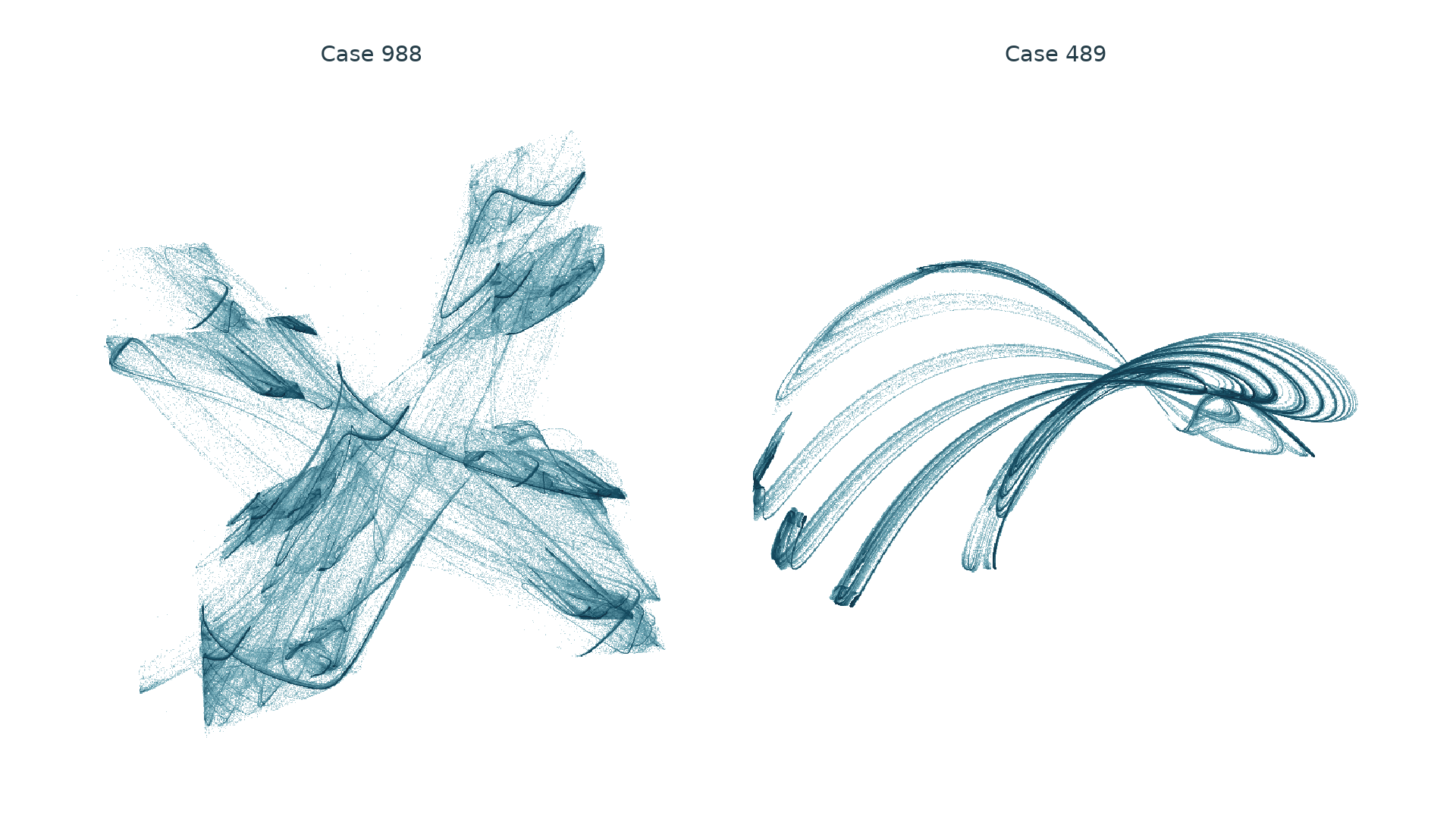
First recorded portrait: 2026-11-01.
Case 988 is the principal candidate: four curved, folded wings occupy a substantial volume in all three coordinate directions. Case 489 is a more anisotropic companion with layered arches and curled edges. These descriptions refer to numerical point clouds, not certified surfaces or topological classifications. Each panel includes two million consecutive states after 100,000 discarded iterations. No symmetry replication, interpolation, smoothing, or nonlinear visual transformation is applied. Centering and orthogonal cameras preserve native geometry; spatial units are equal within each panel. Panel scales and density saturation differ. The displayed window represents the frequently visited core. Section 4.1 shows rare exits found in a much longer run; this portrait is not a complete boundary of an invariant set.
The 24-second rotation uses the last 250,000 consecutive states of the same rendering inputs, with fixed states and scale throughout. The apparent curves are dense sets of discrete iterates. No period at most 512 is detected in the recorded selected tails; this finite test does not prove aperiodicity.

Case identifiers are local to this product-alphabet campaign. The canonical-site study has separate case numbers. In particular, this Case 988 is not a renaming of its cubic Case 653. The full evidence packet retains exact inputs, source snapshots, unsuccessful selections and numerical checks.
2. Model, factorization and established interpretations
For coordinate alphabets , take the uniform prior on . Independent Gaussian observation noise with variance gives
The full posterior factors exactly into these three scalar distributions. The initial campaign evaluates , corresponding to 8, 27 and 64 spatial sites. Sections 3.1–3.2 extend the alphabet size and spacing. The deterministic recurrence is
It is smooth wherever . If and , then
This is the established relaxed-reflection construction with a posterior mean in place of one metric projector. The signal interpretation concerns this deliberately specified iteration, not an observed communication device or a standard decoder implementation. The sphere introduces a known coupling through normalization. The shared equivalence review covers mean shift, MMSE estimation, proximal interpretations, plug-and-play splitting, sigmoid networks and chaotic iterative decoding.
Write . The exact derivative is
For an ideal symmetric binary alphabet , the familiar independent-spin response is
For the ideal ternary alphabet , it becomes
The latter is the standard spin-1/Blume–Capel single-site response, after parameter identification. These identities prevent presenting the scalar nonlinearity as a new invention. The initial campaign's alphabets are separately rounded binary64 arrays built from . Their exact entries, rather than ideal symmetry identities or rounded table entries, define the recorded experiments.
| Case | Levels per coordinate | beta | tau |
|---|---|---|---|
| 988 | 2 | 0.9268088431125507 | 0.020935697765931374 |
| 489 | 4 | 0.9699380761357025 | 0.035825792302107334 |
| Case | Halfwidths a | Center c |
|---|---|---|
| 988 | (0.9987935485318303, 0.9138440923765302, 1.1366534527391194) | (-0.13522116094827652, 0.2182737350463868, -0.07052738964557648) |
| 489 | (1.0288301357999443, 0.17564048673957586, 0.18828875999897718) | (0.104424723982811, -0.5549065947532654, -0.0760837271809578) |
Exact hexadecimal parameters and alphabet entries are recorded in the verification report. Translation or unequal coordinate scaling does not preserve the unit-sphere normalization, so simply centering or stretching the alphabet does not produce an immediate conjugacy to the earlier cubic map. This observation excludes only that elementary identification.
3. Complete search and selection
The initial state is . The declared screen contains
one exact input control from canonical Case 653, a complete 216-case
centered isotropic grid, and 512 scrambled Sobol draws each evaluated at
all three alphabet orders. The Sobol seed is 2026110144. The eight
coordinates determine beta, temperature, three halfwidths and three shifts;
the exact ranges and construction appear in the executed source.
After 5,000 discarded and 15,000 observed iterations, 177 cases have a leading rate above 0.005 in all ten windows. A period test through lag 64 rejects two. All remaining 175 receive 30,000 discarded and 500,000 observed iterations with full three-direction QR calculations. Of these, 165 retain positive leading growth in every window without a detected period: 46 binary, 60 ternary and 59 four-level cases. Nine others have detected periods (four fixed, three period two, one period four and one period 43); one additional case has a nonpositive leading window.
All fifteen preview pages were inspected before selecting twelve cases: 203, 287, 397, 489, 607, 893, 933, 988, 1351, 1450, 1660 and 1709. Each receives a fresh 100,000-step transient, five million observed steps, twenty full-spectrum windows, and a separate two-million-state portrait. All twelve retain positive leading growth. Eight have an observed smallest covariance fraction below ; numerical growth alone does not make them convincing spatial candidates. Five cases receive the start and precision controls below. The two displayed cases were selected for geometry and those controls, not through a preregistered visual score.
3.1. Higher-order visual search
A separate extension packet
tests five, seven and nine levels per coordinate: 125, 343 and 729 fixed
posterior sites. Its 851 inputs comprise two exact earlier controls,
81 centered grid cases and 256 Sobol geometries evaluated at all three
orders. Temperature is scaled by the squared geometric-mean level spacing;
the Sobol seed is 2026110152. This changes the alphabet, not the established
posterior/reflection construction.
All 46 short flags retain positive leading growth in twenty windows over 500,000 observed updates, without a detected period through 512. After inspection of all four preview pages, eight cases receive five million observed updates and separate two-million-state portraits. All eight retain positive leading windows. Their images are predominantly thin folded arcs, frames and layered ribbons. They were not selected to replace the principal four-wing portrait: this is a recorded visual judgment, not a mathematical classification or evidence that higher-order alphabets cannot produce other geometries. Extension identifiers are local; its Cases 0 and 1 are the exact earlier Cases 988 and 489. The packet retains the full selection, numerical controls and bounded reference-library comparisons.
Three of those higher-order cases, 109, 185 and 414, retain positive growth in separate 70- and 100-digit observations. However, only 10, 14 and 11 of 33 fresh starts respectively retain positive growth in every window without a detected period. The remaining outcomes include 22, 19 and 22 finite periodic captures, plus one nonperiodic Case 109 trace with a nonpositive leading window. Positive growth at one selected start is therefore insufficient to establish a unique attracting regime.
3.2. Nonuniform alphabets and folded shells
A subsequent 770-input survey replaces uniform interior spacing by sorted
nonuniform levels, at three, four and five levels per coordinate. It includes
the same two earlier controls and 256 paired Sobol geometries, seed
2026110154. All 41 short flags receive 500,000-step observations and retain
positive leading windows without a detected period through 512. All four
preview pages are inspected before selecting Cases 6, 7, 102, 118, 212 and
673 for five-million-step observations and two-million-state portraits.
All six retain positive leading windows. These identifiers belong to the
nonuniform survey and are distinct from the higher-order identifiers above.
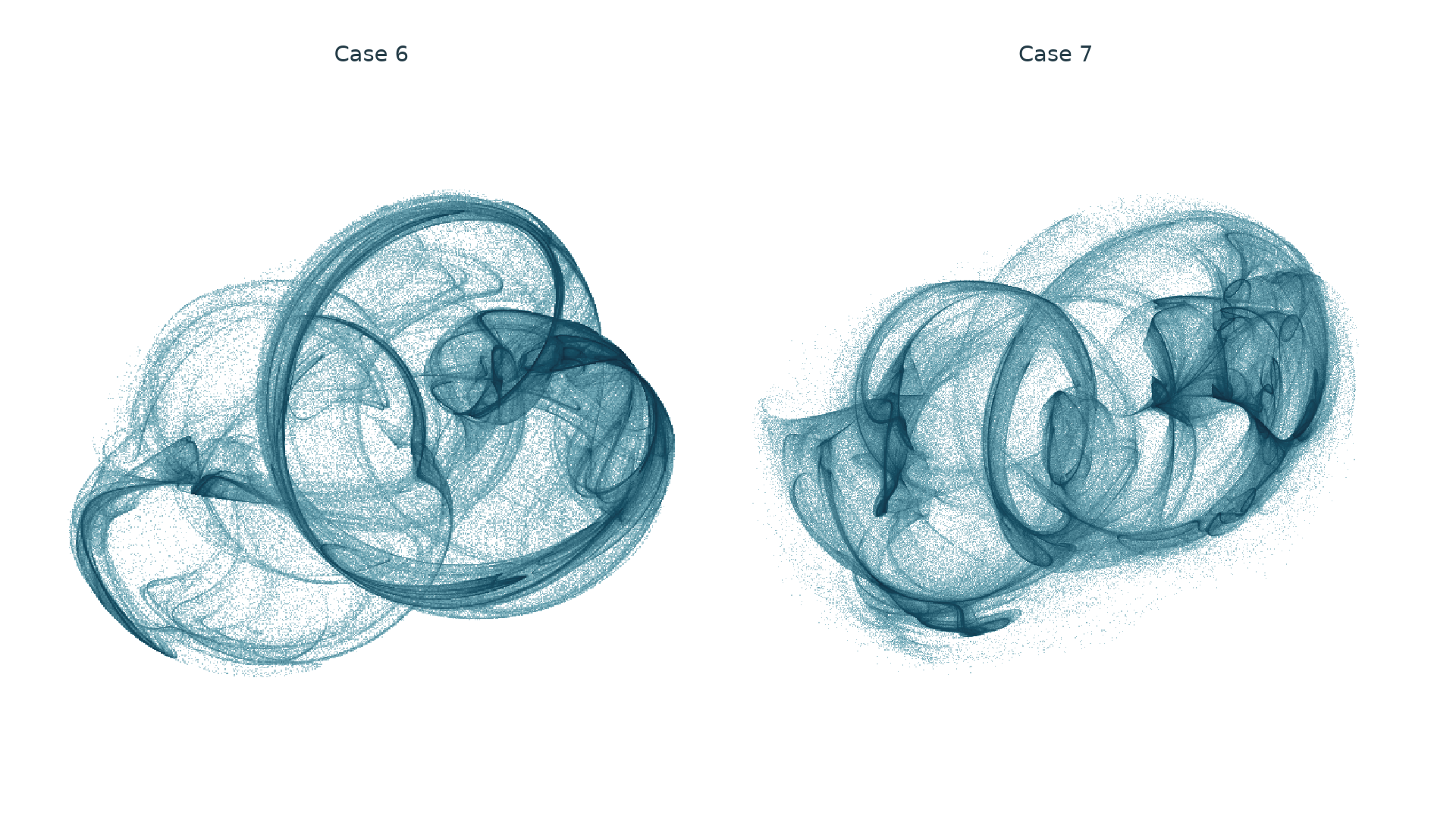
First recorded portrait: 2026-11-01.
Cases 6 and 7 are additional numerical visual candidates, with folded shells and several curled openings. The wording describes appearance; no torus, genus, smooth surface or closed-curve classification is asserted. Each static panel contains two million consecutive states after 100,000 discarded updates, with an orthogonal camera and equal units. The 24-second rotation keeps the last 250,000 states and the spatial scale fixed.

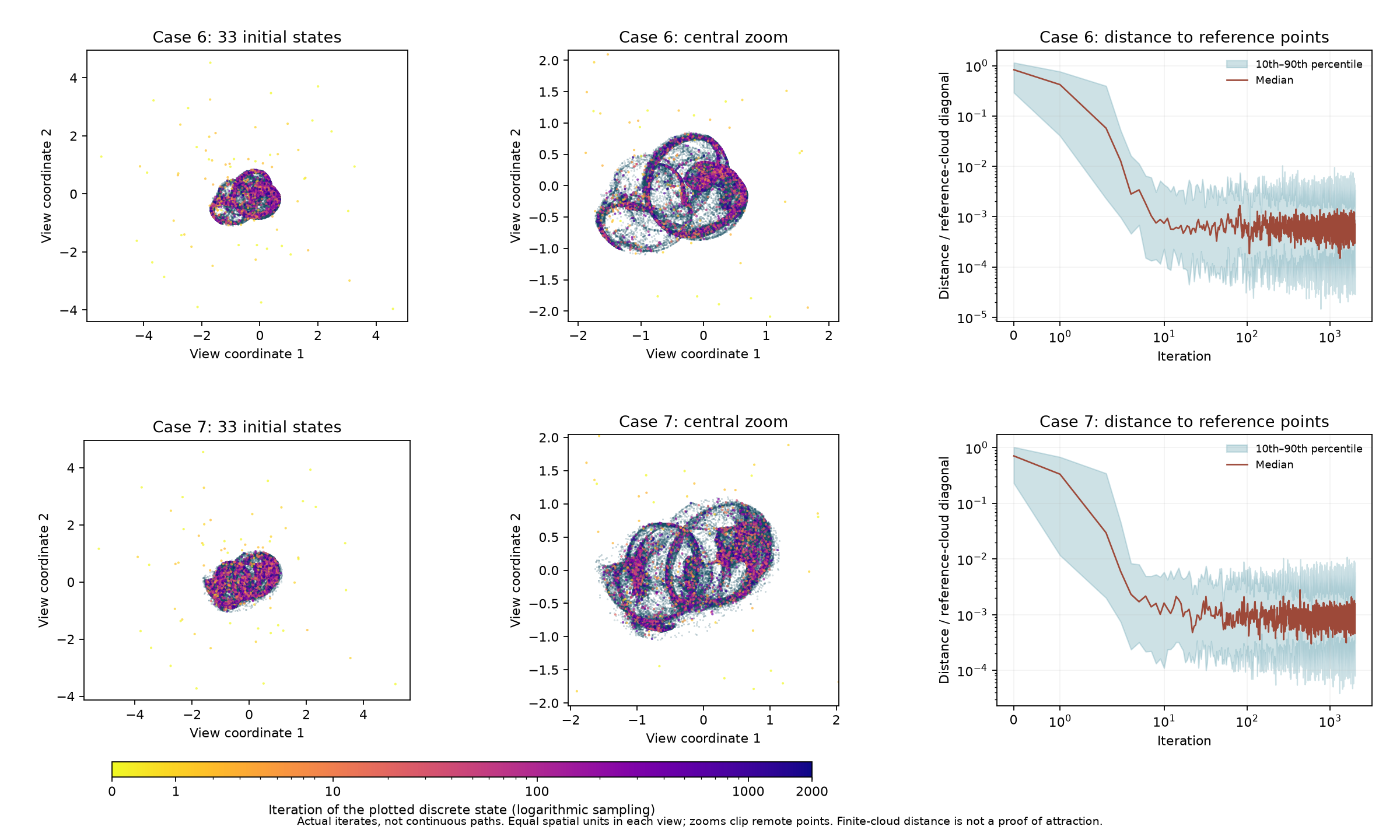
The same 33 initial states are followed for their first 2,000 updates. Colors mark actual discrete states at logarithmically sampled iteration indices; they are not interpolated flow lines. The zooms clip remote points and keep equal spatial units. The right panels measure distance to 100,000 uniformly sampled reference states, divided by that reference cloud's bounding-box diagonal. At update 2,000 the median distances are 0.0006974 and 0.001557. Their positive floors reflect finite reference sampling as well as dynamics; neither the curves nor the finite start cohort prove asymptotic attraction. The approach packet retains plotted states, all distance quantiles and independent expression checks at 132 selected steps.
| Diagnostic | Nonuniform Case 6 | Nonuniform Case 7 |
|---|---|---|
| Levels per coordinate | 4 | 5 |
| beta | 0.9984140746686607 | 0.9984140746686607 |
| tau | 0.17863014837168806 | 0.10047945845907452 |
| Five-million-step QR rates | (0.308444, -0.139512, -0.840100) | (0.357043, -0.041116, -0.404836) |
| Twenty-million-step QR rates | (0.308678, -0.139961, -0.840244) | (0.357078, -0.041303, -0.405067) |
| Smallest leading window | 0.306768 | 0.355429 |
| Positive nonperiodic outcomes among 33 starts | 33 | 33 |
| Smallest 70-digit leading window | 0.301826 | 0.348977 |
| Smallest 100-digit leading window | 0.298781 | 0.347495 |
The start and precision protocols are the same as in Section 4; they use these cases' exact stored nonuniform levels. The extension packet records every level, all outcomes, complete numerical replays and the image selection. The entropy, reversed-return and singularity certificates for Case 988 do not transfer to these new parameter sets.
A fresh twenty-million-step observation retains positive leading growth in every two-million-step block. All twenty block endpoints and minimum normalization radii are replayed exactly. Relative to each original two-million-state coordinate box enlarged by 0.02, Case 6 has no recorded exceedance and Case 7 has two. The threshold is inherited from the earlier inspection protocol and selected after the extended calculation, before this census. Neither result is a trapping certificate or an estimate of an invariant probability; the portraits represent finite observation windows.
Visual precedent matters. Toroidal and folded-shell motifs are established. Letellier and Gilmore (2009), publisher abstract describe a genus-three toroidal flow and its genus-one symmetry image. Rosalie and Letellier's 2011 author poster, whose diagrams were inspected, relates a symmetry-reduced Li template to a Rossler template up to orientation and torsion. Thus a different-looking portrait can conceal an established structure. For the nonuniform cases, neither that identification nor its exclusion has been proved.
The 108-reference comparison gives Case 6 a similarity fingerprint nearest to the frozen Sprott P cloud, with best local alignment residual 0.21966 against a within-case value 0.06626. For Case 7 the first fingerprint match is SprottTorus; among its three shortlisted fits, Sprott O has residual 0.12149 against within-case 0.06238. These are finite, locally optimized comparisons, not global minima or tests of nonlinear conjugacy. The O/P equations were checked in Sprott (1994), Table I. Affine-normalized rankings and all six selected cases are retained. The review receipt records the exact reading and figure scope. No claim of a previously unseen shape or a new class of strange attractors follows from this extension.
4. Numerical validation and rejected interpretations
| Diagnostic | Case 988 | Case 489 |
|---|---|---|
| Five-million-step QR rates per iteration | (0.251100, -0.280399, -0.440762) | (0.337780, -0.406624, -0.787602) |
| Smallest leading window | 0.248311 | 0.335313 |
| Covariance fractions, ascending | (0.237213, 0.327906, 0.434880) | (0.020710, 0.086140, 0.893149) |
| Positive, nonperiodic outcomes among 33 starts | 33 | 13 |
| Numerical fixed-point outcomes among 33 starts | 0 | 20 |
| Smallest 70-digit leading window | 0.235852 | 0.319821 |
| Smallest 100-digit leading window | 0.229787 | 0.322401 |
The start cohort combines the original initial condition and 32 scrambled
Sobol points in , seed 2026110146. Each gets 100,000 discarded
and 500,000 observed iterations, twenty full-spectrum windows and a period
test through lag 512. Case 988 has a minimum leading window of 0.232913
over the entire cohort. The finite sample does not establish basin volume,
a unique attractor, or a global basin. Case 489's coexistence is a material
limitation. Other tested cases are retained: Case 933 gives seven positive
outcomes, twenty fixed points and six periodic captures; Case 1450 gives
eleven positive outcomes and twenty-two fixed points.
The arbitrary-precision controls lift the exact binary64 inputs into 70- and 100-digit arithmetic. They use scalar squared-distance Gaussian weights, nested reflections and finite separation, without the production Jacobian. Each discards 10,000 iterations and observes 50,000 in ten windows; separation sizes are and , respectively. This is an independent numerical expression and precision control, not an interval proof or an independent derivation of posterior factorization.
A separate 70-digit check sums all eight spatial posterior weights for Case 988, without scalar factorization. Its mean leading rate is 0.245820 and its smallest window is 0.223730 over the same observation length. This additional implementation retains the nested-reflection expression and finite-separation method, so those components are shared.
Parameter neighborhoods contain regular windows. For each selected case, 64 Sobol directions are evaluated at two declared perturbation radii. At radius 0.01, 45 of 64 runs retain positive leading growth without a detected period for each case. At radius 0.05, the corresponding counts are 39 for Case 988 and 26 for Case 489; all other runs in these cohorts have detected periods. Beta changes by the radius times its distance from one, temperature and halfwidths change multiplicatively in logarithmic coordinates, and centers change in halfwidth units. Each run uses the original initial state, a 100,000-step transient and 500,000 observed iterations. These results support nearby recurrence but do not establish an open region of robust chaos or preservation of the four-wing geometry.
Case 203 exposes a precision-sensitive capture. Its binary64 dense trajectory lies on the exact floating plane and has leading growth about 0.809. The high-precision calculations instead retain three comparable covariance fractions and leading growth about 0.56 over their recorded windows. Its attractive-looking projected cloud therefore cannot be reported as evidence for the same spatial regime across precisions. No claim about the infinite-time fate at arbitrary precision follows.
All screen arrays, all 175 follow-ups, all twelve long observations and all twelve dense trajectories and histograms are replayed from the stored inputs. Independent full-site posterior/covariance evaluations and nested finite differences check the factorized map and derivative at 192 points. QR steps are checked against LAPACK with the same incoming frame, and accumulated volume changes against log determinants. Independently propagated subordinate QR frames differ in two nearly planar cases; the first verifier rejected this discrepancy and is preserved. The corrected verifier records both rates and tests the local identity separately. Both selected candidates also pass the accumulated three-rate agreement check. Numerical replay uses the production recurrence and does not independently certify its dynamics.
4.1. A hundred-million-step horizon and rare excursions
The horizon extension restarts both published cases from the same initial state, discards 100,000 updates and observes 100 million binary64 updates in fifty blocks. Full QR spectra remain positive in their leading component in every block. Neither final recorded tail has a detected period through lag 512.
| Case | Mean QR rates per iteration | Leading block range | Smallest sampled normalization radius |
|---|---|---|---|
| 988 | (0.251237, −0.280582, −0.440516) | 0.249650–0.252559 | 0.246827 |
| 489 | (0.337895, −0.406882, −0.787966) | 0.336477–0.339178 | 0.416578 |
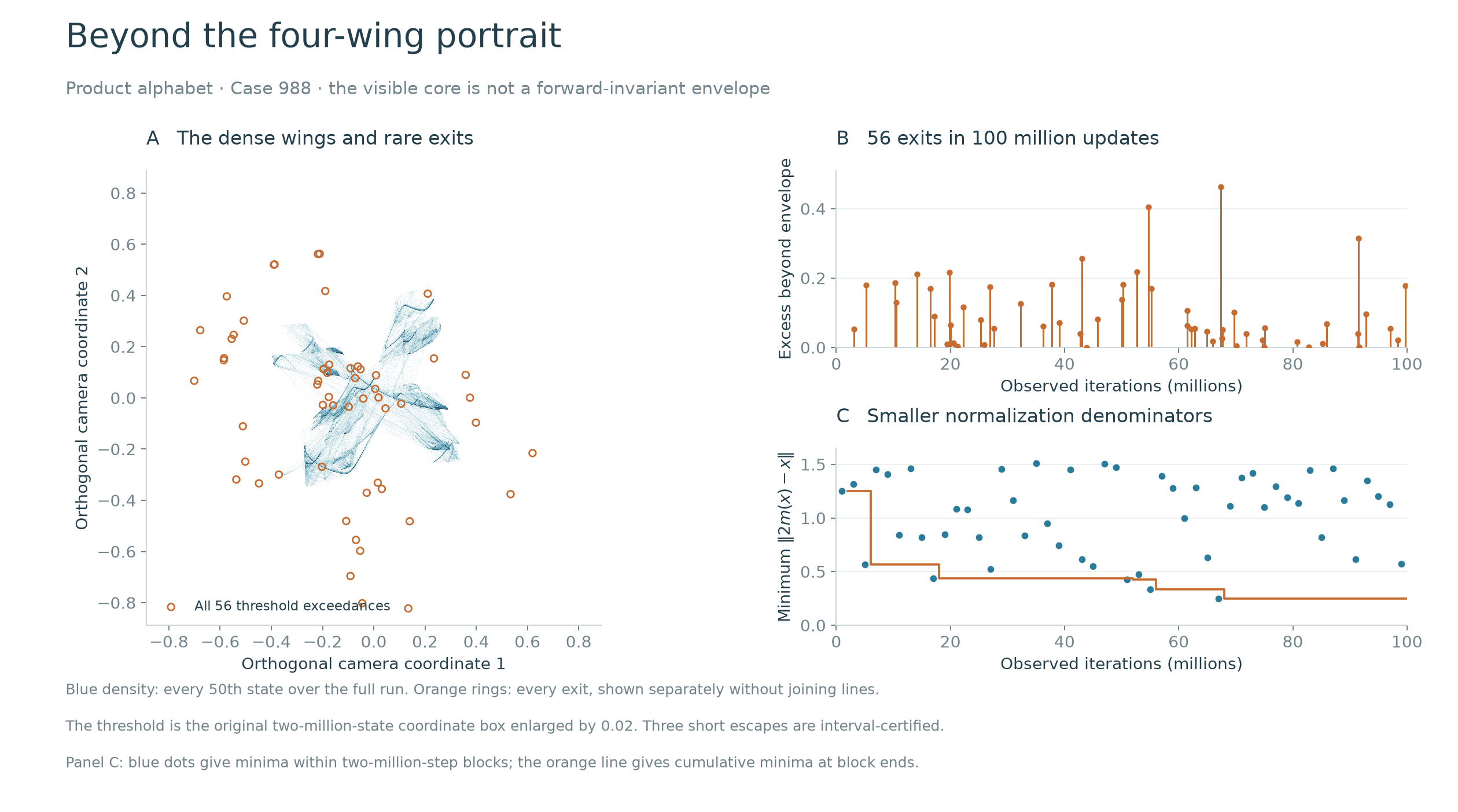
For Case 988, define E as the coordinatewise bounding box of the original two-million-state portrait enlarged by 0.02 in each direction. Its exact binary64 endpoints are retained in the extension. This threshold was selected after inspecting the longer run, not preregistered. There are 56 observed states outside E, a finite-record fraction of . All are separated by more than 128 updates. This fraction is not an invariant probability, a return-time law or a confidence estimate.
The left panel uses every fiftieth state of the full run for density, with every threshold exceedance overlaid separately. The camera is the original orthogonal projection, at equal coordinate scales and with a wider viewport. No plotted state is clipped. Rings mark discrete observations; they do not trace a continuous outer orbit. The right panels show exceedance magnitudes and normalization minima in two-million-step blocks. Every Case 988 block endpoint and normalization minimum is reproduced exactly in a second pass. The same replay passes for Case 489, which has no observed exits from its analogously enlarged original envelope over this window.
Three finite escapes are certified. Choose the three blocks with the smallest normalization minima and restart 32 updates before each minimum, using that stored binary64 state as an exact real initial center. Interval boxes of radius , propagated for forty steps at 140 digits, start strictly inside E and leave it at update 33. Full-eight-site automatic derivatives at 180 digits repeat the check with radius . The respective certified exit margins exceed 0.46319, 0.40401 and 0.18140 in a coordinate direction. Every normalization denominator along these short boxes is strictly positive. An exact rational endpoint audit and six deterministic payload replays pass.
Consequently E is not forward invariant for the exact recurrence. These certificates concern trajectories from tiny open neighborhoods of three restart states; they do not shadow the full hundred-million-step numerical orbit or put the restart neighborhoods in the certified subsystem C. The largest midpoint discrepancy from the binary64 short segment is below over the forty updates. The precise input states, selection history and all enclosing endpoints are retained.
Rare bursts are an established phenomenon: the publisher abstract of Grebogi, Ott, Romeiras and Yorke (1987) describes intermittent departures after attractor-widening crises. No crisis parameter, collision mechanism or critical scaling law is established here, so these observations are not classified as crisis-induced intermittency.
5. Approach from multiple starts
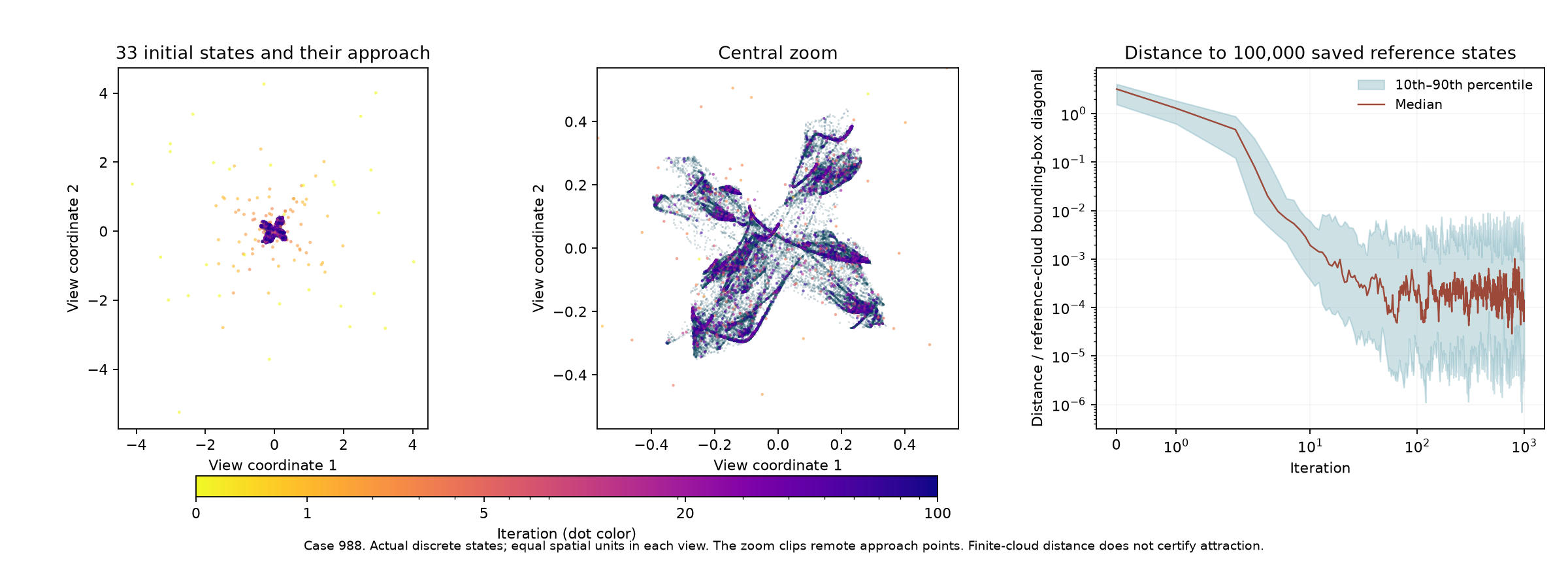
The left panel shows the broad initial distribution; the middle panel enlarges the central region. Colored dots are actual iterates 0 through 100, with color indicating iteration. The right panel shows the median and 10–90 percentile band of the distance to a separate 100,000-state reference tail, normalized by that tail's bounding-box diagonal. The distance is a finite-cloud diagnostic, not a certified distance to an invariant set. It need not approach zero at the displayed resolution. The central zoom clips the distant initial points explicitly shown on the left. No continuous orbit is inferred between dots.
For comparison, iterating the posterior mean alone from the same 33 starts reaches the numerical stopping threshold within three steps in Case 988 and 82 steps in Case 489. Thus these sampled irregular regimes depend on the reflection feedback. This control does not claim that posterior-mean iterations are globally convergent for every finite prior.
6. A certified positive-entropy subsystem
The separate symbolic packet uses exactly the binary64 parameters and eight sites of Case 988. Put . Twenty-three affine windows have one exit coordinate and two entry coordinates. The centers, basis factors and radii are exact real lifts of stored binary64 values. The matrices and their inverses are formed over the rationals; their complete entries are retained in input.json.
The certified graph is
For each arrow, the full source volume maps either strictly outside the target exit interval, or strictly inside both target entry intervals. The two exit faces map strictly to opposite exterior sides. These are sufficient conditions for Theorem 16 of Zgliczynski and Gidea (2004). Theorem 9 of that work realizes every closed chain by a periodic point. These established covering theorems supply the topological step; the new calculation supplies their hypotheses for the exact Case 988 map.
Two interval implementations. The primary calculation uses 80-digit outward intervals, the exact binary posterior factorization and its analytic Jacobian. It composes four original steps and applies mean-value enclosures in exact rational window coordinates. The second calculation uses 110-digit intervals, all eight Gaussian squared-distance weights, nested spherical reflections and forward automatic derivatives. Its weighted sum is centered at one site by an exact algebraic identity to reduce interval overestimation. It revisits every primary leaf in reverse order and subdivides further when needed. Both implementations share mpmath interval arithmetic, the supplied windows and the mean-value enclosure principle.
| Coverings | Primary leaves | Full-site AD leaves |
|---|---|---|
| 0 to 0 | 16 | 16 |
| 0 to 1 | 11 | 11 |
| Remaining 22 arrows | 151 | 183 |
| Total, including volumes and both exit faces | 178 | 210 |
Exact-rational audits check complete binary subdivision trees, all strict inequalities using stored binary interval endpoints, matrix inverses, source hashes and . Minimum normalized margins exceed 0.00629 and 0.01915, respectively. The sphere-normalization radius exceeds 2.3799 throughout all four-step source enclosures in both checks. These are bounds on the validated windows and their intermediate images, not on the entire numerical cloud or a parameter neighborhood.
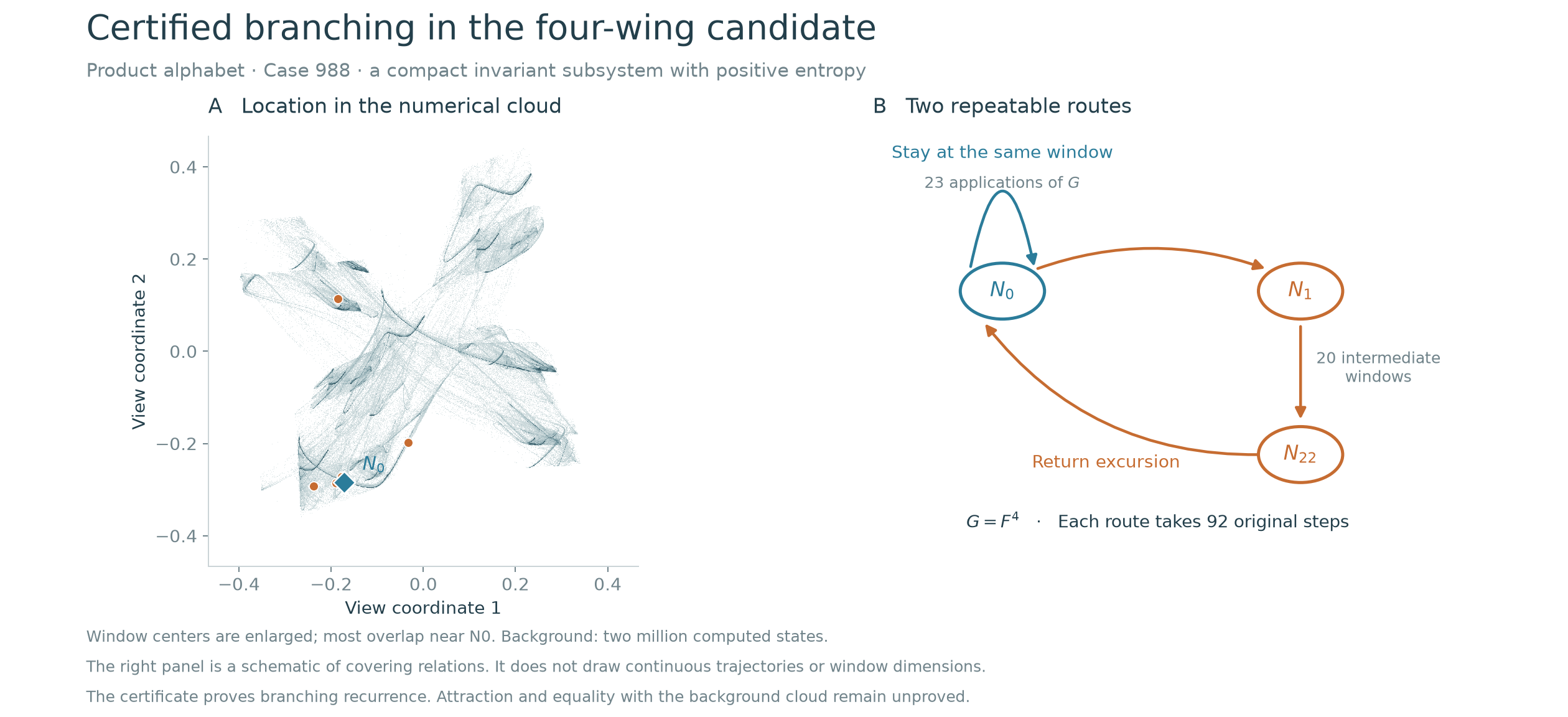
Figure 3. The background is the same two-million-state numerical cloud seen through an orthogonal, equal-unit camera. Orange markers locate window centers; the blue diamond marks N_0. Symbols are enlarged, and many centers overlap at this scale. The right panel is schematic: 23 self-loops and one 23-arrow excursion each use 92 original iterations. Window centers are not asserted to constitute an exact orbit. Attraction is not inferred from their plotted proximity to the cloud.
Theorem. For the exact Case 988 instance, there is a nonempty compact set in the smooth domain with and
Proof. A return to N_0 may use either one self-loop or the 23-arrow excursion. Let count words in these two returns with total length n in G-steps. Then , for negative n, and . Each word gives a closed covering chain and hence a point fixed by with its prescribed visits.
Let . Two distinct equal-length words have a first different return choice after a common prefix. One G-step later their realizing points lie in N_0 and N_1. Therefore these points are -separated for F. This argument does not require the other windows to be pairwise disjoint.
All these periodic orbits lie in the compact set
The validated normalization bound puts X in the smooth domain. Let C be the closure of the union of the selected periodic orbits. Continuity gives . Compactness of X supplies a convergent subsequence of periodic predecessors for each limit point, giving . Thus . The positive root rho above obeys . Upper and lower positive multiples of bound , first for n from 0 to 22 and then by induction. The separated-set definition of entropy gives the stated bound. The audit checks exactly and bounds its logarithm by a positive rational series, establishing the displayed decimal lower bound without a floating-point root assumption. ∎
As a simpler consequence, choosing 23 self-loops or one excursion in each block gives arbitrary binary itineraries sampled every 92 original steps and the weaker bound . Compactness also realizes infinite prescribed routes. Unique symbolic coding, a transverse homoclinic orbit and uniform hyperbolicity are not asserted. Section 6.3 proves that this C is not Lyapunov stable.
Search and unsuccessful certificates. The window search starts from 512 numerical cycle fits at periods 1–16, retaining 70 numerical cycles. A period-four saddle proposal guides linear unstable-line searches and multiple shooting with linear endpoint constraints. These guides are not used as invariant-manifold certificates. Early window programs failed; the default absolute linear-program feasibility tolerance also exceeded some proposed widths. Rescaling and explicit constraint checks corrected that numerical issue before the interval validation. Two grid-trapping proposals in the symbolic packet did not close. A wider, uncentered full-site interval expression was stopped incomplete after the algebraically centered implementation passed. All these outcomes and executed sources are inventoried separately from the frozen numerical survey. None of the unsuccessful trapping runs is used to claim that C attracts a neighborhood.
6.1 A reversed return and an equivalence obstruction
The separate orientation packet keeps the preceding certificate unchanged. On each complete window it bounds by multiplying the four one-step determinants. Taking the determinant of an interval enclosure of the entire matrix product is also valid, but was substantially wider in this calculation.
The factorized calculation uses 100 decimal digits and one box per window. The full eight-site formula uses 140 digits and forward automatic derivatives; it bisects only . Its intermediate image boxes intersect natural enclosures with mean-value enclosures. Both computations prove negative determinants precisely on windows 4, 5 and 6, and positive determinants on the other twenty windows. All normalization radii exceed 2.3799. The 23 and 24 accepted boxes are audited using exact rational arithmetic, including complete partitions, binary endpoints, determinant products and hash links to the accepted covering certificate. The arithmetic library, windows and determinant-product argument are shared between implementations.
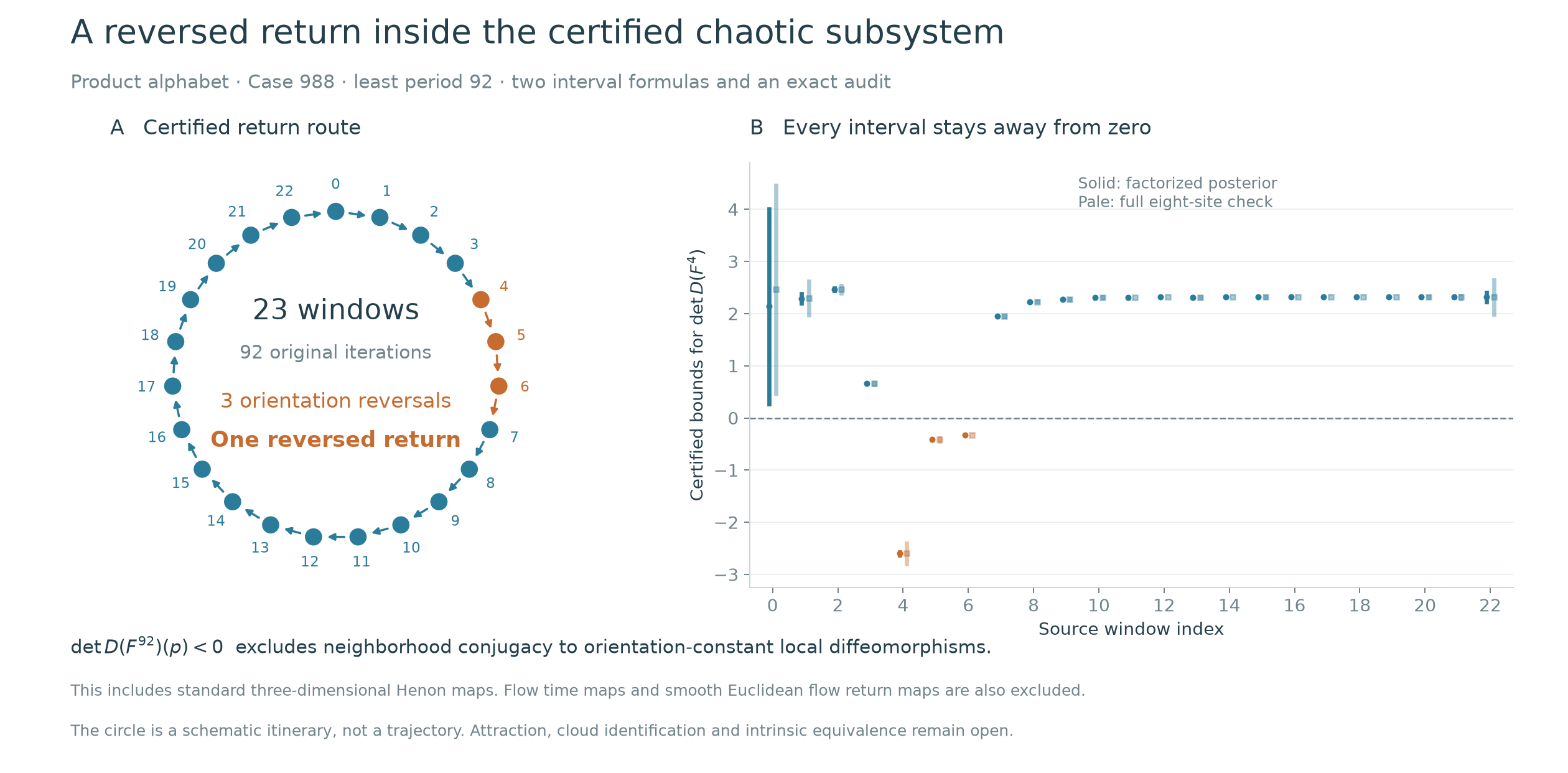
Figure 4. Each arrow represents four original iterations. The circular layout is a schematic itinerary, not an orbit in state space. Vertical bars are rigorous interval bounds, not statistical error bars. Three negative factors force a negative determinant for the complete return.
Theorem. The set C from Section 6 can be chosen to contain a point p of least period 92 with . More specifically, every periodic realization of the 23-arrow excursion satisfies the following independently obtained outward bounds:
| Calculation | Boxes covering all windows | Bound on the complete return determinant |
|---|---|---|
| Factorized posterior, 100 digits | 23 | [−3,198,898, −173,698] |
| Full eight-site posterior, 140 digits | 24 | [−5,197,901, −198,607] |
Proof. The covering theorem supplies a point p whose successive G-images visit and return to p. Hence . The chain rule gives
The only proper divisors of 92 are 1, 2, 4, 23 and 46. The first three would imply , contrary to the disjointness of and . For a period d of 23 or 46, the return derivative would satisfy
since the exponent is even. This contradicts the certified negative sign. Thus the least period is 92. The excursion is one of the closed routes used to construct C, so its selected periodic realization belongs to C. ∎
Corollary: ambient-neighborhood inequivalence. There is no homeomorphism between open neighborhoods of this orbit that conjugates F there to a local diffeomorphism having a constant orientation sign on a domain containing the corresponding orbit. In particular, the obstruction applies to any local diffeomorphism on a connected open domain containing all its phases, and therefore to the usual nonsingular three-dimensional Henon maps.
To see this, is a local diffeomorphism at p with local degree −1. A conjugating homeomorphism has local degree +1 or −1; its contribution and that of its inverse cancel at the return point. The local degree of the return is therefore invariant under neighborhood conjugacy. A map with constant orientation sign has return degree , a contradiction. This uses the standard multiplication and regular-value properties of local Brouwer degree, recalled in Zgliczynski and Gidea (2004), Appendix 6.1. Differentiability of the conjugating homeomorphism is not required. The target-domain condition matters: a map on disconnected components may have different orientation signs on different components.
Fixed-time maps of smooth flows in Euclidean space are orientation preserving. The same obstruction applies to a smooth Poincare return map on a three-dimensional transverse section of an autonomous flow in four-dimensional Euclidean space. At a periodic return, the full flow monodromy has determinant and a tangent multiplier 1. The transverse return determinant is consequently positive, including when the section is visited several times before closing. These standard identities are reviewed in Garcia, Latorre and Maza (2026), Sections 2.1–2.2. This statement concerns smooth transverse returns, without resets, symmetry quotients, nonorientable ambient identifications or dimension changes.
Short periodic checks. A separate Krawczyk calculation at 180 digits, recomputed with full-site automatic derivatives at 220 digits, certifies three short saddle cycles. The root-box radii are respectively and . Exact rational audits recompute the Krawczyk arithmetic, exclude proper divisors and verify three disjoint real-root brackets of width approximately for each characteristic polynomial. The following numbers are rounded summaries of those brackets.
| Local cycle identifier | Least period | Return multipliers | Return determinant | Membership information |
|---|---|---|---|---|
| 14 | 4 | −11.46142820, −0.65951618, 0.30644260 | 2.31639883 | Unique self-loop realization in , hence in C; Section 6.3 |
| 16 | 4 | 57.70879233, −0.73025254, 0.21613615 | −9.10840785 | No C or cloud membership claim |
| 23 | 7 | 66.89511321, −0.11247103, 0.05138757 | −0.38662787 | No C or cloud membership claim |
These identifiers name periodic-root proposals, not additional parameter cases. All use the exact Case 988 parameters. The period-92 theorem does not depend on locating a numerical root of the 92-step map or on these short-cycle fits.
Limits. The result excludes a specified class of ambient-neighborhood models. It does not exclude a conjugacy defined only on the invariant set, known noninvertible models, symbolic equivalence, or an alternative embedding. It does not identify C with the plotted numerical cloud. Section 6.3 rules out Lyapunov stability of C, without ruling out a larger attracting set. In the extension, a third grid proposal exhausted its eight-million-new-cell budget. Two elementary-domain scouts tested 224 box/ball and normalization cutoff combinations; every combination had a sampled violating witness. Those unsuccessful proposals are retained and are not trapping proofs.
6.2. A normalization singularity and its local image limits
A separate interval Krawczyk calculation isolates a zero of near
The factorized calculation uses 160 digits and box radius ; the full-eight-site calculation uses 200 digits and radius . Both have strict Krawczyk inclusion and contraction bounds below . Positive diagonal-dominance margins above 156 prove that is nonsingular throughout each root box. The two formulas share mpmath interval arithmetic and a Newton center proposal; they are not independent interval libraries. An exact rational audit verifies the supplied Krawczyk inclusions and derivative inequalities.
The map F is undefined at s. The inverse-function theorem gives a useful local consequence: its cluster set of images as x approaches s is exactly
Indeed, local invertibility of v supplies points for every unit direction u and small positive t. Since , . Conversely, every accumulation direction of is a unit vector and the remaining terms tend to s/2. This is an elementary consequence of normalization and local invertibility, not a new general theorem or a spherical-attractor claim.
The three certified short excursions pass close to this singularity before their large jumps. We have not proved that s belongs to the closure of the long numerical orbit. The positive-entropy subsystem C remains in its separately certified smooth domain, away from zero normalization. A trapping proof for the observed regime must address these exits rather than treating the main portrait's visible envelope as invariant. Three additional completed uniform/nonuniform grid proposals also fail closure; their sampled bounds are retained as unsuccessful proposals, not interval proofs.
6.3. The certified subsystem is not Lyapunov stable
The mechanism and instability packet resolves attraction of the specific set C negatively in the usual stable sense. This conclusion concerns C from Section 6, not every invariant set of Case 988 or the closure of an indefinitely continued numerical orbit.
Theorem. Every invariant subset of the covering atlas X that contains the period-four cycle 14 is not Lyapunov stable. In particular, the set C constructed in Section 6 is not Lyapunov stable and cannot be the stable attractor obtained from a strict compact trapping neighborhood.
Proof. Put . First, the certified point p of cycle 14 is the unique G-fixed point in the whole affine window . A Krawczyk inclusion refines p, and a complete subdivision of verifies
for one fixed nonsingular rational matrix B. Convexity of and the mean-value integral imply injectivity of there. The factorized and full-site calculations require two and sixteen subcells respectively; the former contraction bound is below 0.683891. Thus every realization of the one-arrow self-loop equals p, and the definition of C includes p.
Use an exact rational coordinate matrix E centered at this exact p, with coordinates . On , , , write the derivative blocks of the local G map as . The horizontal derivative has fixed negative sign. Outward bounds A, B_1, C_1, D_1 satisfy
The graph-transform inequalities are
For an L-Lipschitz graph through the origin, the horizontal image is strictly decreasing, expands secant lengths by at least , and covers . The stable image stays within its allowed box. Restricting the image to this horizontal interval defines a graph transform. The ratio bounds its slope; the next displayed line gives its contraction in the uniform norm. The complete space of L-Lipschitz graphs through zero therefore has a fixed graph h. Its horizontal inverse contracts by at most , so backward G-iterates of every graph point approach p. All required original F-steps remain in the validated smooth domain.
Take the true graph point , . Its unknown stable coordinates are enclosed by . Twenty validated G-steps, using mean-value propagation in the fixed rational chart, enclose in a box separated from all 92 enclosing boxes for X. The minimum certified coordinate gap exceeds 0.00011729734758437. Thus its Euclidean distance from X also exceeds this number.
Let be successive backward graph iterates. Then , while remains a fixed positive distance from X and hence from C. This contradicts Lyapunov stability. The same argument applies to every invariant subset of X containing p. ∎
Both expressions independently validate the root, complete uniqueness partition, unstable graph and forward escape: factorized intervals at 120 digits and eight-site automatic derivatives at 160 digits. Exact rational audits check the stored endpoint arithmetic, graph inequalities, partition coverage, matrix inverses and all 92 separation tests; frozen source replays reproduce the proof payloads exactly. The two expressions share mpmath interval arithmetic. Failed one-step propagation, excessive interval widths and implementation errors remain in the packet.
The result does not exclude an unstable attractor in a weaker Milnor sense, nor a larger stable attracting set A containing C and the escaping unstable branch. It does show that identifying the covering subsystem itself with a stable attractor would be incorrect. Proving such a larger A requires a new trapping construction and an additional connection to the observed cloud; the entropy certificate alone does not supply either. Section 6.6 tests the larger-set interpretation directly.
6.4. Local folds, singular preimages and boundedness
Six ordinary folds. On six fixed-coordinate lines, outward determinant brackets isolate roots of . Let be the cross product of the first two Jacobian rows. Each root box proves
At the root, n spans the one-dimensional kernel and the Jacobian has rank two. The second inequality makes that kernel transverse to the critical surface. By using two independent image coordinates as local coordinates, this is precisely the nonzero second derivative in the remaining kernel direction: an ordinary fold. This standard local criterion is applied here, not proposed as a new singularity type.
The primary 120-digit calculation uses closed-form first and second derivatives of the binary posterior and radial normalization. The 160-digit calculation uses all eight squared-distance weights, nested reflections and second-order automatic derivatives. Root radii along the free coordinate are and respectively; the other two coordinates are exact rationals. An exact audit reconstructs determinant gradients, row cross products and transversality inequalities. The six source proposals lie between 0.0001225 and 0.00047595 from a saved state, numerically. This proximity proves no invariant-set membership.
Singular preimages. Two further Krawczyk inclusions prove distinct points with , where s is the certified singularity from Section 6.2. Rounded locations are
Their entire tiny root boxes lie inside the original rendering coordinate box. Both derivatives are nonsingular; the rounded determinants are −4.18512 and 0.342455. The singular target is an interval enclosure, not a rounded point: uniform Krawczyk inclusion guarantees the inverse for the exact s. Thus F is smooth near these points but its second iterate is undefined at them. Removing only the central singularity from a coordinate box that still contains either point cannot produce a forward-invariant smooth-domain trap. No claim puts these points in C or in the long-orbit closure.
A weaker global bound. Every posterior mean lies in the convex hull of the sites. An exact rational check gives a common norm bound , and consequently
For the exact Case 988 weight, . Every forward orbit that remains defined therefore eventually enters the radius-40 ball and stays inside it. Iterating the scalar inequality proves this directly. The ball contains normalization singularities and is not a compact trapping region in the smooth domain. Boundedness must not be substituted for a chaotic-attractor theorem.
6.5. Switching, postcritical images and parameter dependence
For binary levels , write . The posterior slopes satisfy
When , the switching strip has half-width
For Case 988 these widths are approximately 0.031117, 0.032985 and 0.028539. Away from the three switching planes, decreasing noise drives each scalar posterior toward one of its two levels and its slope toward zero. The limiting map has eight saturated posterior branches coupled by the internal radial normalization. This explains the source of branch changes; it does not predict the exact invariant geometry.
Let . Rearranging the derivative gives
Since P is an orthogonal projection, the Euclidean operator norm obeys
The bound is below one at 981,426 of the two million saved states (a floating evaluation of an analytic inequality). The first 1,000 tangent steps are omitted from the following conditional statistics.
| Coordinates with posterior slope above one | Saved states | Mean one-step leading log growth |
|---|---|---|
| 0 | 1,309,915 | −0.301774 |
| 1 | 575,560 | 1.262434 |
| 2 | 112,330 | 1.505396 |
| 3 | 1,195 | 1.840909 |
Thus the measured stretching is concentrated in switching regions, while the complement contracts on average along the propagated tangent. These are orbit-conditional finite statistics, not an invariant measure or a statement that every switching step expands.
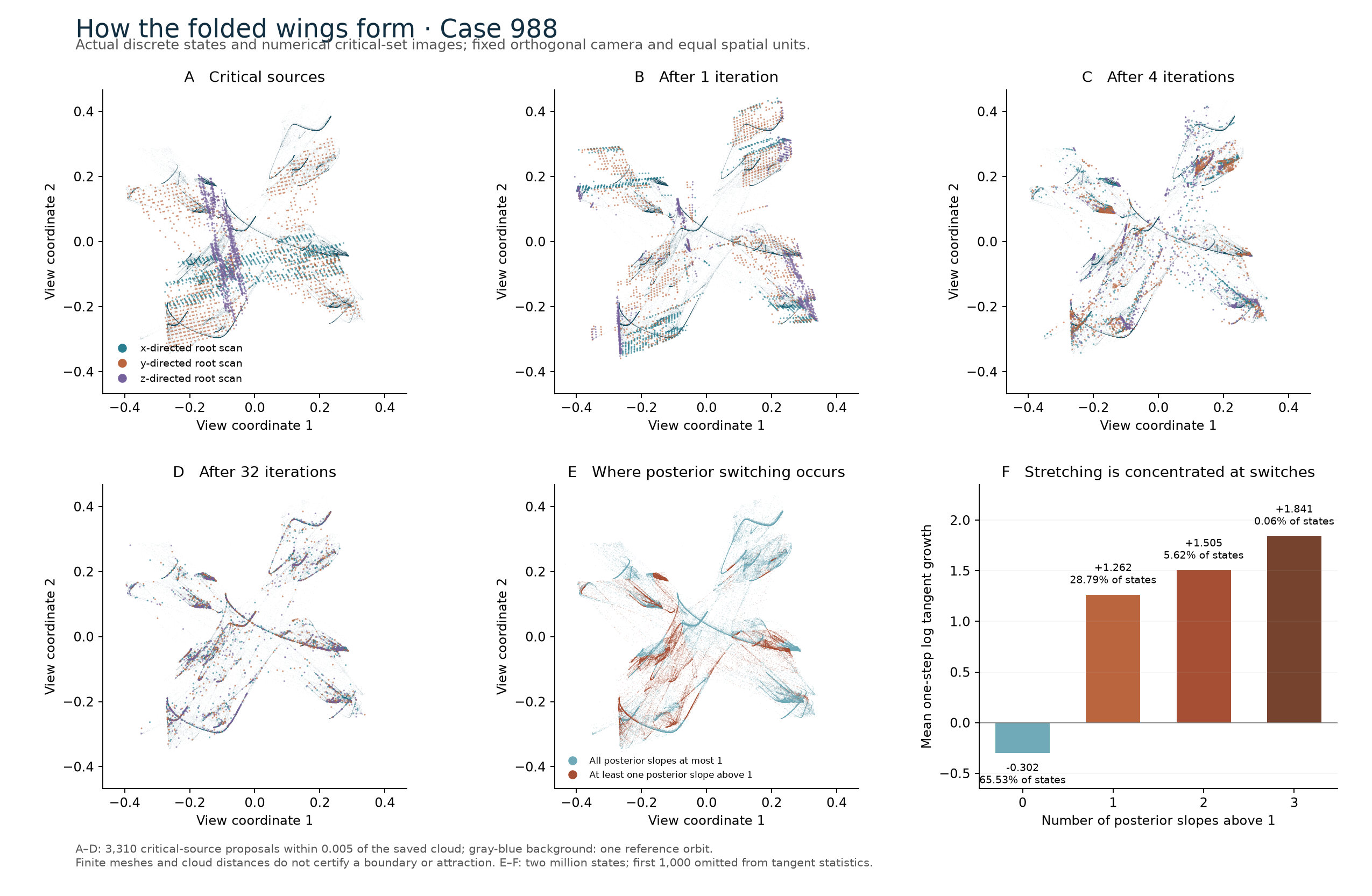
Figure 5. A 65-by-65 mesh in each pair of transverse coordinates, combined with sign-bracketed one-dimensional determinant roots, produces 30,017 critical-source proposals. Colors identify the root-scan direction, not proven connected surface components. Panels A–D follow the 3,310 proposals initially within 0.005 of the two-million-state reference cloud. Their median reference distance decreases from 0.003231 to 0.00004598 after 32 steps. The complete unfiltered mesh and all ten checkpoints through step 1,024 are retained. Maximum source determinant residual is . Only the six local folds in Section 6.4 are interval-certified; neither the mesh nor its images enclose an attractor boundary. Points are discrete states, with a fixed orthogonal camera and equal spatial units.
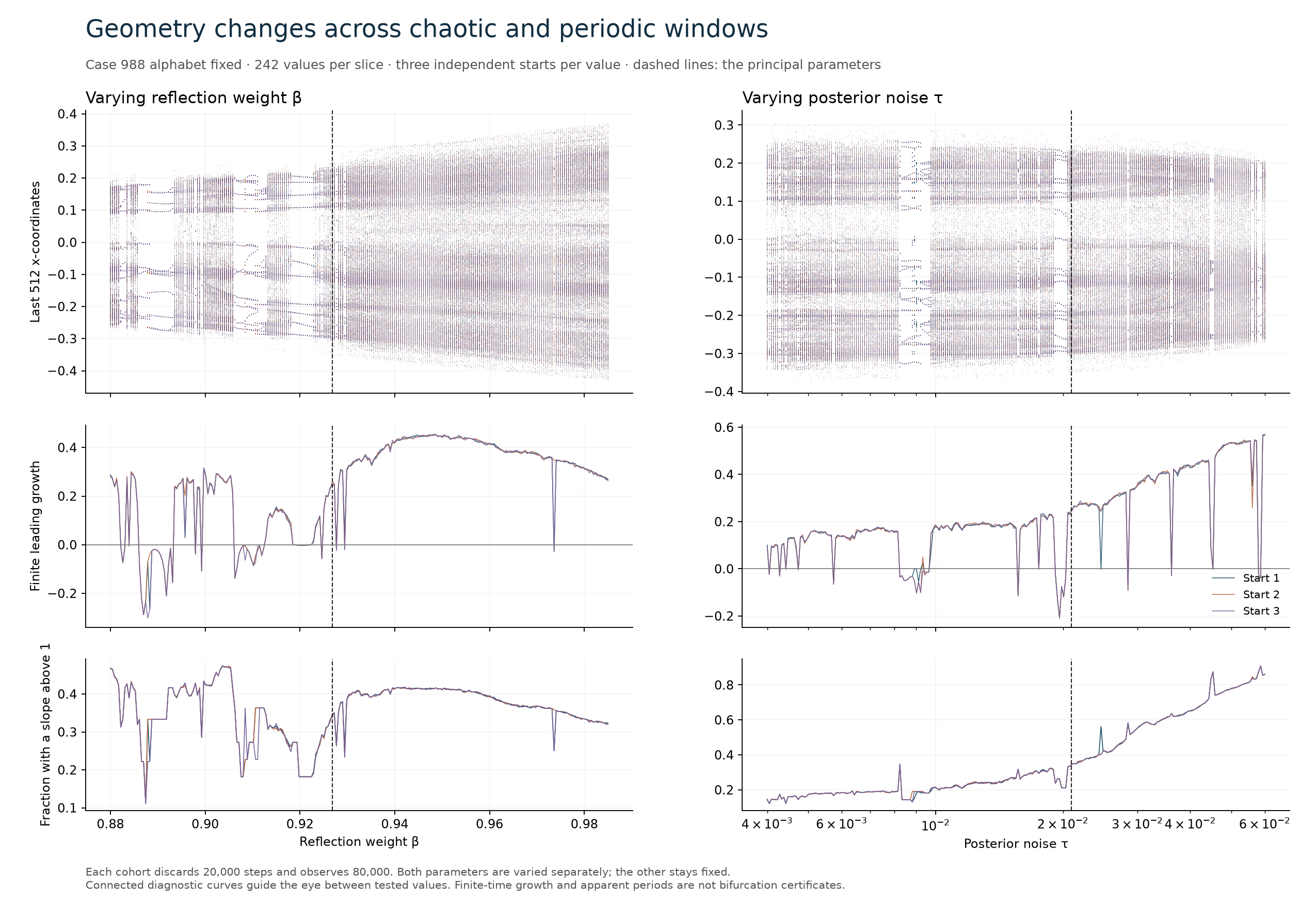
Figure 6. The alphabet is fixed. One slice varies beta uniformly from 0.88 to 0.985; the other varies tau logarithmically from 0.004 to 0.06. Each has 241 grid values plus the exact principal parameter, and three declared independent starts at every value. Each cohort discards 20,000 updates and observes 80,000, retaining its last 2,048 states. The plot displays the last 512 x-coordinates, leading growth and the fraction of steps in switching strips. Of 1,452 cohorts, 1,193 have positive leading growth in all ten blocks; 254 meet the finite period test through period 512. All cohorts complete without a normalization or finite-value flag. The two slices show periodic windows and changes in geometry; no exact bifurcation location is certified.
The numerical verifier reproduces every slice and every critical mesh array byte for byte in the recorded environment. At 128 separate probes, full-site formulas and finite differences check the analytic Jacobian; a full-site tangent pass checks the first 2,048 diagnostic steps. A four-cluster partition initialized at cycle 14 follows the suggested cyclic order on only 39.97% of transitions. The four visible wings therefore should not be labeled a verified period-four band attractor.
6.6. Testing containment in a larger attracting set
Failure of stability for C does not imply that C lies outside every attractor. The larger-set investigation therefore follows the outgoing unstable directions of cycle 14, whose phase p belongs to C, and separately searches for returns from the observed regime. These are different tests: an external saddle can feed an attractor without belonging to it.
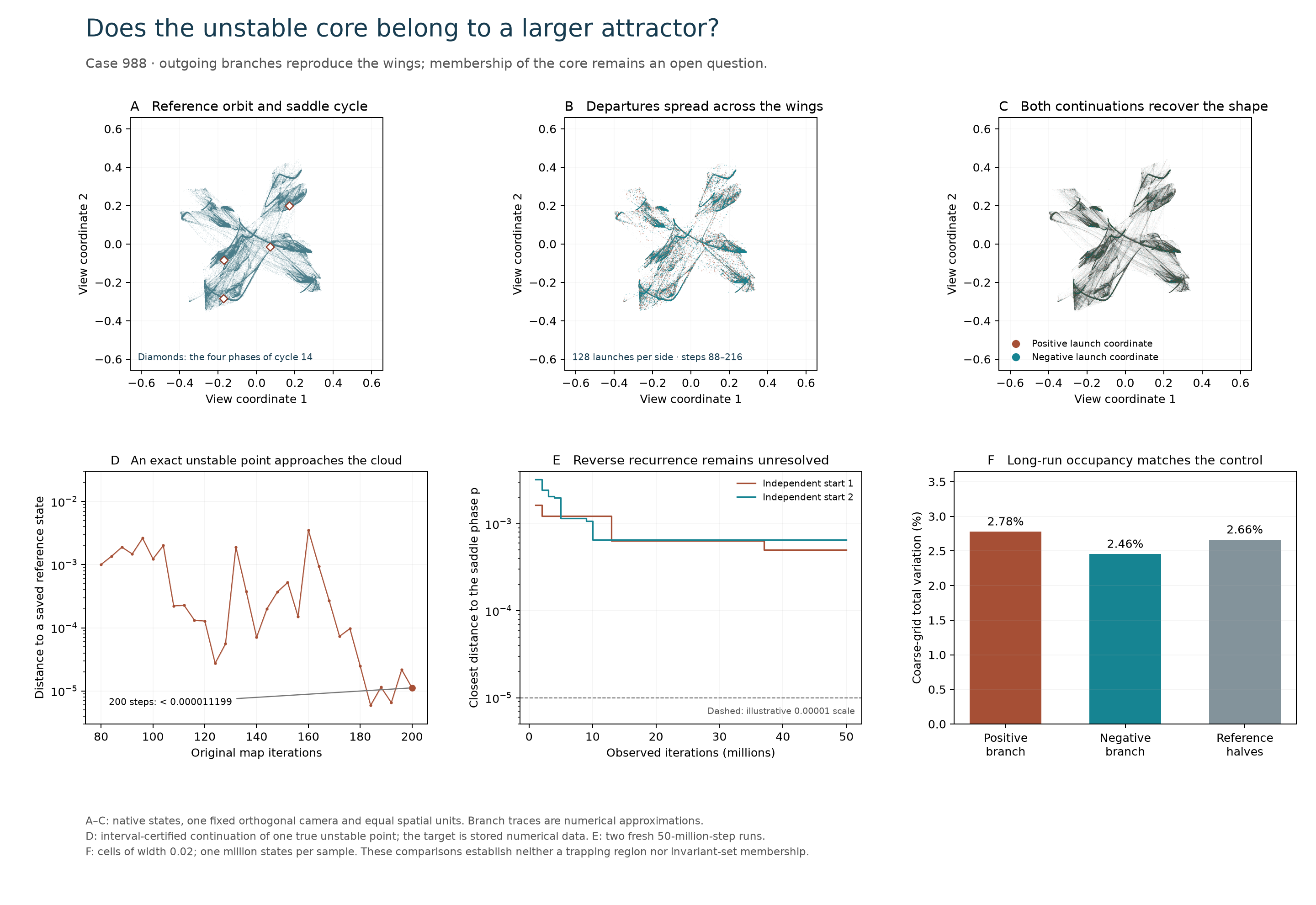
A certified finite connection to the numerical cloud. The exact graph point q from Section 6.3 has a validated continuation through 200 original iterations. The initial enclosure preserves the correlation of the unknown stable coordinates. Four-step propagation keeps the rational eigenvector chart during local departure and switches to rational moving charts after step 80. Factorized 120-digit intervals and full-eight-site 160-digit intervals both enclose the complete finite orbit in the smooth domain. At step 80, the separation from X remains greater than 0.00011729734758. At step 200, both calculations prove
where is an explicitly retained binary64 state from the reference trajectory. Exact rational audits check chart inverses, initial and propagated errors, atlas separation and squared-distance upper bounds; frozen-source replays reproduce both trajectories. The graph theorem is imported from Section 6.3, and both expressions share the mpmath interval library. This is a theorem about finite proximity to stored data, not a proof that q returns to an invariant set or belongs to an attractor. A first one-step propagation attempt stopped at step 129 because its interval width exceeded the declared limit; that attempt is retained.
Outgoing numerical branches. There are 128 eigenline launches on each side of p, with horizontal magnitudes from to . The first 88 steps use 100-digit arithmetic, followed by 2,048 binary64 steps. The unknown local-graph stable coordinates are set to zero for these proposals, so the full fan is not a validated global unstable set. Both fans spread across the observed wings. Two selected launches, one from each side, then discard 20,000 steps and retain one million states each. Their finite leading growth rates are 0.253499 and 0.251242; every one of their ten blocks is positive.
No geometric alignment or rescaling is used in the comparison. On fixed native-coordinate cubes of side 0.02, the total variation between reference and branch cell frequencies is 2.7792% and 2.4554%. The same comparison between the two million-state halves of the reference gives 2.6623%. More than 99.85% of the branch mass occupies cells shared with the reference. Reverse nearest-neighbor medians, from 200,000 reference states to each million-state branch sample, are 0.00005968 and 0.00006022; the disjoint reference control gives 0.00006050. These are finite distribution and support comparisons, not equality of invariant measures. Rare excursions remain: the maximum branch-to-reference distances are 0.37856 and 0.10352, so a uniformly close match of the entire clouds is not claimed.
A further 256 starts surround p: 64 deterministic spherical directions at each radius . Every cohort discards 20,000 steps and observes 40,000. All ten leading-growth blocks are positive for all 256 starts. Their late-state median reference distances lie between 0.00003804 and 0.00003937. This supports a common attracting numerical regime near p but establishes neither an open basin nor inclusion of p in its recurrent support.
The reverse connection remains unresolved. Two fresh trajectories, with distinct declared initial states and an alternative tanh expression, each discard 20,000 steps and observe 50 million. The search records approaches to all four phases of cycle 14 and the other 22 window centers. The closest approaches to p are 0.000503336 and 0.000650731. There are nine visits within 0.001 in total, none within 0.0005, and no visits to the affine window N_0. Longer observation improved the original two-million-state distance of 0.000973808, but did not resolve arbitrarily close recurrence. Absence of a finite hit proves no invariant exclusion.
All branch and perturbation arrays replay bit for bit. The first million steps of each recurrence run replay, all retained closest-state distances and cumulative counts are checked, and 180 independent full-site formula probes agree within . The remaining alternatives are (i) an embedded saddle core in a larger attracting set and (ii) a saddle core whose outgoing trajectories approach a different attracting component. The tests establish the outgoing association much more strongly than membership of the entire C.
What would establish containment. If a compact nonsingular region N contains C and satisfies , then its attracting set contains C: invariance gives for every n. Conversely, any compact Lyapunov-stable A containing p must contain every defined point with a backward G-orbit converging to p. For any positive tolerance, stability supplies a neighborhood whose forward images remain within that tolerance of A; sufficiently late backward iterates lie in this neighborhood. Their fixed forward endpoint is therefore arbitrarily close to the closed set A and belongs to A. Thus the escaping unstable branch is something a proposed larger attractor must include. Such an N is still missing, and even its construction would not alone prove transitivity or identify a physical chaotic measure.
This distinction has direct precedent. Jelleyman and Osinga (2022), Sections 2–3, describe a noninvertible map in which saddle branches first approach separate attractors and, after a homoclinic transition, participate in a merged attractor described by the closure of the unstable set. Their setting demonstrates why outgoing association and embedded membership must be distinguished. Neither that bifurcation nor their wild-chaos criterion is established for Case 988; the larger-core interpretation itself is not a novelty claim.
6.7. Attraction status and a nearby singular preimage
The classification remains open for the full four-wing regime. The proved core C fails Lyapunov stability (Section 6.3). For a larger set, the new attraction-status packet adds a finite transient search and a rigorous obstruction to a specified trapping neighborhood. Neither result proves or disproves every possible attractor interpretation of the numerical wings.
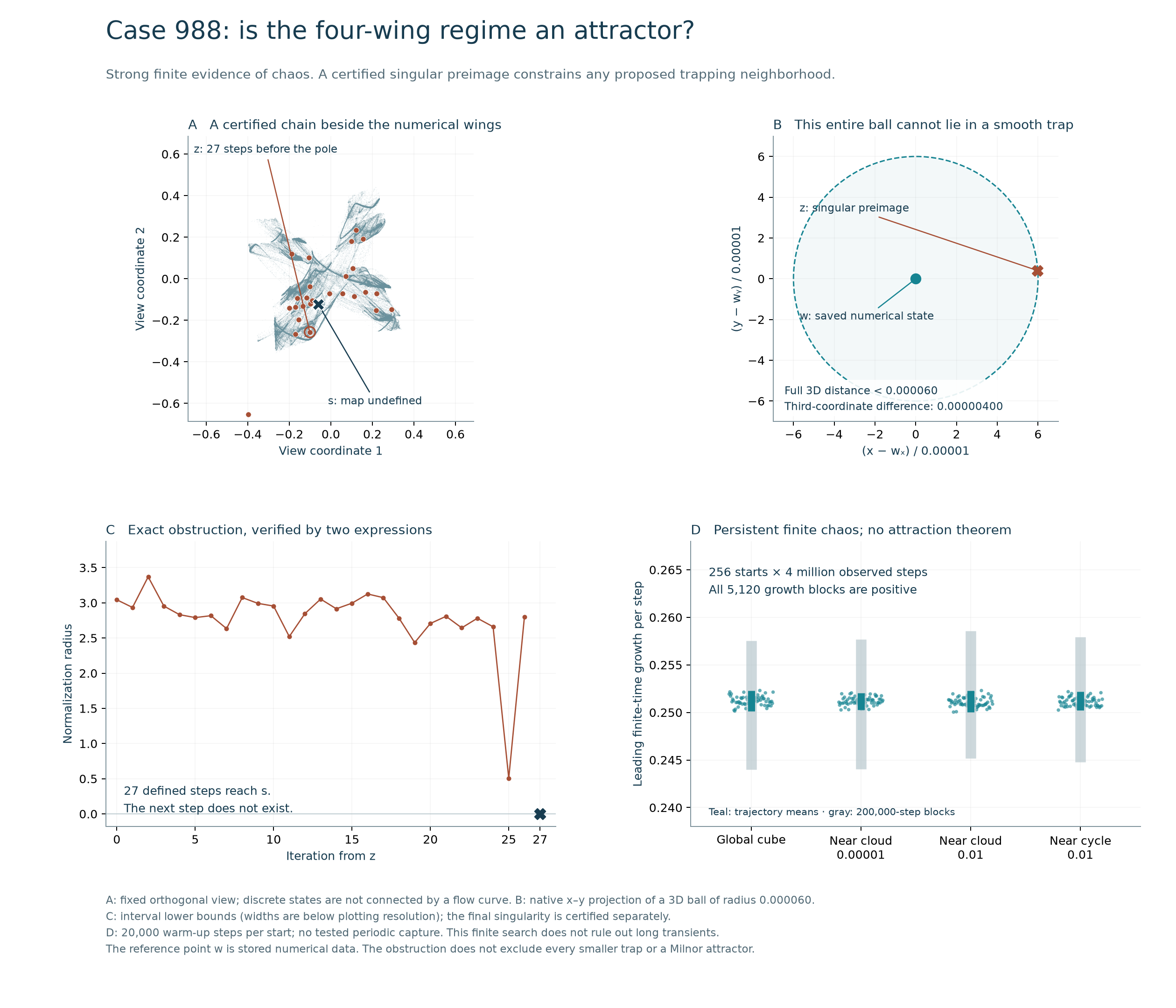
Finite survival search. Four declared cohorts have 64 starts each: a Sobol sample in the cube of half-width 2.2, perturbations of saved cloud points by coordinate offsets of maximum size 0.00001 and 0.01, and offsets of maximum size 0.01 from the first phase of cycle 14. These are coordinate half-widths, not Euclidean radii. Each start receives 20,000 warm-up updates and four million observed updates, divided into twenty growth blocks.
| Cohort | Range of trajectory-mean leading growth | Smallest sampled normalization |
|---|---|---|
| Global cube | 0.250144–0.252305 | 0.288307 |
| Cloud offsets, half-width 0.00001 | 0.250265–0.252053 | 0.280612 |
| Cloud offsets, half-width 0.01 | 0.250036–0.252301 | 0.178882 |
| Cycle offsets, half-width 0.01 | 0.250249–0.252180 | 0.197905 |
All 256 runs finish, and all 5,120 leading-growth blocks are positive; the smallest is 0.244015689. No terminal periodic capture is detected for lags 1 through 128, 256 or 512, using 512 comparisons and tolerance 0.000000001. This does not exclude other periods, later capture, or long chaotic transients. The cohorts are not independent random basin samples and supply no basin-volume or lifetime-confidence estimate. Sixteen declared trajectories replay for their full observation lengths, totaling 64 million updates. All batch concatenations, saved normalization minima and terminal-period tests are checked. A separate eight-site formula with automatic derivatives agrees at 640 states within 2.28 × 10⁻¹⁵, including normalized tangent directions and one-step logarithmic growth.
A certified obstruction near the saved cloud. Let D be the smooth domain where the normalization radius is nonzero, and let s be the exact central singularity isolated in Section 6.2. The reference state w is entry 1,841,277 of the archived two-million-state array, using zero-based indexing. Its three stored Float64 coordinates are interpreted as exact dyadic real numbers; their round-trip decimal representation is:
There exists an exact point z satisfying
Consequently, the next iterate, , is undefined. No forward-invariant subset N of D can contain z. In particular, no such N can contain the entire open ball , or the full 0.000060-neighborhood of the archived cloud. This is a statement about a specified neighborhood of numerical data; w has not been proved to belong to an invariant attractor.
Certificate and proof. A backward numerical beam search supplies proposals, not enclosures. Its second run retains all 45,792 nodes and all attempted solves; node 28,333 gives the selected 27-step chain. Write and seek successively. Starting from the previously certified enclosure of s, each stage uses a box B of radius 10⁻⁴⁰ about a rational center c, a rational nonsingular preconditioner H, and the preceding target interval T. The computed Krawczyk enclosure is
For each exact target in T, the contraction has a unique fixed point in B, and that root lies in K. Induction therefore gives an exact chain ending at s. The normalization lower bound over all 27 source boxes exceeds 0.50674007; the final distance enclosure proves the displayed bound for . A factorized expression at 140 digits and the full eight-site expression at 180 digits both pass. An exact-rational audit checks the Krawczyk arithmetic, outward target inclusion, strict interiority, nonsingularity, all 27 links and the squared-distance bound. Frozen-source replays reproduce both chain files exactly. The two expressions share mpmath interval arithmetic; they are not independent arithmetic libraries. If a forward-invariant N in D contained z, invariance would put s in N after 27 steps, contradicting .
Rejected wider region and remaining alternatives. A sampled nonuniform-grid expansion within the coordinate cube of half-width 2.2 reaches 3,368,148 occupied cells and includes the central-pole cell. Exact rational comparisons put the entire previously certified pole enclosure strictly inside that cell. Thus this proposed union cannot serve as a trapping region in D. Its sampled expansion is not a validated enclosure algorithm, and its failure is not an actual-orbit escape proof.
The finite singular chain supplies neither a density theorem for singular preimages nor their membership in the asymptotic set. A thinner or perforated trapping neighborhood remains possible. An isolated terminating orbit also does not by itself disprove attraction for a positive-measure set of initial conditions. The unresolved requirements are a nonsingular trapping region tied to the observed regime, or an instability/escape argument reaching arbitrarily close to a proved point of that regime. The present positive distance to one saved state does not meet the latter requirement. The new contribution is a model-specific obstruction with an explicit distance and iteration count, not a new general theory of noninvertible attraction or a historical uniqueness claim.
7. Prior art and geometric comparison
The literature audit explicitly includes equivalent terminology. Its receipt distinguishes reviewed equations, abstract-only evidence and uninspected figures.
| Earlier formulation | Relationship and limit |
|---|---|
| MMSE/mean shift, proximal denoisers, relaxed reflections | Established ingredients of the full construction; reviewed in the shared priority note. |
| Independent-spin tanh response | Exact ideal binary posterior identity. Calling it a new quantizer or neural activation would be incorrect. |
| Spin-1/Blume–Capel response | Exact ideal ternary posterior identity. The scalar response is established. |
| Chaotic spin-1 recursion | Tomé and Salinas (1989) already report strange-attractor evidence in a two-dimensional competing-interaction recursion. |
| Spin models with feedback | Sinelschikov and colleagues (2023) study oscillations and chaos in feedback lattice models, including a four-dimensional mean-field Potts flow. |
| Labyrinth and polyhedral attractors | Spatial loops, folded threads and polyhedral organization have direct precedents; their appearance alone is not novel. |
| Iterative phase retrieval | RAAR and RRR trajectories can retain stationary fluctuations; this algorithmic behavior predates the present examples. |
| Four-wing flows and generalized Henon maps | Four wings, double figure-eight forms and super figure-eight forms are established visual motifs. Section 6.1 supplies a neighborhood-conjugacy obstruction for particular ambient model classes, not a new shape classification. |
| Learning on a sphere | Projected neural-network training already exhibits sustained irregular regimes; sphere-normalized optimization is not a new setting for such behavior. |
| Recurrent attention and divisive normalization | Chaotic or nonstationary normalized neural dynamics have direct precedents, including a September 2026 repulsive-attention preprint. The fixed posterior sites and the complete reflected recurrence must be compared, not just the softmax component. |
| Critical curves, critical surfaces and postcritical boundaries | Established tools for noninvertible maps, including three-dimensional Lotka–Volterra maps; the mechanism in Section 6.5 is not a new general principle. |
Ülgen and Sünel (2013) give the Blume–Capel mean-state recurrence in Section 2.1. The reviewed scalar formula matches the ideal ternary response after parameter identification, but does not contain the present three-coordinate radial feedback. Tomé and Salinas (1989) report chaos in a spin-1 recursion; only their publisher abstract was accessible in this audit, so no full equation or figure comparison is claimed.
Sinelschikov, Poggialini, Abbate and De Martino (2023) derive mean-field feedback dynamics for Blume–Capel and Potts systems. Sections 2.3–2.4, including equations (14)–(34) in the reviewed preprint, establish a particularly relevant precedent for softmax/spin feedback and chaos. Their reduced Potts model is a four-dimensional continuous flow, whereas the present recurrence has three discrete coordinates and explicit sphere normalization. This difference in displayed equations is not a proof against nonlinear equivalence or equivalence to a return map. Figure 5 was also visually inspected: its chaotic panels show Poincare sections in two coordinates, so their curled islands are not directly comparable to a full three-state cloud. The inspected figure and surrounding text do not supply an equation-level identification with Case 988.
The finite geometric comparison uses 108 frozen reference regimes.
Fingerprint ranking is followed by local point-cloud alignment for the
three highest-ranked references, using 48 initial orthogonal alignments
and twenty local iterations on 1,500 points. Similarity normalization and
affine whitening are tested separately. For Case 988, the closest
similarity fingerprint is the frozen ThomasLabyrinth trajectory; its
local alignment residual is 0.24454, compared with 0.04702 between two
time halves of the candidate. After affine whitening, the leading
fingerprint is Coullet, with local residual 0.22509 versus a self-comparison
of 0.05269. These are dataset/code labels, not independently revalidated
historical attributions for every reference formula.
Sprott and Chlouverakis, Labyrinth Chaos (2007)
provide a primary precedent for the nearest similarity family. Its cyclic
sine flow, coexistence discussion and Figures 4–9 were reviewed. Figure 8
combines six coexisting strange attractors, whereas each of our selected
portraits comes from one orbit. This specific distinction does not rule out
similar single-attractor geometry elsewhere in that family. Case 489's closest similarity fingerprint
is Chua (local residual 0.16861 versus self-residual 0.04135). All 108
rankings and both normalization controls are retained, including references
whose local fit is better despite a worse fingerprint rank. No global
alignment optimum, topological invariant, nonlinear conjugacy test or
historical exclusion follows from these finite distances.
Barnett, Millane and Kingston (2024) compare DM, RRR and RAAR in crystallographic phase retrieval. Their Section 2.1.4, equation (6), is the same RAAR algebra with metric projections; Sections 6–7 discuss persistent fluctuations around a stationary mean. Those observations prevent claiming the first irregular reflected reconstruction trajectory. The reviewed constraints are Fourier amplitudes, solvent flatness and histogram matching, rather than this three-coordinate product posterior. The text and Figure 7 caption were reviewed; the image download was inaccessible, so no visual comparison to that figure is claimed. The supplementary review receipt records this scope and the covering-theorem source.
There is an earlier communications precedent as well. Yedidia, Wang and Draper (2010 preprint; 2011 journal article) apply divide-and-concur/difference-map dynamics to LDPC decoding. Section II.B, equations (1)–(2), gives the reflection-based update and explicitly notes possible complicated cycles or strange attractors. Sections III–IV use replicated graph messages, hard parity-check projections, an energy constraint and min-sum updates. These are not the displayed three-coordinate posterior and internal sphere normalization here. The comparison rejects novelty of reflection-based decoding and of its possible irregular dynamics; it does not establish a conjugacy exclusion or a matching attractor. The supplementary receipt records the reviewed preprint equations; its figures were not visually audited.
Gonchenko, Ovsyannikov, Simo and Turaev (2005) study the three-dimensional Henon map , with constant determinant B. Its equation (1), surrounding discussion and Figures 1–2 were reviewed. Gonchenko and Gonchenko (2016) extend the comparison to generalized maps and describe double and super figure-eight attractors. Their equation (1.4), relevant Sections 3–5, the schematic Figure 4 and numerical Figures 7–8 were inspected. The certified negative even-period return excludes neighborhood conjugacy to these nonsingular constant-determinant maps for any nonzero B. It does not exclude similarity of their silhouettes or equivalence restricted to a fractal invariant set.
Four-wing geometry also predates these comparisons. Liu (2009) reports a three-state cubic four-wing flow; only its publisher abstract was reviewed here. Deng, Wang and Yang (2020) give a four-state polynomial flow with a stable equilibrium and a four-wing hidden-attractor regime. Equation (1), Section 3.1 and the four planar projections in Figure 2 were reviewed in the author-hosted PDF. These are explicit precedents for the name and visual motif; this study does not claim a first four-wing attractor or classify Case 988 as hidden.
Kodryan, Lobacheva, Nakhodnov and Vetrov (2022) study projected gradient training on a sphere and describe convergence, chaotic equilibrium and divergence. Their abstract and Sections 1–3.1, including the projected-gradient update (2), were reviewed; no figure comparison was made. Their full state is constrained to a fixed sphere, whereas Case 988 normalizes an internal reflected vector. This equation-level distinction is not by itself an equivalence theorem. The updated review receipt records all reviewed scopes, including the degree and flow identities.
The attention terminology requires a further comparison. Our posterior is exactly a biased fixed-key attention update, as derived in the shared priority note. Poc-López and Aguilera (2024) derive recurrent attention mean-field equations with tanh responses, equations (13)–(16), and report irregular regimes with a four-token context. Their Section 4 classifies the displayed regimes by visual inspection and point counts. Figures 3–4 were inspected: the latter contains planar projections of selected mean-field variables. Their history-dependent attention and positional drive differ from our fixed eight-site memory; the visual comparison does not establish dynamical inequivalence.
Gao, Yang and Chen (September 2026) study repulsive recurrent self-attention. Their equations (4)–(8) recompute attention between moving tokens and normalize each updated token, whereas our sites remain fixed and only an internal reflected vector is normalized. Sections II and III.8 and Figures 1, 3 and 13 were reviewed. Those figures show token configurations, a schematic and projected high-dimensional states, rather than a three-state orbit matching the present portrait. This is direct prior art for chaos with softmax and norm feedback; it is not an identified equivalent of the full Case 988 recurrence.
Tomihari and Karakida (2025) likewise analyze recurrent attention through Jacobians and normalization; their Section 3, equations (5)–(9), defines spherical normalization, AKOrN and iterative self-attention. The abstract and Sections 3–5.1 were reviewed, without a figure audit. Morone and colleagues study dynamical divisive normalization in the ORGaNICs model; the reviewed 2025 preprint, Section II, equations (1)–(3), uses continuous principal and inhibitory states. Its 2026 journal record was checked separately. These precedents rule out claiming normalization as a new neural feedback principle.
Even discrete leaky neural recurrences have established chaos results: Liz and Ruiz-Herrera (2014), abstract and Section 1, equation (1.1). Their fixed weighted sum of scalar responses, with delays, differs from the state-dependent radial coupling here. Only that displayed architecture was compared; the generality of their result is not an equivalence exclusion. The supplementary attention and neural review records the reviewed versions and visual scope. None of these comparisons supports a first-discovery claim for neural chaos or a proof of historical uniqueness for this candidate.
The new geometric explanation has direct precedents. Gardini and Mira (2010), Noninvertible maps describe critical sets, changing inverse multiplicity and absorbing boundaries formed by critical-set images. Their equations (2.9)–(2.10) and Figure 2.5 were inspected. Calling folding or postcritical boundary formation a new mechanism would therefore be incorrect.
Bischi and Tramontana (2010) study three-dimensional discrete Lotka–Volterra maps. Equation (1), Section 5, Appendix B and Figures 3, 8–9 were reviewed in the author-hosted copy. Figures 8(b,c) were visually inspected: a three-lobed folded object is shown from two viewpoints. This is a relevant geometric and dynamical precedent. The inspected study uses polynomial population updates, not the displayed posterior/reflection formula; that distinction alone does not exclude conjugacy on an invariant set.
A targeted reproduction evaluates all five displayed parameter values of that reference family, using the declared initial point (0.2, 0.3, 0.4), 100,000 discarded steps and one million observed steps each. Their last 100,000 states are compared with Case 988. The best local similarity alignment residual is 0.27967, against a candidate time-halves control of 0.05031. After affine whitening, the best residual is 0.25749 against 0.04948. All five results, including the different winners under the two normalizations, are retained and replayed. These finite fits find no geometric identification among those five sampled regimes; they neither exhaust the reference family nor exclude nonlinear equivalence. Its noninvertibility also means the orientation obstruction in Section 6.1 does not dispose of this comparison.
Glendinning and Simpson (2021) combine trapping regions with induced maps and expanding cones in a two-dimensional border-collision normal form. Their abstract, introduction and opening theorem framework were read as a methodological comparison, not as a theorem applicable to the present three-dimensional noninvertible map. Positive entropy inside an isolated subsystem must still be connected to attraction. The new reading receipt records these scopes and the locally inspected figure pages.
8. Contribution and open questions
The supported result is a fully specified four-wing numerical regime of an eight-site product posterior with sphere feedback, a multilevel companion with documented coexistence, and a complete search and control record. Separate certificates prove positive entropy and failure of Lyapunov stability on a compact invariant subsystem for the exact principal parameters. Its least-period-92 reversed return excludes ambient-neighborhood topological conjugacy to specified invertible models and smooth Euclidean flow return maps. The unexpected setting is a quantized-signal posterior inside an established numerical reflection construction. It is not a new physical phenomenon established by measurement. The additional local certificates and conditional-growth diagnostics explain concrete folding, switching and singularity obstructions in this instance.
Neither a strange-attractor theorem nor a claim that the geometry has never appeared before is justified yet. Positive finite-time growth, multiple starts, precision controls and finite-library differences narrow the candidates; those numerical tests do not prove asymptotic chaos, transitivity, a fractal dimension, or historical uniqueness. The four research questions now have distinct outcomes:
| Question | Supported outcome | Remaining gap |
|---|---|---|
| Does the regime attract a neighborhood? | All 256 new starts retain positive growth through four million observed updates each. A certified 27-step singular preimage excludes any smooth-domain trap containing a specified radius-0.000060 ball beside the saved cloud. | This does not exclude every thinner trap. A compact nonsingular trapping region tied to the numerical regime remains unproved. |
| Is the entropy subsystem the attractor in the picture? | C is rigorously not Lyapunov stable. Its cycle has an interval-validated outgoing connection near the numerical wings; both numerical branches recover the observed statistics. | A fresh 100-million-step recurrence search does not establish reverse membership. Containment of C in a larger attracting A remains open. |
| Is the dynamics meaningfully different from known models? | The period-92 orientation obstruction excludes specified invertible neighborhood models; a targeted five-regime noninvertible comparison finds no finite-cloud match. | Intrinsic conjugacy to known noninvertible sets and historical priority remain unresolved. |
| Why does the figure have this geometry? | Six ordinary folds, singular preimages, an analytic derivative bound, postcritical images and parameter slices support a concrete mechanism. | A theorem identifying the full invariant boundary or bifurcation sequence is absent. |
The defensible contribution is this explicit collection of numerical regimes, validated dynamical properties and a negative attraction result for the certified core. The study does not claim a new universal folding mechanism, a first four-wing shape, or a historically unique strange attractor. A further trapping proof must concern a larger set than C; even a trap containing C would not alone prove that its maximal invariant set is transitive or supports a physical chaotic measure. The certificates for other parameter cases do not transfer here.