Layered spatial dynamics from a circle and a finite point set
Status, 2026-11-01: reproducible numerical candidates in the known RAAR algorithm. The selected configurations produce separated curved sheets and columns in their actual three-dimensional state space. Long runs, multiple starts and higher precision support persistent sensitivity. Neither a chaotic attracting invariant set nor historical uniqueness is certified here.
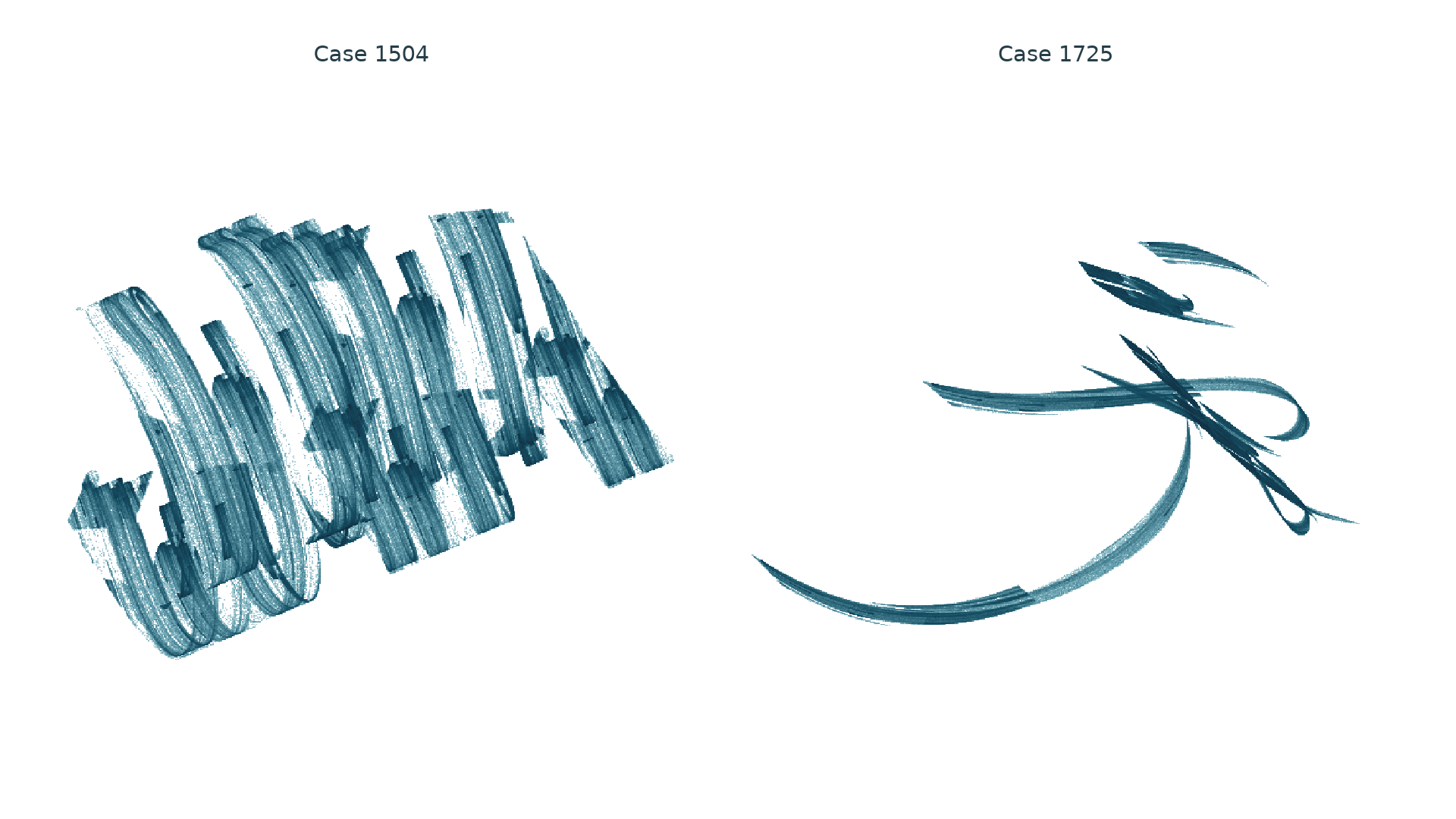
First recorded portrait: 2026-11-01.
Case numbers identify saved parameter sets, not measured quantities. Each panel contains two million consecutive post-transient states. Centering, an orthogonal principal-axis basis and a rigid camera preserve shape and relative spatial units; the panels have independent scales. No interpolation between map iterates, trajectory replication or image synthesis is used. The rotation displays a fixed 250,000-state subset per case.

Model
Let A be the unit circle in the xy-plane and B a finite set of spatial points. B consists of vertices, not a solid polyhedron or its convex hull. With b the nearest point of B to x and u the normalized xy-component of 2b-x,
F(x) = beta*x + beta*(u_x,u_y,0) + (1-2*beta)*b,
0 < beta < 1.
This is the standard operator beta/2*(R_A R_B + I) + (1-beta)*P_B. Its formula is not new. Nearest-point selection changes across Voronoi boundaries, so the map is piecewise smooth and generally discontinuous. The scout stops at a relative nearest-point squared-distance gap below 1e-12, or circle-projection radius below 1e-12; it does not smooth either singularity. These stopping thresholds are numerical controls, not lower bounds valid for every future iterate.
Every beta and point coordinate in the reported exact model is the exact real value represented by its stored binary64 number. The point sets were generated by numerical rotations, scaling and translation of standard polyhedron vertices. Exact algebraic polyhedral symmetry is not asserted. The long-run report includes hexadecimal beta and point coordinates.
The selected values are beta = 0.9328500449163839 for Case 1504 and beta = 0.970660805775784 for Case 1725. The original point sets have four and six sites, respectively. Only sites 0, 1 and 2 are visited in the recorded post-transient motion of either case, including all 33 starts. Removing the other sites gives the same sampled geometry in a fresh run. This observation does not prove their global or asymptotic irrelevance.
Within a fixed nearest-site branch, write r = |(2b-x)_xy| and t = (-u_y,u_x,0). The Jacobian is beta*(I - t*t^T/r). Its z-direction multiplier is exactly beta, and its determinant is beta^3*(1-1/r). Switching between branches remains part of the full dynamics. Consequently, local derivative growth alone is insufficient to certify a chaotic attractor of this discontinuous map.
The elementary norm estimate
|F(x)| <= beta*|x| + beta + |1-2*beta|*max_b |b|
gives bounded trajectories away from undefined projections. This estimate does not establish a continuous trapping-map theorem or identify a unique asymptotic set.
Search and controls
The declared screen contains 2,048 cases: 512 scrambled Sobol geometric draws, each evaluated with tetrahedron, octahedron, cube and icosahedron vertices. All cases completed. Seventy-two exceeded 0.005 in every one of ten finite-time growth windows. Every flag received a fresh 500,000-step follow-up; 66 retained the criterion. Cases 126, 156, 803, 1159, 1790 and 1987 instead approached detected periods 2, 9, 31, 2, 3 and 2. These outcomes remain in the archive.
All 72 follow-up portraits were inspected before selecting six for longer runs. Each selected run starts at (0.317,-0.211,0.419), discards 100,000 iterations and measures five million more, split into twenty windows. The following rates are per iteration. The two xy exponents and the exact branchwise z exponent are listed separately, not sorted.
| Case | Leading xy rate | Other xy rate | log(beta) | Smallest leading window |
|---|---|---|---|---|
| 124 | 0.025311 | -0.328620 | -0.014988 | 0.024965 |
| 611 | 0.045496 | -0.663245 | -0.060664 | 0.044617 |
| 896 | 0.037877 | -0.633626 | -0.015253 | 0.036298 |
| 1504 | 0.113020 | -1.111107 | -0.069511 | 0.111745 |
| 1725 | 0.081646 | -1.918538 | -0.029778 | 0.080994 |
| 1873 | 0.036374 | -0.372733 | -0.136404 | 0.035115 |
For each of these six cases, a further cohort uses the original start and 32 scrambled Sobol starts in [-4,4]^3, with 100,000 discarded and 500,000 measured iterations. All 198 runs complete and retain positive growth in every window. For Cases 1504 and 1725, the smallest cohort window is 0.107519 and 0.077577, respectively. These finite samples do not establish a basin boundary or uniqueness of an invariant measure.
An independently expressed nested-reflector implementation uses 70 and 100 decimal digits, exact lifts of the same binary64 inputs, and renormalized finite separations rather than the analytic Jacobian. After 10,000 discarded iterations, each run measures 50,000 iterations. All ten windows are positive. The means are 0.112927/0.112525 for Case 1504 and 0.078843/0.083094 for Case 1725. Perturbations use 1e-30 and 1e-40; no nearest-site disagreements occur within these infinitesimal pairs. This checks numerical sensitivity, not asymptotic chaos.
A separate 300-value beta sweep over [0.85,0.9995], retaining the original spatial sites, flags 236 values for Case 1504 and 105 for Case 1725 under the short screen criterion. It does not establish that every flagged parameter has the same geometry. Fixed-point branch diagnostics are numerical and are not presented as interval certificates.
Comparison with the reference atlas
Each of the six clouds is compared with the frozen 108-regime reference set, both after uniform normalization and after covariance whitening. The latter removes nonsingular affine distortion from the empirical cloud. The method and limitations are those of the existing shape audit.
For Case 1504, the closest descriptor match is JerkCircuit before whitening and SprottO afterwards. Their best found local alignment residuals are 0.204257 and 0.224851, compared with 0.033605 and 0.037225 between separate temporal halves of the candidate. For Case 1725, Bouali is the closest descriptor match in both representations; residuals are 0.251266 and 0.251687, versus 0.041201 and 0.036641 for temporal halves. Fits use 1,500 states and 48 initial orientations, allowing reflection. These are best found local fits, not certified optimal distances.
This is evidence of geometric separation from the specific sampled regimes tested. It is not a comparison with all published attractors, all their parameters, all invariant measures, or nonlinear coordinate changes. The complete rankings and resamples are retained.
Prior art and equivalent terms
The relevant literature includes finite-alphabet phase retrieval, bit retrieval, Fourier-modulus constraints, difference maps, relaxed reflect-reflect, relaxed Douglas–Rachford and Voronoi-facet attraction. Searching only for polyhedra and strange attractors would miss this connection.
- Elser, Bit retrieval: intractability and application to digital watermarking (2003 preprint) already combines a Fourier-modulus torus with a discrete hypercube. Its appendix discusses chaotic mixing in inconsistent projection problems as a hypothesis. Reviewed PDF pages 13 and 25; this is not a full-paper audit.
- Elser, The complexity of bit retrieval (2016 preprint) gives the RRR iteration and describes attraction toward Voronoi facets of a finite alphabet, including an inconsistent 41-component example and a discontinuous flow schematic. Reviewed Section 6 excerpts, equation 48, and Figures 11–12 with their surrounding text. The small-step RRR mechanism does not identify our fixed-beta RAAR configurations, but rules out claiming discovery of finite-site switching or facet attraction in projection algorithms.
- Barnett, Millane and Kingston (2024) explicitly gives this RAAR formula in equation 6 and distinguishes it from RRR and reversed RRR. Their constraints concern crystallographic reconstruction. Reviewed Sections 2.1.3–2.1.4 and the abstract; no full-paper review is claimed.
- Earlier explicit strange-attractor portraits in projection methods, and the equivalence-search gaps, are documented in the spatial-circle priority audit. They also preclude a first-discovery claim for algorithmic chaos here.
There is a direct geometric link to the smallest real bit-retrieval problem. Under the orthogonal coordinates
q0 = (s0+s1+s2)/sqrt(3),
q1 = (2*s0-s1-s2)/sqrt(6),
q2 = (s1-s2)/sqrt(2),
a fixed signed DC component q0=d and a fixed nonzero Fourier magnitude give a circle q1^2+q2^2=rho^2. The binary alphabet {−1,+1}^3 becomes a rotated cube. Thus a circle with a discrete spatial alphabet is already within the geometry of known phase-retrieval constraints. This reduction is our explicit comparison, not a claim made by the cited papers for these two cases. A generic rotated point set need not equal that particular Fourier cube; different input geometry does not by itself prove different attractor dynamics.
The defensible contribution at this stage is a documented family of spatial numerical examples, their layered morphology, and reproducible controls. A new topological class, a new general mechanism and historical uniqueness remain unestablished. The source-review record records inspected material and access limits.
The extended quantized-feedback audit adds overflow filters and sigma-delta terminology. Nonconstant branch trace excludes ambient affine conjugacy on an open set to ordinary piecewise-affine filters; nonlinear equivalence and reductions confined to invariant sets remain open. The paired sphere survey also shows how a visually intricate million-step transient can ultimately settle into a cycle.
Other selected views and reproducibility
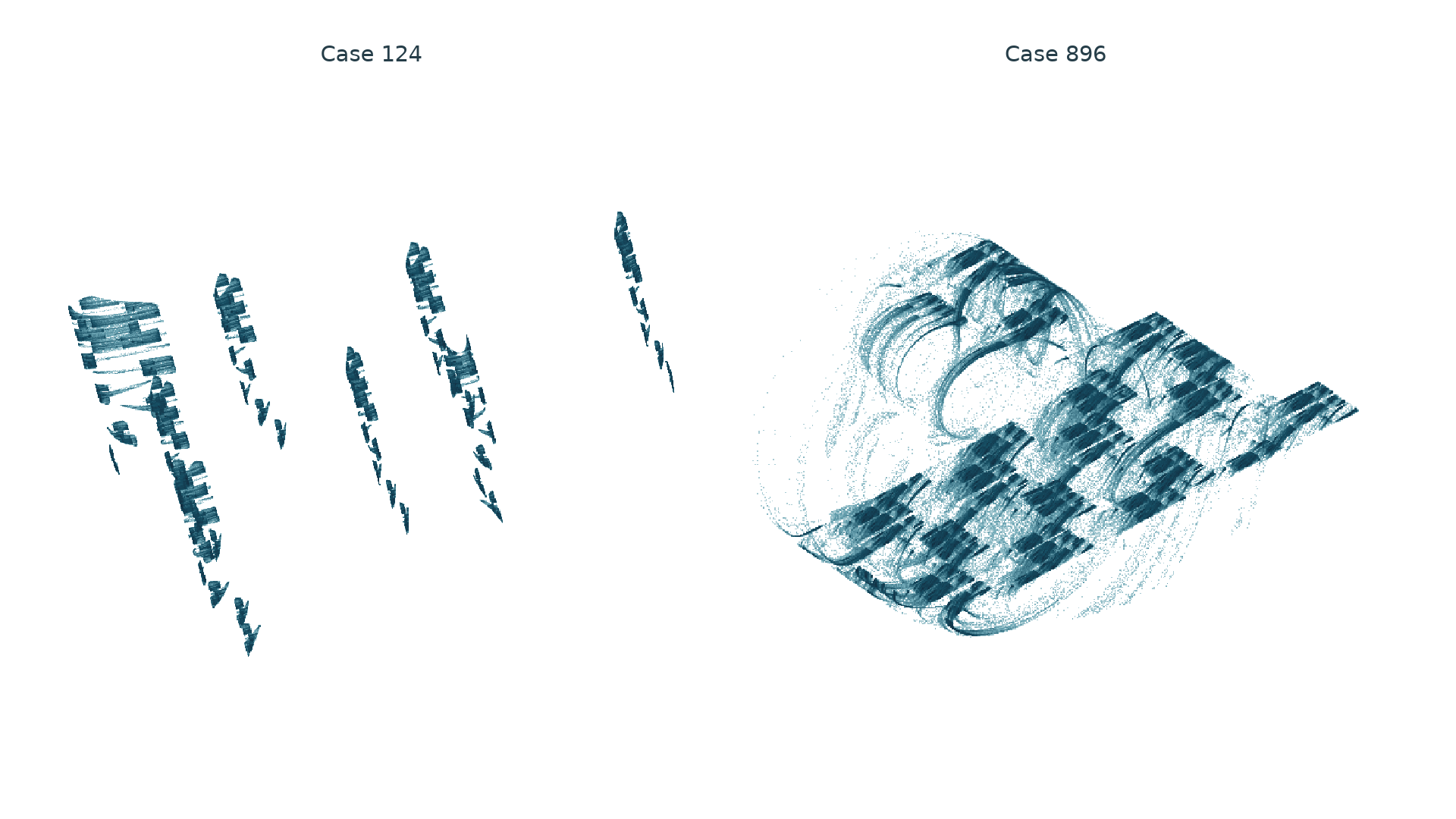
First recorded portrait: 2026-11-01.
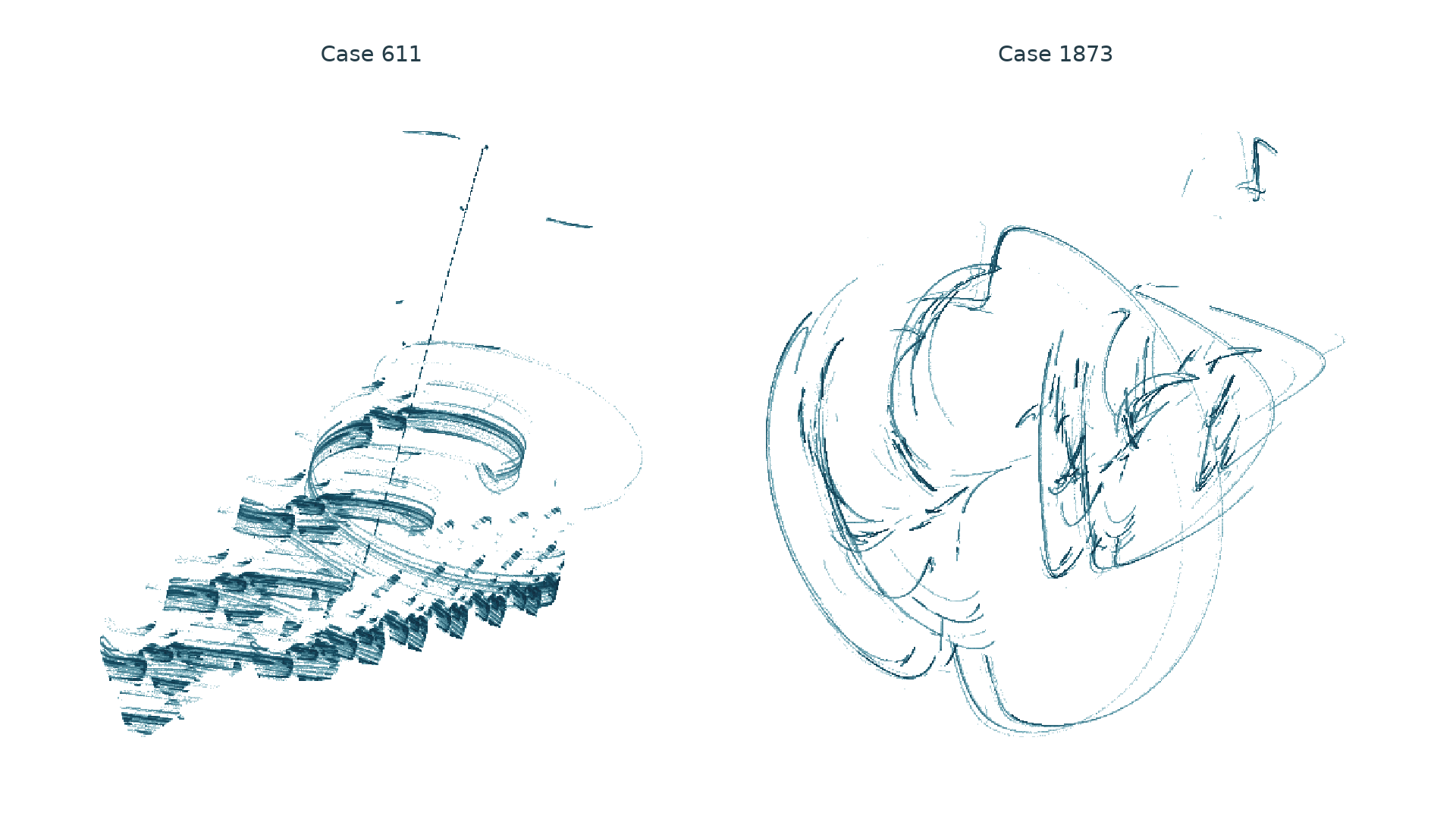
First recorded portrait: 2026-11-01.
Complete run inventory and commands · All 72 screening portraits · Cyclic three-circle search