A Whitney fold in the attracting spatial-circle RAAR set
CHAOS ATTRACTOR LAB · RESEARCH PREPRINT · 1 NOVEMBER 2026
Abstract. We prove that a previously certified compact attracting positive-entropy set of the spatial-circle RAAR map contains a smooth Whitney fold of the full map. A thin self-covering window yields a connected crossing continuum inside the attracting set. Opposite whole-face signs of det DF after 42 steps force a critical point in its image. Exhaustive interval classification verifies the fold criterion at every possible critical point in that window image. Two map/derivative realizations and separate partition audits pass.
The fold excludes conjugacy on an open neighborhood of the attracting set, by any ambient homeomorphism, to a map locally injective throughout the corresponding set. This is a precise local-equivalence obstruction. It does not establish noninjectivity of the restricted invariant-set dynamics or a historically new attractor class.
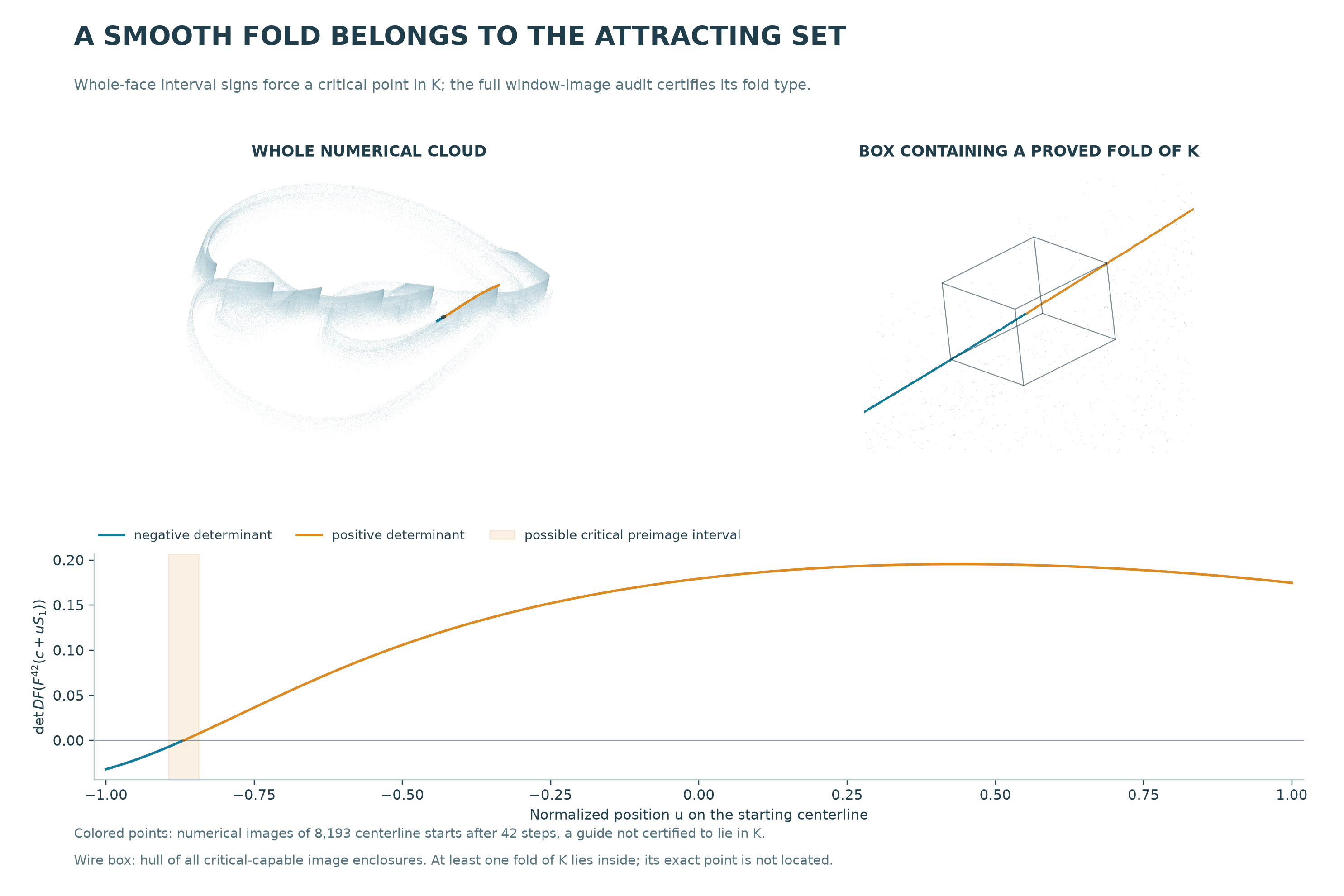
Figure 1. A proved fold of K lies inside the wire box. The colored guide shows 8,193 actual images of a centerline after 42 iterations; that centerline is not certified to lie in K. The pale background is the earlier finite numerical reference. The two upper panels use the same rigid orthographic camera, with a magnified crop on the right. The lower graph is a numerical guide, separate from the whole-face interval proof.
1. Exact map and certified window
Let A be the unit circle in the xy plane and B the circle c+r(cos t, cos θ sin t, sin θ sin t). With nearest projections onto the circumferences, Luke’s published RAAR iteration [1] is
| Parameter | Exact binary64 input |
|---|---|
| beta | 0.9708823579074815 |
| r | 1.9886915469542146 |
| theta | 0.9028818255996501 |
| c_x | -0.1435409113764763 |
| c_y | 0.5745496526360512 |
| c_z | -0.7745124697685242 |
Each listed number denotes its exact binary64 lift. The earlier trapping certificate [2] constructs a finite union Q of 21,405,802 closed cubes, avoids both projection singularities, and verifies
Consequently K is compact, invariant and attracts a neighborhood of Q. Its certified entropy is at least log(2)/49. Those completed computations are explicit dependencies, not regenerated by this new face calculation.
Write N=c0+S[−1,1]3, S=B0diag(ρ), with exact binary64 entries
| B column 1 | B column 2 | B column 3 |
|---|---|---|
| -0.2323036470597354 | -0.09754348589931008 | 0.9602881626052217 |
| 0.8662592186016529 | 0.7569218185352454 | 0.2673319366440987 |
| 0.44230078199162143 | -0.6461846709601738 | 0.07987665748141355 |
The displayed 10−5 and 10−6 also denote binary64 lifts; products defining S are mathematical products. This is the old saddle window with only its stable widths reduced. Exact comparison gives N⊂N0⊂Q. The basis is invertible.
For G=F7, let g=(g1,gs) be its expression in N coordinates. The interval checks prove g1>1 on u=−1, g1<−1 on u=1, and: at every source point, either |g1|>1 or both stable image coordinates lie strictly in (−1,1). No cone condition or certified smooth unstable manifold is assumed.
2. Crossing continuum and membership
Crossing lemma. A crossing path in N is a continuous path whose endpoints lie on the opposite u faces. The inequalities in Section 1 imply that G maps any such path across N. More precisely, its unstable coordinate starts beyond one face and ends beyond the other. Select the subinterval from the last encounter with the starting face before the first encounter with the opposite face. Between these endpoints its unstable coordinate stays in [−1,1]. The volume condition puts both stable coordinates strictly inside, so this image subpath is a crossing path in N.
Start with a centerline path and repeatedly select a crossing subpath in the preceding path’s image under G. Every resulting path is compact, connected and meets both faces, with
Compactness of the hyperspace of nonempty compact subsets of N supplies a Hausdorff-convergent subsequence, with indices tending to infinity, and a nonempty compact limit C.
The limit is connected: otherwise disjoint small neighborhoods of its two separated compact pieces would both meet, and together contain, every sufficiently late Pn, contradicting connectedness. The closed-face intersection property also passes to the limit. For every m, sufficiently late Pn lie in the closed set Fm(Q), since the forward images of Q are nested. Thus C⊂K∩N, and C crosses both faces. C is not asserted to be a smooth curve.
Forced critical point. The function h(x)=det DF(F42(x)) is continuous on N, because N⊂Q and the trapping certificate gives smoothness along all forward iterates. Whole-face interval enclosures establish the conservative bounds
The connected image h(C) contains values of both signs, hence contains zero. Choose x∈C with h(x)=0. Invariance of K gives z=F42(x)∈K and det DF(z)=0. This supplies membership in the asymptotic attracting set, rather than proximity to a finite reference orbit.
Fold type. Section 3 classifies the entire image F42(N). Every critical point in it has rank DF=2 and a kernel direction v with ∇(det DF)·v≠0. The critical hypersurface is smooth and its kernel is transverse; the standard Whitney-fold criterion applies [3]. At least one such point of K lies in the outward box
The box encloses all fold-capable primary image cells. We do not locate a unique critical point, assert that the numerical centerline belongs to K, or infer that all points in the box are critical.
3. Exhaustive interval computation
The 42-step image of each source cell is enclosed by a reconditioned mean-value representation X⊂C+Aδ+Br. A and B are point matrices, while δ and r are interval vectors. For arbitrary finite selected matrices A′ and invertible B′, the mean-value theorem gives
An interval enclosure of (B′)−1E becomes the next remainder r′. A numerical QR factorization selects B′, but exact orthogonality or accuracy of this choice is not assumed: its actual inverse is enclosed and verified. The explicit mismatch DF(X)A−A′ absorbs the chosen linear approximation. Positive projection-axis bounds are checked throughout each convex enclosure.
Every source cell in N is accepted only if the final image X either has det DF(X) bounded away from zero, or passes the fold criterion at all possible critical points in X. In the second case, select two rows of DF. Their cross product v has a component bounded away from zero, certifying a nonzero 2×2 minor. The interval contraction ∇(det DF)·v also excludes zero. At a critical point, rank is then exactly two and v spans its kernel.
| Complete check | Vector, 70 digits | Scalar AD, 100 digits |
|---|---|---|
| Self-covering volume leaves | 60 | 41 |
| Self-covering face leaves | 2 | 2 |
| Opposite-sign face leaves | 2 | 2 |
| Regular image cells | 452 | 270 |
| Fold-capable image cells | 26 | 13 |
The primary realization uses vector projectors and analytic derivatives. The second uses scalar circle coordinates, nested reflectors and forward first/second automatic derivatives; it differentiates the determinant by its six permutation products. They share mpmath interval arithmetic, the enclosure construction and subdivision driver. They are not wholly independent software stacks.
An additional unreconditioned mean-value face calculation passes with four left-face leaves and one right-face leaf. Separate audits check complete binary subdivision trees, strict inequalities, exact window containment, source identities and both frozen dependency manifests. These accounting audits do not independently recompute the interval images.
The frozen packet retains all 45 width proposals, successful and incomplete face trials, a failed matrix-selection conversion, a corrected Decimal accounting check, and the interrupted wide-window volume experiment. Only completed thin-window computations enter this proof. The software arithmetic assumptions are explicit; this is not a proof-assistant formalization.
4. Equivalence, priority and reproduction
Ambient obstruction. At a smooth fold, separate source and target coordinate changes give the local form (s,t,w)↦(s,t,w²), up to signs and permutations [3]. Thus F is not injective on any open neighborhood of z. If an ambient homeomorphism H conjugated F to T on an open neighborhood of K and T were locally injective at H(z), the conjugacy identity and injectivity of H would force F to be injective on a sufficiently small neighborhood of z. This is a contradiction.
The nearby pairs witnessing the fold need not both belong to K. Therefore the argument does not show noninjectivity of F|K and does not rule out abstract conjugacies defined only on invariant sets. The fold normal form itself is not a dynamical conjugacy.
A concrete known comparison. The generalized Hénon map H(x,y,z)=(1.76−y²−0.1z,x,y) in [4] has an explicit global inverse. Our result excludes an ambient-neighborhood conjugacy to it. Its symbolic dynamics and hyperbolicity were already computer-assisted results; neither covering proofs nor a folded-looking portrait are new concepts.
Noninvertible folded strange-attractor candidates also precede this study [5]. The institutional abstract of [5] was reviewed; its full body remains an access gap. The present contribution is a specific fold-membership certificate in an instance of the known RAAR algorithm, with a precise equivalence exclusion. Historical priority, transitivity of K, a physical measure and equality of K with the sampled cloud remain unresolved.
Reproduction. The companion README supplies all commands. The frozen packet results/raar-critical-membership contains the exact input, both full computational realizations, complete leaf certificates, dependency-bound accounting audits, figure data and source snapshots. Its theorem.md states the full mathematical proof; priority.json records bounded searches and review limits. The earlier symbolic and trapping packets remain unchanged. No claim that an equivalent attractor has never appeared follows from failure to locate an exact match.
References
[1] D. R. Luke. Relaxed averaged alternating reflections for diffraction imaging. Inverse Problems 21 (2005), 37–50. doi:10.1088/0266-5611/21/1/004.
[2] Chaos Attractor Lab. An attracting positive-entropy set in spatial-circle RAAR (2026-11-01), repository research note. Dependency packets: results/raar-trapping and results/raar-symbolic-dynamics. Public repository: github.com/Griboedow/chaos-attractor-lab.
[3] R. Montgomery. Who’s Afraid of the Hill Boundary? SIGMA 10 (2014), 101, Appendix B and Section 3.1. doi:10.3842/SIGMA.2014.101.
[4] A. Gierzkiewicz. A computer-assisted proof of the existence of Smale horseshoe for the folded-towel map. Communications in Nonlinear Science and Numerical Simulation 96 (2021), 105680. arXiv:2101.10416.
[5] S. Garst and A. E. Sterk. The dynamics of a fold-and-twist map. Indagationes Mathematicae 27 (2016), 1279–1304. doi:10.1016/j.indag.2016.07.002.