Folded triangles and scissor wings inside an adaptive solver
A stable linear spring gives two striking numerical-controller candidates when the standard RK23 algorithm is studied as a dynamical system in its own right. The folded triangle and scissor wings below are actual accepted-step states, not deformed versions of another attractor. Historical uniqueness and asymptotic chaotic attraction remain unproved.
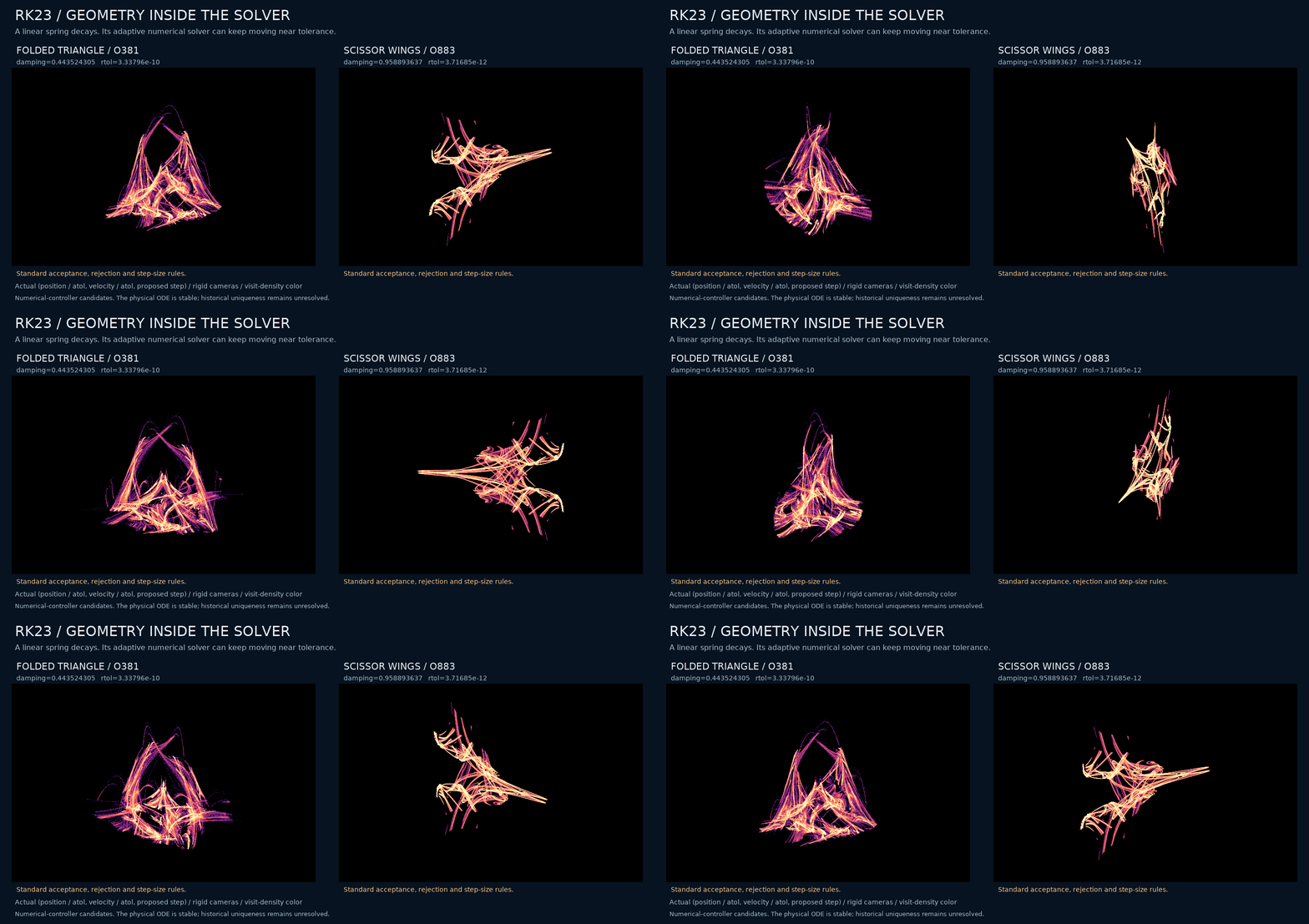
First recorded portrait: 2026-11-01.
Research manuscript (Markdown) · Proof, evidence and reproduction · Large portrait · Independent evidence · Initial volumes approaching · Exact structure and boundedness · Prior-art and equivalence audit


Where the geometry lives
The physical equation is only
Every exact solution decays to zero. The three plotted coordinates are
(q/atol, p/atol, proposed next step). Near the requested absolute tolerance,
the adaptive solver can keep taking steps around its stability boundary. That
numerical feedback, including rejected trials, produces the displayed clouds.
The result is not physical chaos in a linear oscillator.
We use the existing Bogacki–Shampine 3(2) pair with SciPy's standard weighted RMS
error, componentwise scales, safety factor 0.9, factor limits 0.2 and 10,
and the post-rejection growth restriction. The source and implementation match
are documented in the structure note.
Each portrait contains eight million consecutive actual states after a further 100,000-step warm-up. The animation uses the last consecutive million states. The cameras are proper orthogonal rotations with equal coordinate units, constant envelopes and zero clipped points. Color indicates visit density; there is no geometric warping, smoothing, interpolation between iterates or curve invented to join them. The visual names are descriptions, not dynamical classifications.
Selected cases and independent checks
| Case | Damping zeta |
Relative tolerance | Five-million-step mean spectrum |
|---|---|---|---|
| O381, folded triangle | 0.4435243054088205 | 3.3379616873243337e-10 | (0.085762, -0.109390, -0.182760) |
| O354, folded wings | 0.4803776211887598 | 0.0011646941675974745 | (0.174079, -0.121821, -0.302704) |
| O883, scissor wings | 0.9588936367407441 | 3.71684809666591e-12 | (0.217953, -0.272192, -0.407174) |
Rates are per accepted iteration of the numerical map. These are finite
estimates, not exact asymptotic Lyapunov exponents. All 20 windows of each
five-million-step run have a positive leading estimate. The smallest leading
window values are 0.083727, 0.172882 and 0.216943, respectively.
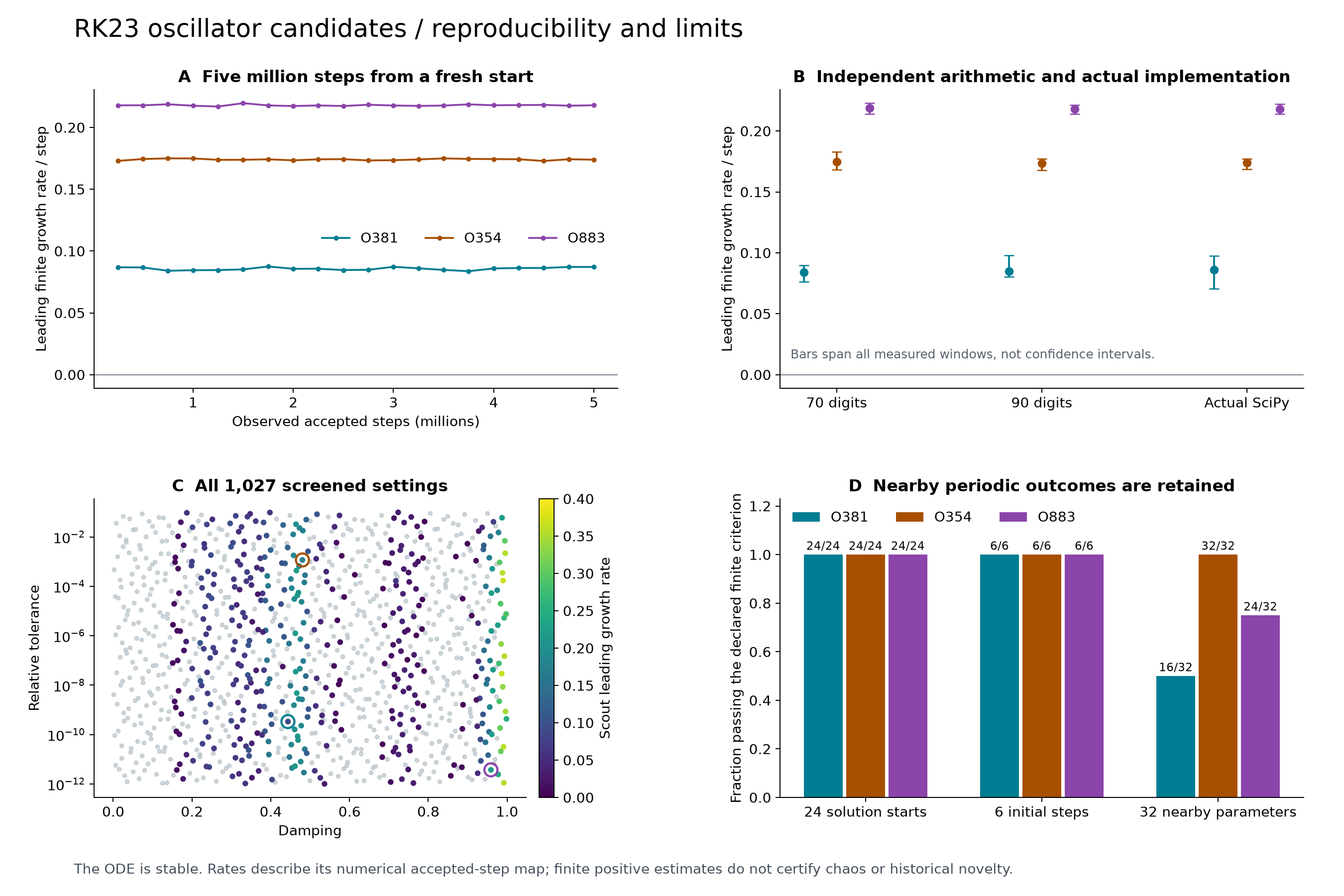
The verification has several independent components:
- Analytic derivative and implementation. The real-coordinate Jacobian was
compared with 256 central finite differences (maximum absolute difference
1.68e-9), and 256 one-step states were compared with the unmodified installed SciPy routine (maximum difference6.00e-15). Rejections were included. - Long fresh starts. Three full QR directions, with two-pass modified
Gram–Schmidt, were followed from normalized
(q,p,h)=(1,0,0.1)for 100,000 warm-up and five million measured steps. The sum of the three window rates agrees with an independently accumulated log determinant to below2e-14. - Independent arithmetic. A separate four-stage implementation, importing neither the production recurrence nor its Jacobian, used 70 and 90 decimal digits, finite separations, 100,000 warm-up, 5,000 alignment and 100,000 measured steps. Every leading window is positive for all three cases. The exact rational method coefficients are used; this is not a repetition of rounded binary64 stage coefficients.
- Actual library. Unmodified SciPy 1.18.1 ran from physical
(q,p)=(1,0)withatol=1e-6for 400,000 accepted steps. Its floating-point clock is retained. Analytic tangents evaluated on the actual states give positive leading rates in all 29 measured 10,000-step windows. Maximum one-step transcription residuals are below2.55e-10in normalized solution/log-step coordinates. These tangents are mathematical-map derivatives, not a derivative of floating-point rounding.
The first O381 library trajectory was completed before an analysis-driver compilation error. It was reused byte for byte after fixing that driver. A subsequent input-path mistake occurred before any solver run. Both failures, their sources and the recovery are retained. The completed O381 trajectory's function-evaluation count was not recorded before the first failure and is reported as unknown.
Approach and nearby periodic regimes
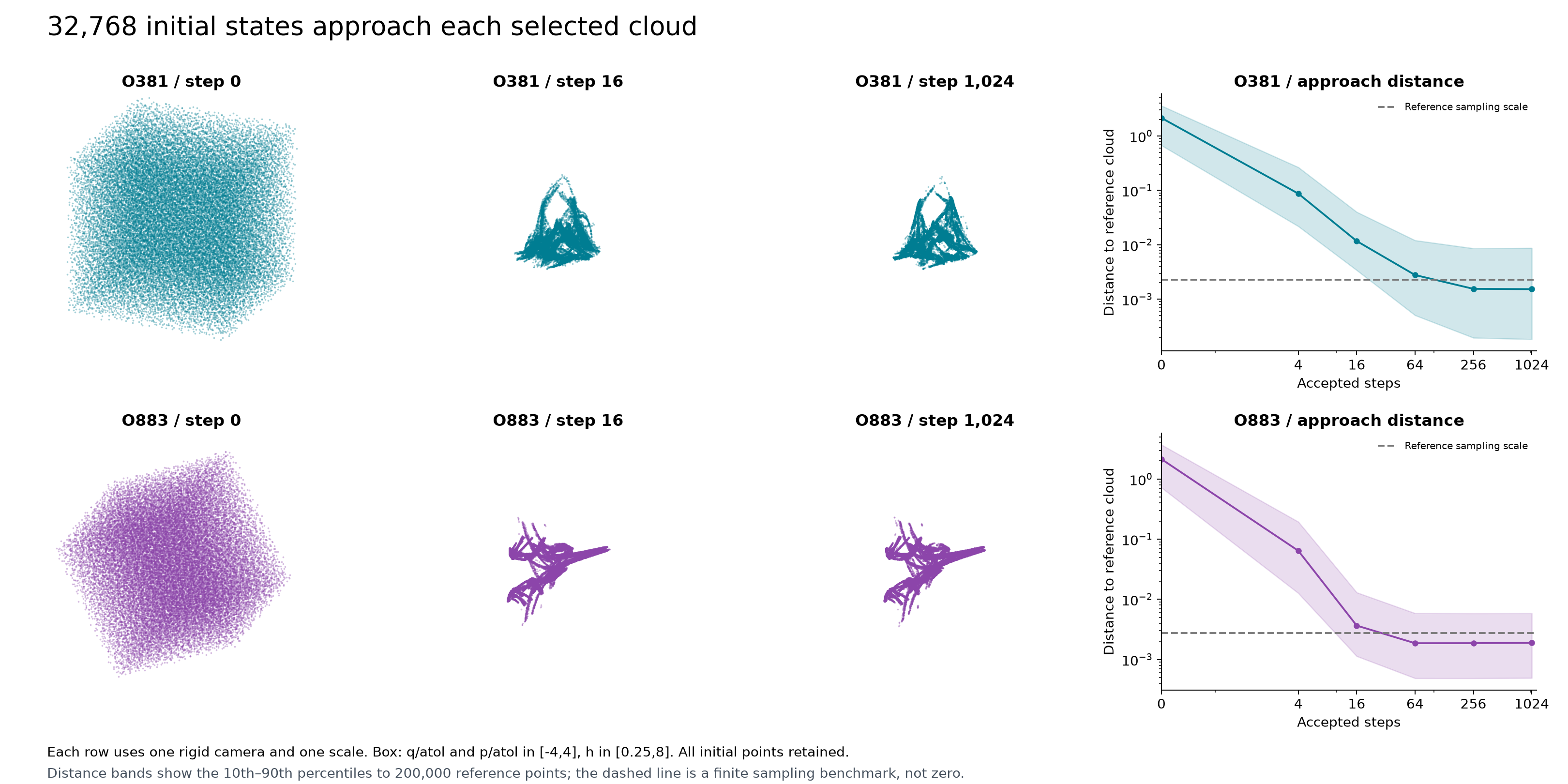
For each portrait, 32,768 scrambled Sobol initial states fill the declared box
q/atol,p/atol in [-4,4], h in [0.25,8]. All 65,536 trajectories complete
1,024 steps. The median distance to a separate 200,000-point reference cloud
decreases from approximately 2.14 to 0.00153 for O381 and 0.00189 for
O883. The reference's own finite sampling scale is shown. These are distances
to data, not certified distances to an invariant set or a basin-measure proof.
Each selected case also passes all 24 declared nonzero solution starts (four radii, six phases) and all six alternative initial step proposals. Nearby parameters give a more qualified result:
| Case | Positive leading rate in all ten windows | Periodic neighbors |
|---|---|---|
| O381 | 16 / 32 | 16 / 32 |
| O354 | 32 / 32 | 0 / 32 |
| O883 | 24 / 32 | 8 / 32 |
The neighbors independently vary both parameters by up to exp(±0.02).
Detected periods range from 3 to 56. They are retained rather than counted as
chaotic outcomes. The exact-zero control has zero physical solution and an
ever-growing ideal step proposal; all three zero controls leave the declared
step-size box. Thus there is no compact global attractor on the unrestricted
full state domain.
Search accounting and other directions
The main screen contains 1,024 scrambled Sobol parameter pairs plus three
controls, with 20,000 warm-up and 50,000 measured steps. It flags 396 settings
whose leading estimates exceed 0.001 in every one of ten windows. Every flag
receives a fresh 100,000-step warm-up and one million measured steps. 393
retain the declared finite chaos criterion; three settle into periods 14, 19
and 172. Twenty-four geometrically diverse flagged settings are rendered
before the three portrait candidates are selected.
Three further settings have two positive finite growth estimates throughout
the million-step follow-up. Their separate longer, high-precision and
actual-library checks are retained in the hyper-* directories. Their visual
forms are not substituted for the more distinctive portrait candidates.
| Case | Five-million mean second rate | Smallest second window, 70 digits | 90 digits | Actual SciPy |
|---|---|---|---|---|
| O37 | 0.003838 | -0.000440 | 0.000539 | -0.000027 |
| O526 | 0.004799 | 0.003191 | 0.001849 | 0.000466 |
| O689 | 0.002281 | 0.000926 | -0.004088 | -0.004142 |
All three retain two positive estimates in every 250,000-step window of their five-million-step checks. O526 is the stronger independently supported two-direction candidate: both 70/90-digit runs and every actual-library window also have positive second estimates. O37 and O689 have mixed short-window results, despite positive overall second means. These failures of the stricter criterion are explicit, not averaged away.
O526 uses (zeta,rtol)=(0.1717106344755739,0.03929059404001495) and has mean
spectrum (0.024016,0.004799,-0.034250). The structure audit
provides a separate exact-rational bounded-solution certificate for this case;
the conservative general tolerance threshold alone does not cover it.
Two preliminary directions are also retained:
- A scalar Heun/Euler PI experiment screens 8,198 settings. No raw unguarded case passes the declared screen; 1,089 cases with a custom declared guard do. Of those, 1,079 retain the longer finite criterion, four become periodic and six do not finish within the declared conditions. This is not a complete SUNDIALS solver replay. Its log-coordinate pictures are not promoted as undistorted actual-state geometry.
- A complex-scalar RK23 screen tests 1,027 settings and follows all 35 flags for one million steps; all 35 retain positive quotient expansion. Three actual SciPy checks and a regular control agree. The exact phase symmetry makes the three-dimensional clouds rotations of an amplitude/step quotient, so they are not treated as separate new mechanisms.
A controlled change of error norm
The change z=q-i*(p+zeta*q)/sqrt(1-zeta^2) turns the physical equation into
z'=(-zeta+i*sqrt(1-zeta^2))*z. Using a complex absolute-value error scale in
those coordinates is a deliberate change of numerical error rule, not simply
a new view of the same accepted-step map. Starting from the corresponding
physical (q,p)=(1,0), a million-step comparison gives:
| Original-coordinate case | Detected period of the complex amplitude/step quotient | Mean quotient spectrum |
|---|---|---|
| O381 | 3 | (-0.016995,-0.116763) |
| O354 | 23 | (-0.017457,-0.068499) |
| O883 | 1 | (-0.212297,-0.212297) |
| O37 | 3 | (-0.044500,-0.052529) |
| O526 | 30 | (-0.044378,-0.087734) |
| O689 | 29 | (-0.012290,-0.013337) |
The complex phase supplies a neutral direction. A periodic amplitude/step quotient does not by itself imply a closed full complex-state trajectory. This control locates the observed difference in the numerical feedback rule; it does not establish a new coordinate-dependence principle or prove inequivalence of invariant sets. Hall and Higham's earlier norm analysis is explicitly credited in the priority audit.
What can be claimed
The exact bound proves bounded solution
coordinates for all accepted-step sequences when
rtol < (1-zeta)/(128*sqrt(2)). All three main candidates satisfy this
condition. It does not bound the step coordinate or certify a chaotic
attracting invariant set.
The evidence supports reproducible, bounded sampled clouds with sustained finite expansion in a standard numerical algorithm. Persistent tolerance-scale oscillations, adaptive-controller instability, polynomial-map analysis and the role of error norms are prior work. The priority review identifies those overlaps and important unread sources. Neither distinctive appearance nor a different error norm proves historical or topological uniqueness.
Reproduction and retained evidence
The frozen packet is results/rk23-controller. It includes all screened outcomes and follow-ups, declared starts, finite window rates, actual-library states, independent precision records, source snapshots, figures, hashes and the failed drivers. Large raw portrait inputs and non-promoted preliminary gallery clouds remain local with hashes and complete regeneration information. The large PI follow-up is split losslessly into row blocks.
Example commands, from the repository root:
python research/search_rk23_oscillator.py --out NEW-SCOUT-DIRECTORY
python research/follow_rk23_oscillator.py --source NEW-SCOUT-DIRECTORY/screen.npz --out NEW-FOLLOW-DIRECTORY
python research/check_rk23_oscillator_precision.py --cases results/rk23-controller/oscillator/precision/input.json --out NEW-PRECISION-DIRECTORY
python research/verify_rk23_controller.py --root results/rk23-controller --assets docs/assets
The search programs require NumPy, SciPy and Numba; rendering adds Matplotlib and Pillow; independent precision uses mpmath; the symbolic audit uses SymPy. The stored protocols specify seeds, counts, versions and initial states.