Folded spatial regimes from a Gaussian posterior mean and a sphere
Numerical research article · 2026-11-01. Historical priority and the existence of an asymptotic chaotic attractor remain unresolved.
Abstract
We examine a reflected iteration combining a finite-prior Gaussian posterior mean with projection onto the unit sphere in three dimensions. A controlled temperature sweep contains 429 parameter sets, including thirteen exact hard-projection controls. All 138 short-time positive flags receive longer follow-ups; 46 approach numerically detected finite cycles. Seven visually selected regimes retain positive leading tangent growth over five million observed iterations. Two spatial candidates, Cases 155 and 251, exhibit folded strands and three prominent curled lobes, respectively. Their positive growth survives 33 initial states and independently expressed calculations at 70 and 100 decimal digits. We preserve the full selection history, competing regular outcomes and a finite comparison with 108 reference regimes. The component operators and substitution principle are established; these observations do not establish a new general mechanism or historical uniqueness.
1. Geometry and scope
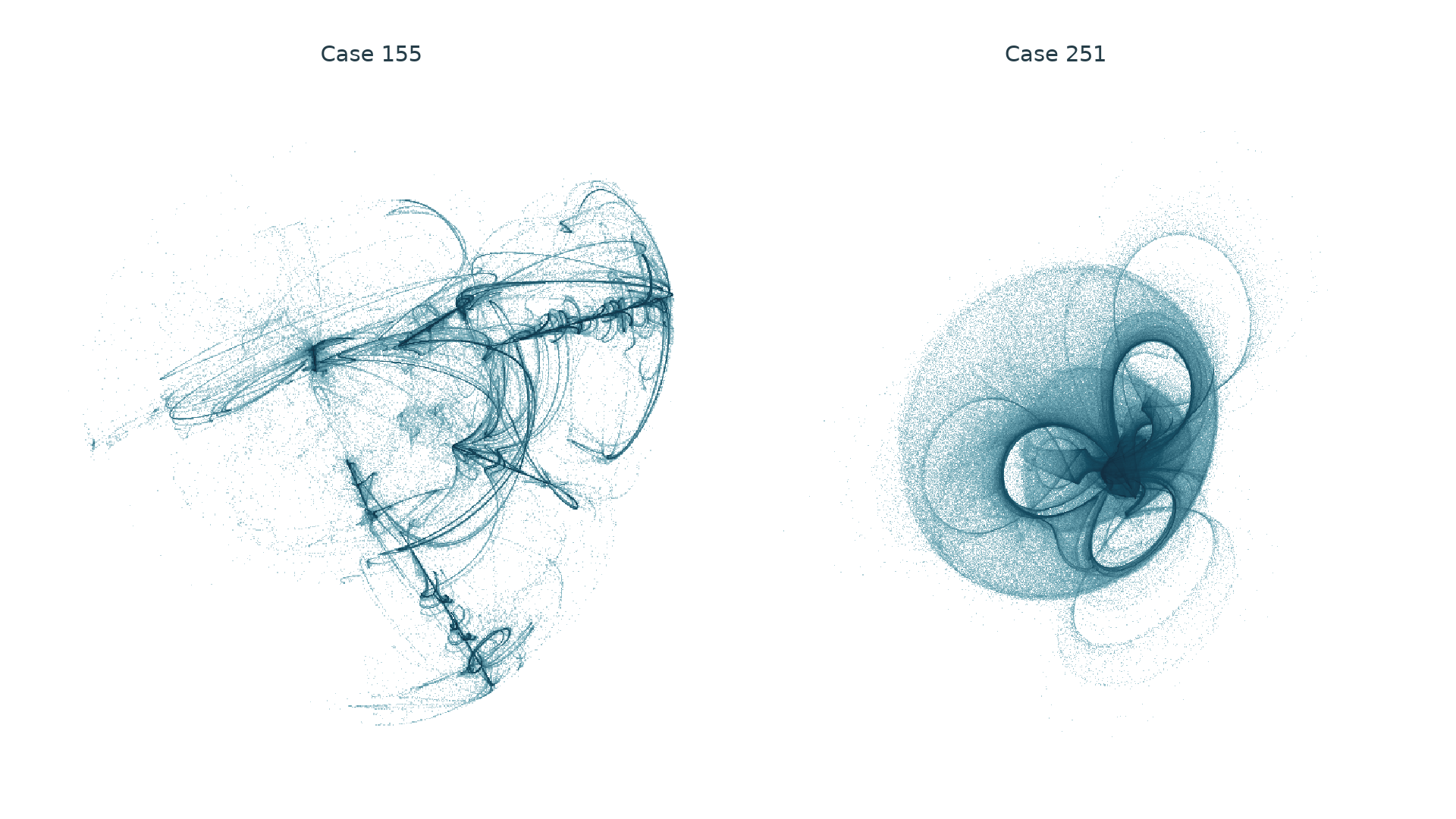
Drawn: 2026-11-01.
The accompanying 24-second rotation shows the actual three-dimensional state coordinates. Each static panel contains two million consecutive iterates. Centering and orthogonal camera rotations preserve shape; units are equal within each panel, while scales and density saturation differ between panels. Apparent strands are sampling density. No line interpolation or synthetic states are used. Each animation uses a fixed terminal subset of 250,000 consecutive states and a rigid camera.

Case numbers are local to this sphere-temperature sweep. They identify stored parameter sets, not physical measurements or cases in the earlier circle study. In particular, the rigorous result for circle Case 156 does not transfer to this map.
The sphere is a natural normalization constraint. Replacing a nearest-site decision by a posterior mean supplies a smooth temperature parameter, but changes the algorithm. This is an experimental reflection model with known ingredients, not a claim that standard finite-set RAAR has these smooth orbits or that this substitution is a newly invented algorithm.
2. Map, derivative and elementary bound
For fixed sites and temperature , put
With , , and , the iteration is
Equivalently, for the sphere projector and reflections , ,
The posterior mean is smooth everywhere. The composition is smooth on the open set ; the sphere projection is not uniquely defined at zero. At zero temperature the implementation explicitly calls the original nearest-site sphere map as a separate control. It does not evaluate a zero-temperature exponential formula.
For the weighted covariance matrix, set
The derivative used for tangent growth is
The implementation uses shifted exponentials and centered covariance. Independent local checks compare the nested-reflection formula, finite differences and LAPACK QR. Since the mean is a convex combination,
This elementary inequality bounds trajectories that remain defined. It does not prove avoidance of the singular set, a trapping neighborhood, positive entropy or attraction to the pictured clouds. All stored binary64 parameters and coordinates specify their exact real values; ideal algebraic polyhedral symmetry is not assumed.
3. Complete selection protocol
The input configurations are the union of all seven flags from the earlier
hard-sphere screen and all six bases
from the circle-temperature experiment:
124, 611, 668, 896, 1086, 1119, 1346, 1504, 1694, 1725, 1788, 1790 and 1873.
Each receives one hard control and 32 logarithmically spaced temperatures
from 1e-5 to 1, multiplied by its minimum squared intersite distance.
The thirteen hard-control leading-rate windows match their earlier values
bitwise. The common initial state is (0.317,-0.211,0.419).
The screen discards 5,000 iterations and measures 15,000 in ten windows.
All 429 cases complete. The 138 cases with leading growth above 0.005 in
every window receive fresh runs discarding 30,000 steps and observing
500,000. Of these, 92 retain the criterion; 46 have detected periods between
1 and 512 at a scale-adjusted 1e-8 terminal return tolerance. These are
finite detections, not periodic-orbit existence proofs.
All twelve pages of the complete follow-up preview
were inspected before selecting Cases 155, 196, 250, 251, 253, 388 and 389
for fresh runs discarding 100,000 steps and observing five million. Selection
favored visible loops, separated curved pieces and folded shells. Every
selected outcome is retained. The preview metadata's legacy leading_xy
field denotes the leading full three-dimensional rate in this study.
| Case | Base | Relaxation beta | Temperature tau | Mean QR rates | Smallest leading window |
|---|---|---|---|---|---|
| 155 | 1086 | 0.957377939824015 | 0.012757228142451395 | 0.22967, -0.38329, -0.62199 | 0.22707 |
| 196 | 1119 | 0.9076405974514783 | 0.0316701644554851 | 0.23095, -0.09073, -0.31008 | 0.22962 |
| 250 | 1504 | 0.9328500449163839 | 0.040379163390726544 | 0.70303, -0.26025, -0.74194 | 0.69829 |
| 251 | 1504 | 0.9328500449163839 | 0.05853931540315792 | 0.79008, -0.03820, -0.84515 | 0.78650 |
| 253 | 1504 | 0.9328500449163839 | 0.12303488973335253 | 0.36414, -0.11796, -0.98132 | 0.35807 |
| 388 | 1790 | 0.9970150632821023 | 0.05567104852742042 | 0.13076, -0.64770, -0.75667 | 0.07765 |
| 389 | 1790 | 0.9970150632821023 | 0.08070858321248979 | 0.18837, -0.56502, -0.71217 | 0.18679 |
Rates are per iteration, estimated from twenty windows of 250,000 steps. They are not certified asymptotic Lyapunov exponents. Case 388 changes substantially from its 500,000-step leading mean of 0.32393, despite retaining positive windows. Cases 388 and 389 have very small third covariance fractions in their terminal clouds; a visually elaborate projection alone does not imply a substantial three-dimensional geometry.
4. Fresh starts and precision controls
The four cases 155, 196, 251 and 389 receive the original start plus 32
scrambled Sobol starts in [-4,4]^3, with seed 2026110121. Each discards
100,000 steps and observes 500,000. Cases 155, 196 and 251 retain positive
leading growth in every window from all 33 starts; their respective minimum
windows are 0.21820, 0.22370 and 0.77296. This is finite basin sampling,
not a unique-measure or global-attraction theorem.
Case 389 has a different outcome: only ten starts retain the positive-window criterion. Four approach fixed points, fifteen approach detected period-four orbits, and four approach detected period-27 orbits. Its attractive visual appearance therefore coexists with strong regular alternatives. These outcomes are preserved in the structure analysis.
Scalar high-precision calculations use inner-product posterior logits and
nested reflections, independently of the production derivative. Exact
binary64 inputs are lifted into 70- and 100-digit arithmetic. After 10,000
discarded steps, renormalized finite separations are measured for 50,000
steps in ten windows, with separations 1e-30 and 1e-40, respectively.
For Case 155 the minimum windows are 0.22144 and 0.21553; for Case 251 they
are 0.77711 and 0.76545. This supports numerical sensitivity beyond ordinary
rounding, without certifying infinite-time behavior.
As a control, iterating the posterior mean alone from every cohort start
reaches a 1e-12 stopping residual within 4, 175, 4 and 7 steps for Cases
155, 196, 251 and 389, respectively. This is consistent with established
mean-shift descent. The reflected composition does not inherit that descent
inequality merely because it contains the same averaging map.
For Case 196, three gaps along the first principal direction of the terminal
long-run sample define four labels. Applying the fixed thresholds to the
separate two-million-state render gives exactly 500,000 states per label
and only the transitions 0 -> 3 -> 2 -> 1 -> 0. Each labelled piece
contains many distinct states; this is not a four-point orbit. Cyclic
chaotic bands are an established phenomenon. The observation supplies a
comparison target, not a new mechanism or an invariant-partition proof.
5. Prior art and equivalent formulations
The posterior mean is exactly equal-weight isotropic Gaussian mean shift, finite-prior MMSE denoising and a biased softmax-attention update. It also admits an exact nonconvex proximal representation. The shared priority review derives these identifications and records the inspected scopes of the primary sources. Its denoising/reflection precedents apply to the sphere substitution as well. The earlier projection-dynamics audit already excludes a first-discovery claim for chaos in nonconvex reflection algorithms.
The convergence results of Teodoro, Bioucas-Dias and Figueiredo (2018) use fixed mixture weights and convex penalties; our state-dependent weights and sphere indicator do not meet those conditions. Shoushtari et al. (2023 preprint) allow nonconvex data fidelity and expansive MMSE denoisers, but require continuously differentiable data fidelity. The sphere indicator fails that assumption. Our experiment does not contradict these convergence theorems. The shared review records the bounded reading scopes; a full audit of all proofs, applications and parameter regimes is not claimed.
The finite shape comparison uses 108 frozen reference regimes. It removes translation, rotation and uniform scale, then separately tests covariance whitening to remove affine distortion. Each local point-cloud fit uses 1,500 sampled states, 48 principal-axis initializations and twenty alignment steps, allowing reflections. The three nearest descriptor matches are fitted; four independently sampled rankings are also retained.
| Candidate | Representation | Closest descriptor reference | Fitted RMS to that reference | Same-case temporal-half RMS |
|---|---|---|---|---|
| 155 | Similarity | Shimizu–Morioka | 0.25731 | 0.05051 |
| 155 | Affine-normalized | Sprott L | 0.22217 | 0.05720 |
| 251 | Similarity | dysts ZhouChen |
0.32493 | 0.12084 |
| 251 | Affine-normalized | dysts ZhouChen |
0.30433 | 0.15453 |
These residuals are the best fits found by local optimization, not certified global minima. The atlas samples only particular models and parameters. Whitening changes shape and is used only in the comparison, never in the main portraits. The separation from these reference samples does not prove topological inequivalence, exclude nonlinear coordinate changes or return maps, or establish historical uniqueness.
There is a bibliographic caveat for the closest Case 251 reference.
The frozen dysts source
defines its ZhouChen label by
The atlas metadata links that label to the 2004 three-layer paper, but this identification has not been verified against its full primary text. The different printed equations quoted in Section 2 of Wang, Sun and Cang (2011) make that verification necessary. Our table compares the exact archived software trajectory, not an asserted reproduction of that paper. Wang and coauthors also report a long-transient correction to the earlier three-layer example and a separate spherical-shaped chaotic model. Reviewed their abstract and Sections 2–3 through the description of Figure 7; their numerical conclusions were not independently reproduced. Spherical appearance alone is therefore not an originality claim.
The present contribution is a reproducible set of visually distinct numerical regimes and negative controls in this particular realization. A new general operator, a new chaos mechanism, and a uniquely new attractor are not established. Rigorous attraction, invariant structure and an expanded equivalence comparison remain necessary before stronger claims.
6. Reproduction and verification
The evidence packet retains exact inputs, executed source snapshots, complete selection records, compact numerical summaries and commands. Large unthinned trajectories remain in the declared external cache, with hashes and recomputation instructions. The stored hexadecimal input values remove ambiguity from rounded table entries.
The replay checks all 429 screen outputs, accounts for every follow-up flag, repeats all seven five-million-step runs and all five two-million-state renderings, and reconstructs their histograms. LAPACK QR and determinant accumulation provide separate local arithmetic checks. The environment and the distinction between numerical replay and mathematical certification are recorded with the verification result.