What survives when the Yogi switch is smoothed?
The two-direction numerical regime survives small, explicitly declared smoothing of the signed memory update. Smoothing can also produce ordinary cycles. This is a mechanism control on a modified equation, not a new optimizer or a proof that the original and modified attractors are equivalent.
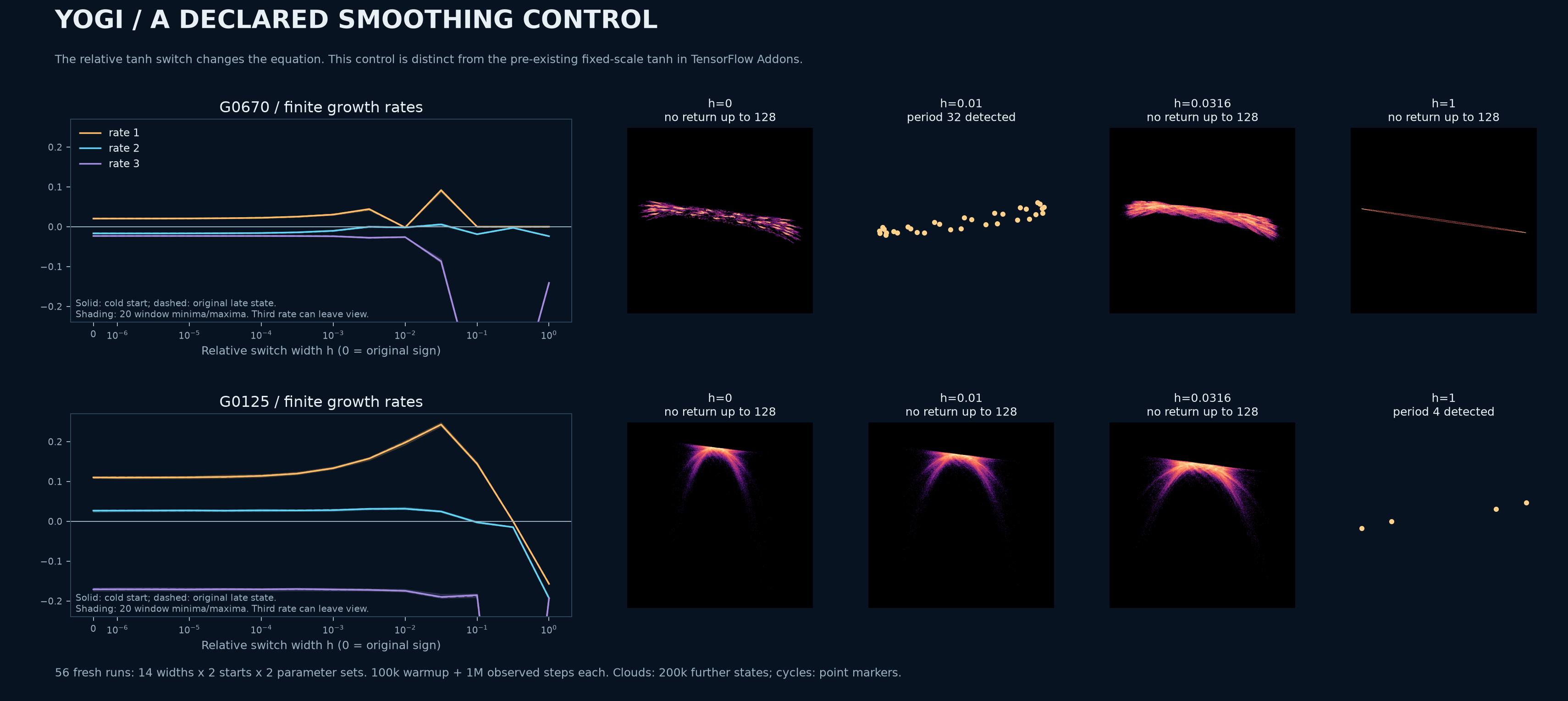
Distinguish two smooth equations
For the original normalized Yogi map, put b=beta1, c=beta2, e=epsilon/alpha, and M=b*m+(1-b)*x. The original second-memory update uses sign(v-x^2). Here we deliberately replace it by
The control at h=0 uses the original sign convention, including sign(0)=0. Every positive h changes the map.
Smooth Yogi itself is prior implementation work. TensorFlow Addons v0.22.0 already offers activation="tanh". Its dense update uses tanh(10*(g^2-v)), without the state-dependent denominator above. On theta^2/2, normalization gives tanh(k*(x^2-v)), where k=10*alpha^2. The full constructor, slot creation, dense/sparse updates and bias correction were read. The existing fixed-scale variant and this relative-width control must not be conflated; neither a tanh substitution nor the word “smooth” establishes novelty.
Declared experiment and results
There are 56 independent runs: the grid cases G0670 and G0125, fourteen widths 0,10^-6,10^-5.5,...,1, and two starts per width. The starts are (0.73,0,0) and the corresponding original map's fixed five-million-step endpoint. A width does not inherit the preceding width's endpoint. Each run has 100,000 warmup steps and 1,000,000 observed steps, partitioned into twenty 50,000-step full-spectrum windows. All 56 complete; all outcomes are retained.
Representative cold-start means are:
| Case | Width | Three finite growth rates | Tail return through lag 128 |
|---|---|---|---|
| G0670 | 0 | (+0.020406,-0.016688,-0.023263) |
None detected |
| G0670 | 0.001 | (+0.030331,-0.010211,-0.023921) |
None detected |
| G0670 | 0.01 | (-0.001833,-0.001832,-0.026040) |
Period 32 |
| G0670 | 0.0316228 | (+0.091506,+0.005724,-0.086607) |
None detected |
| G0125 | 0 | (+0.110076,+0.026669,-0.171036) |
None detected |
| G0125 | 0.001 | (+0.133277,+0.027902,-0.171184) |
None detected |
| G0125 | 0.01 | (+0.197431,+0.031434,-0.174522) |
None detected |
| G0125 | 0.0316228 | (+0.242890,+0.024579,-0.189880) |
None detected |
| G0125 | 1 | (-0.157251,-0.193105,-0.193105) |
Period 4 |
For G0125, every declared width from zero through 0.0316228 retains two positive directions in all twenty windows at both prescribed starts. At h=0.01, the cold-start second rate has minimum +0.029835; at h=0.0316228, its minimum is +0.022861. G0670 gains a second positive direction at the sampled width 0.0316228, with cold-start minimum +0.003115, after the sampled period-32 outcome at h=0.01. These discrete samples do not locate or classify a bifurcation.
Some larger widths have leading means close to zero without a short return. We do not label these as proven invariant circles or tori. The plot uses an explicitly limited vertical range to keep the two leading rates readable; all three complete spectra are in the data. The portraits use rigid cameras and equal spatial units. Detected cycles are shown with point markers; cloud panels use 200,000 further actual iterates.
Exact local identities and a boundedness consequence
Let D=v+x^2+e^2, z=(v-x^2)/(h*D), and q=1-tanh(z)^2. Direct differentiation gives
Unlike the hard map's constant smooth-branch determinant b, this determinant can change sign. The sum of the three finite rates agrees with the separately accumulated average log(abs(b*V_v)) in every saved window to the declared tolerance 10^-7. Four hundred independent complex-step controls have maximum scaled derivative error 1.29e-14. The direct determinant check has a larger cancellation error 2.88e-8, below its separately declared 10^-7 tolerance. These are numerical implementation controls, not a substitute for the algebra.
For 0<=b<1, 0<c<1, e>0, and any fixed h>0, every finite legal initial state has a bounded forward orbit. This follows from the scalar first-exit lemma, without a memory-ordering restriction. To verify its denominator hypothesis, set
If |x|<e, then sqrt(V)+e>=e>|x|>=sigma_h*|x|. Otherwise split the nonnegative second memory into three ranges. For v>=x^2, V>=c*x^2; for x^2/2<=v<x^2, V>=x^2/2; for v<x^2/2, the argument has magnitude at least 1/(5h), so V>=(1-c)*tanh(1/(5h))*x^2. Also V>=0, since a negative update can only occur when v>=x^2. Thus both denominator bounds hold. Once |x|<=B, the second memory satisfies v_t<=max(v_0,(2-c)*B^2): it decreases above x^2 and cannot cross that bound from below. This proves boundedness, not chaotic attraction or historical priority.
Reproduction and limits
Frozen data and exact executed sources include all 56 histories, full window spectra, both initial states, derivative controls, figure clouds and rendering metadata. The first figure composition used density coloring for cycles and made their isolated points too faint; figure02 changes only their display to markers. Both compositions remain archived.
python research/check_yogi_smoothing.py --source results/yogi-plane/plane-five-million/histories.npz --output outputs/yogi-smoothing
python research/render_yogi_smoothing.py --source outputs/yogi-smoothing --output outputs/yogi-smoothing-figure
python research/verify_yogi_smoothing.py --root results/yogi-smoothing
The prior-art audit remains applicable. Finite robustness to a specified perturbation is useful evidence about the mechanism; it does not prove structural stability, asymptotic chaos, a new topological class, or absence of equivalent prior results.