Two stationary attractors with algebraic decay
The points stay fixed throughout the forcing cycle. Inside the three open gain windows both attract nearby solutions except at four isolated gains. At three of those gains a period-three saddle orbit collides with each stationary point. Resonances and the turning triangle The linearized return preserves area exactly. The nonlinear flow loses enough area near each point to pull trajectories inward.
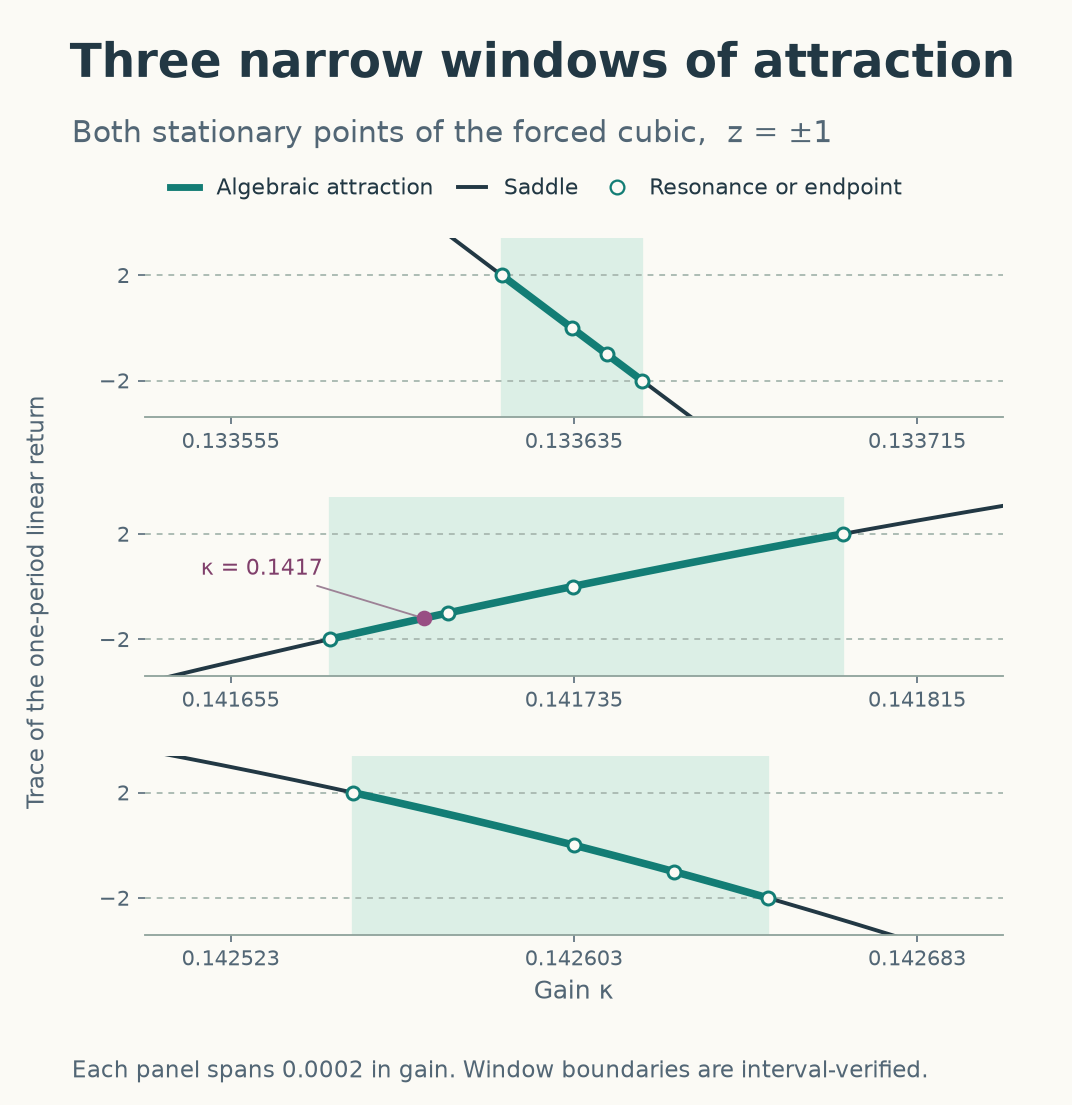
At the one-turn multipliers have modulus one. In the area-normalized elliptical radius defined below, every sufficiently close nonstationary start satisfies after periods. Window endpoints and enclosures for both sites
Equation and proof of the decay rate
The driven cubic has period and obeys
Write for the time- map, and for the real variational matrix along starting at the identity. The divergence is . Liouville's formula gives
Set . When , gives a unique positive definite with and . The measured radius is in real coordinates. In these coordinates the linear return is a rotation.
For the rotation avoids all resonances through order four. The cubic normal form is . Its log determinant starts at . A coordinate change adds a difference of log Jacobians evaluated before and after the map. Through quadratic order these terms have equal angular averages because the normalized map is a rotation plus cubic terms. Averaging the displayed divergence identity on the circle gives
Thus . Inverse squared radius increases by each turn. The normal-form coordinate agrees with the linear one to first order, giving . At the stated gain the checker encloses between 5120.408 and 5120.410 for both sites. Cubic Birkhoff coefficients as stability tests for nonhyperbolic planar maps are established prior work. Cima, Gasull and Mañosa
The verifier bounds the Taylor tails of the fundamental matrix and its integrated Gramian by Cauchy estimates. For each gain window it bounds a degree-18 trace interpolant and its derivative on the entire displayed interval. Reflection combined with a half-period shift conjugates the two stationary returns. Other gain ranges remain open.
python research/shape_search_20261121/frontiers/cubic/elliptic_sites.py