Two saddles on the boundary of three basins
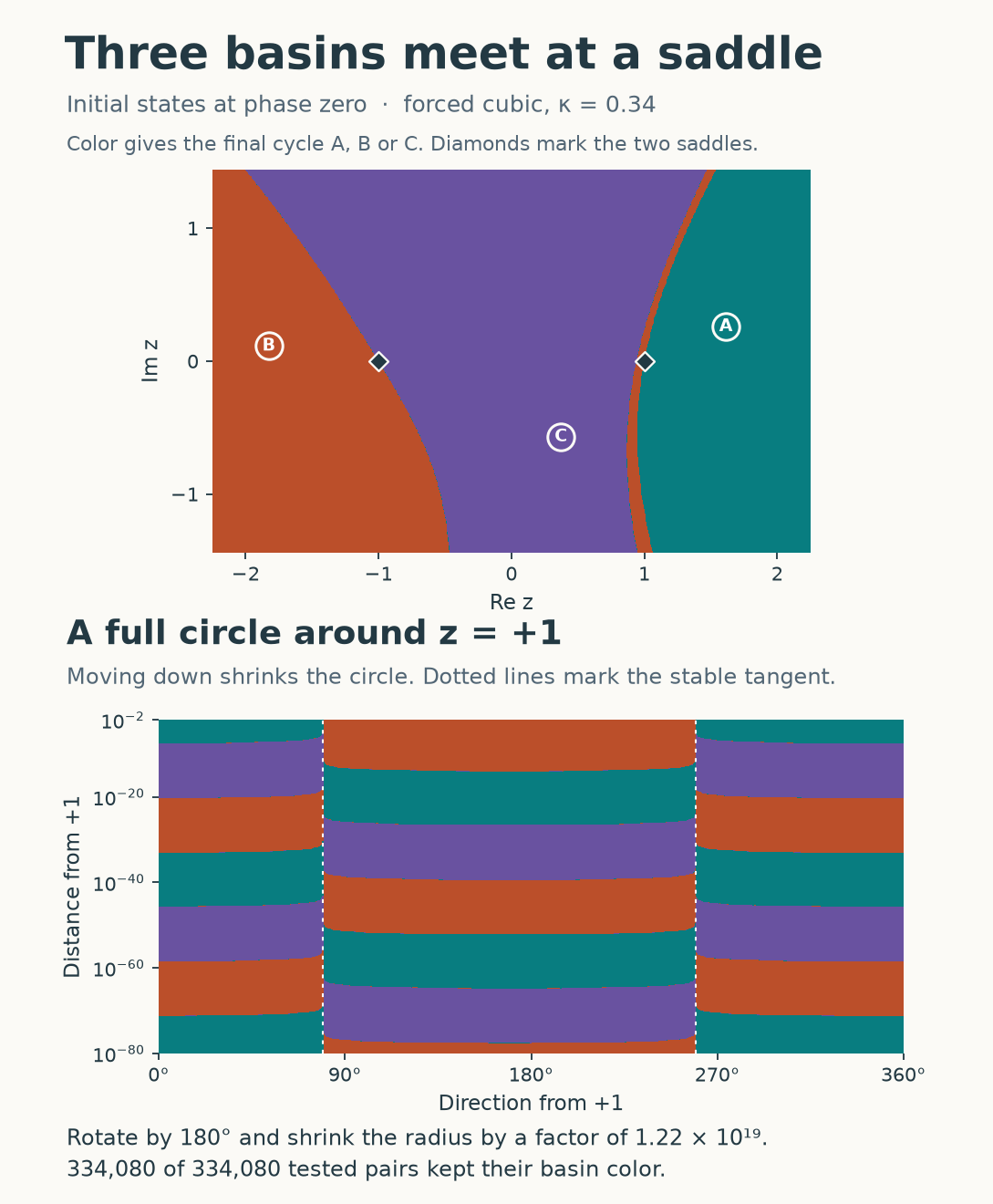
Every neighborhood of contains initial states that converge to each of the three known attracting cycles. The same holds at . The equation, forcing phase and gain are fixed throughout. The stable arc connects this result to chaotic itineraries on the common boundary. Equation and three trapping disks
Read the lower panel one horizontal line at a time. Each line samples a circle around the right saddle. A half-turn and a radius reduction by a factor of about 1.22 × 10¹⁹ preserved the basin color in all 334,080 tested pairs. An independent CPU solver agreed at 512 sampled points from the two panels. Sampling grid and checks
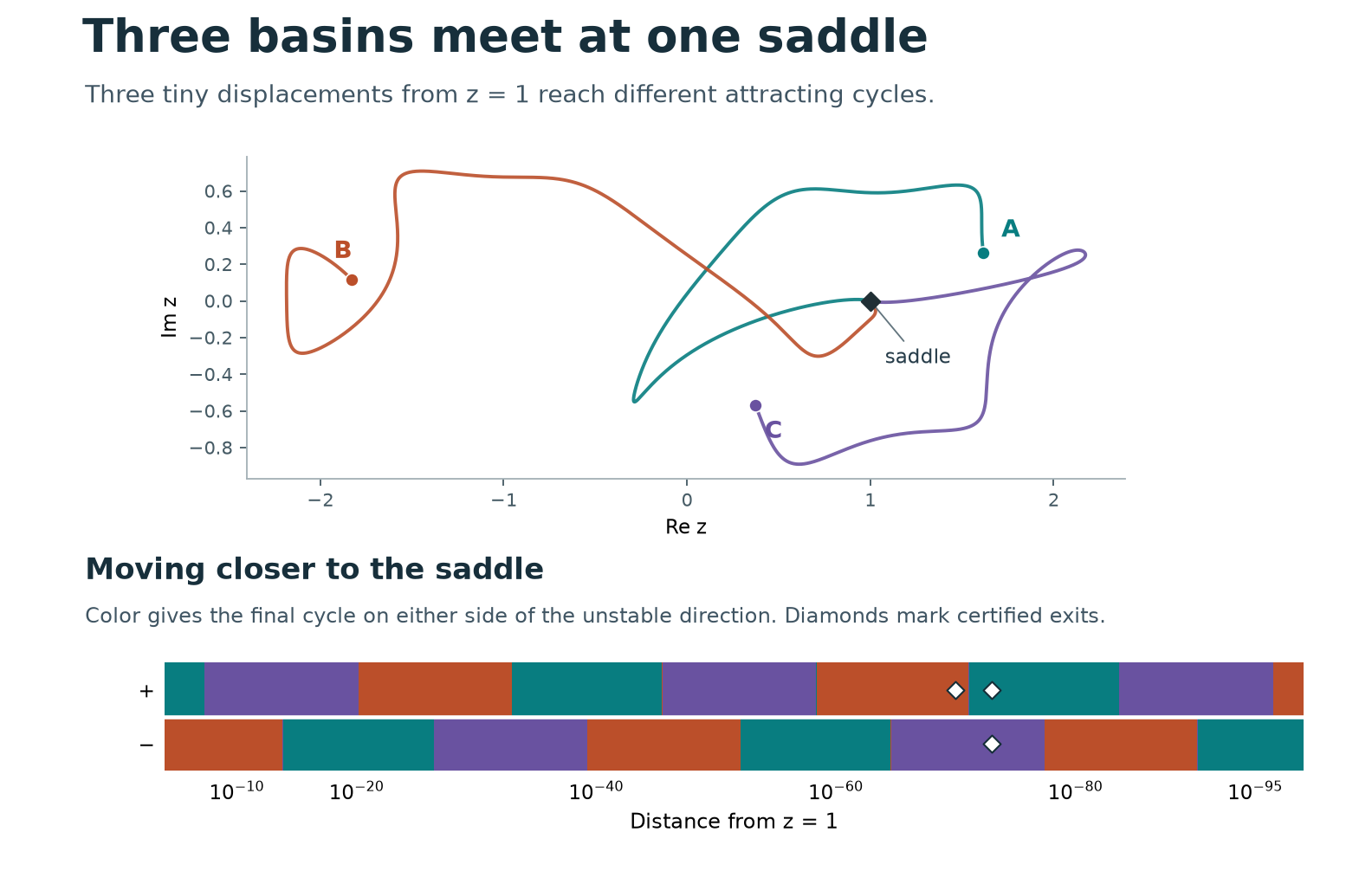
The curves show the fourth driving period for three initial displacements along the unstable direction. The strips show 3,802 numerical starts, using logarithmic distance on either side of the saddle. Halving the integration step preserved every label. The diamonds mark three rigorously enclosed exits. Whether all boundary points have this property (the Wada property) remains open. Kennedy and Yorke, Basins of Wada
Three exits at arbitrarily small scales
Write and let be the one-period map in this coordinate. Its derivative has a unit unstable eigenvector for a multiplier . For each signed scale below, interval integration sends an entire disk around inside the selected cycle's phase-zero trapping disk after four periods. The trapping radius is 0.0055.
| Cycle | Upper bound on the distance to its disk center | |
|---|---|---|
| A | 0.002513 | |
| C | ||
| B |
Set , and . On the disk , the estimates below give
For any , start at . Compare its first iterates with . An error gives . All these points stay inside the stated disk. The th iterate therefore lies within of , exactly the disk included in the four-period check. The starts tend to the saddle as grows. This proves the common-boundary claim.
The substitution exchanges the saddles. Reflecting each certified sink's half-period box places it back inside its own trapping disk, so the same three basins reach .
The same approximants converge to points of the unstable manifold by the geometric-series argument, applied in forward time. Each certified disk thus contains an unstable-manifold point in its assigned basin. The stable arc of this saddle crosses the entire height of the phase-zero passage box.
Local bounds
Take . On an upper bound on the logarithmic norm of the field derivative is . The root-mean-square of is . With , this gives . Initial states in stay in the -disk for one period by Grönwall's inequality, giving the Lipschitz bound.
On the same tube, the Hessian norm is at most . Variation of constants bounds the quadratic remainder by , since linear propagation from to the endpoint has norm at most and the state size at is at most . The verifier checks .
At the saddle the variational equation is , and the monodromy determinant is one by zero divergence there. The verifier encloses both columns by Taylor polynomials and bounds their defects in Euclidean norm, then encloses the expanding eigenvalue and its normalized eigenvector. Forward integration of the three disks uses the same interval flow enclosure as the periodic-orbit proof.
python research/shape_search_20261121/frontiers/cubic/saddle_basins.py --out certificate.json
python results/cubic-saddle-basins/figure.py certificate.json basin-exits.png
To reproduce the two-dimensional map, choose a cache path outside the repository. The compute step uses an FP64 OpenCL device. Rendering includes the SciPy cross-check.
python research/shape_search_20261121/frontiers/cubic/basin_portrait.py compute ../basin-grids.npz
python research/shape_search_20261121/frontiers/cubic/basin_portrait.py render ../basin-grids.npz