A straight ray and a surface-wide average
After the same 62.52 units of travel, initially parallel rays can have vastly different transverse separation. On the fifteen-handle surface at , one straight geodesic amplifies an infinitesimal separation by more than . The geometric mean over uniform positions and headings is less than for every . The sample median at this setting was about .
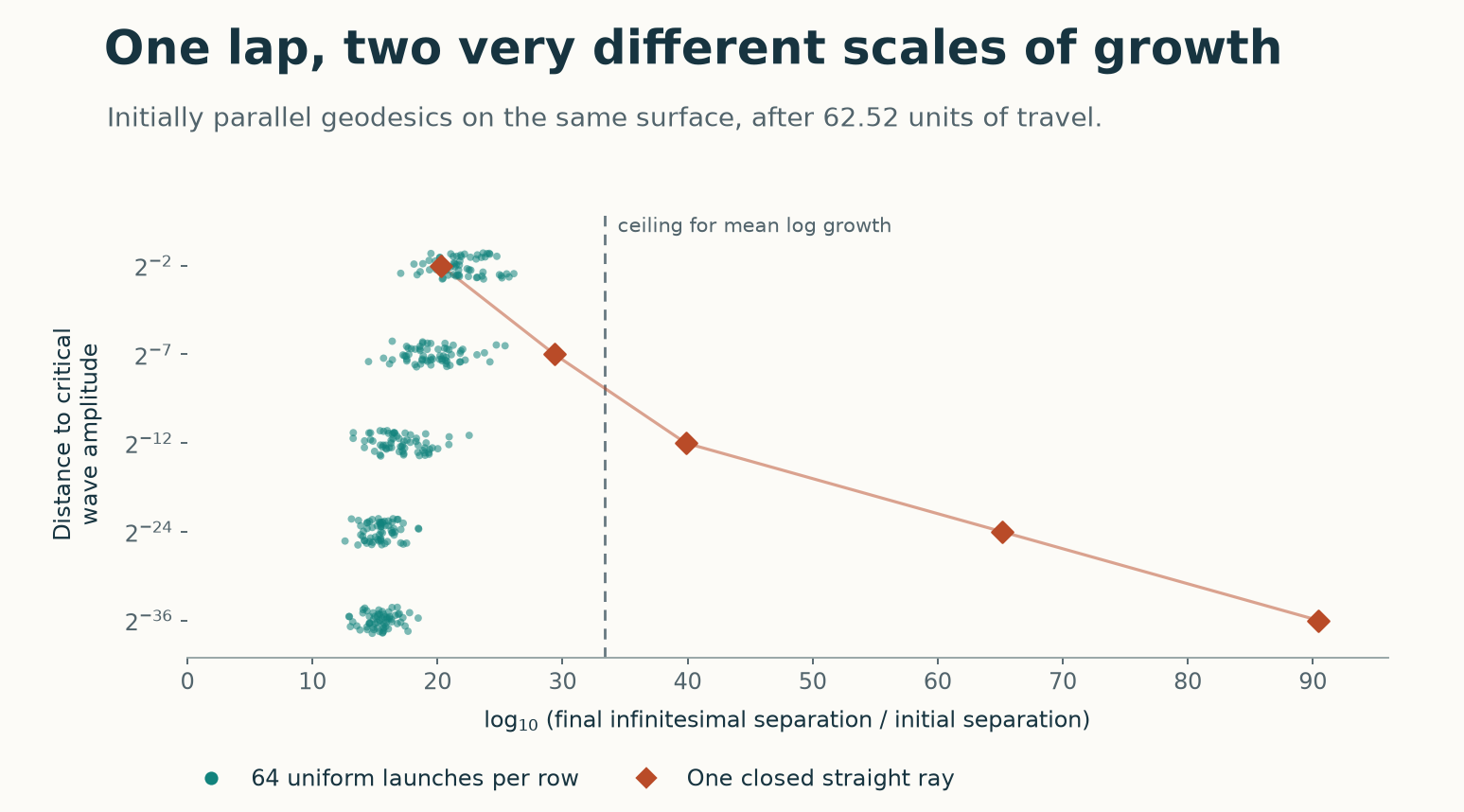
The surface is in the flat three-torus. The observation length is one lap of the closed straight ray. Every launch uses the same transverse Jacobi data .
The uniform bound. Gaussian curvature is nonpositive. Indeed, with , and , the curvature numerator divided by is , positive definite under the strict triangle inequalities. Thus and . The unit-speed flow preserves Liouville probability. Gauss–Bonnet on the genus-fifteen surface gives . Integrating the Riccati equation and using Cauchy–Schwarz gives a finite-time bound,
The projection onto has fourteen preimages wherever . The checker integrates a common subset of these projections for the full parameter interval. For it retains and uses quadrant symmetry. Outward-rounded bounds on 4,096 cells give area greater than 116.2557 and the dotted-line bound in decimal units.
The straight ray. Its Jacobi coefficient is reflection-symmetric about a principal axis of the normal ellipse. Starting at that phase gives equal diagonal entries in the one-lap transfer matrix. Thus for the certified expanding multiplier. Its divergence as gives an unbounded gap at fixed travel distance.
The dots. Each row uses two independent sets of 32 uniform positions and headings. Intersection sampling along coordinate lines is corrected for the surface normal. The cohorts use different solver tolerances. A separate short integration checks the scalar Jacobi equation against curvature computed directly from the ambient Hessian. Measurements and bounds · Reproduce the experiment
Kuznetsov studied geodesic chaos on a three-cosine surface. The Riccati argument follows the classical relation between average curvature and growth of geodesics. Katok, Entropy and closed geodesics
python research/geodesic_typical.py --out results/geodesic-typical-growth