Three periodic routes through eight motor orientations
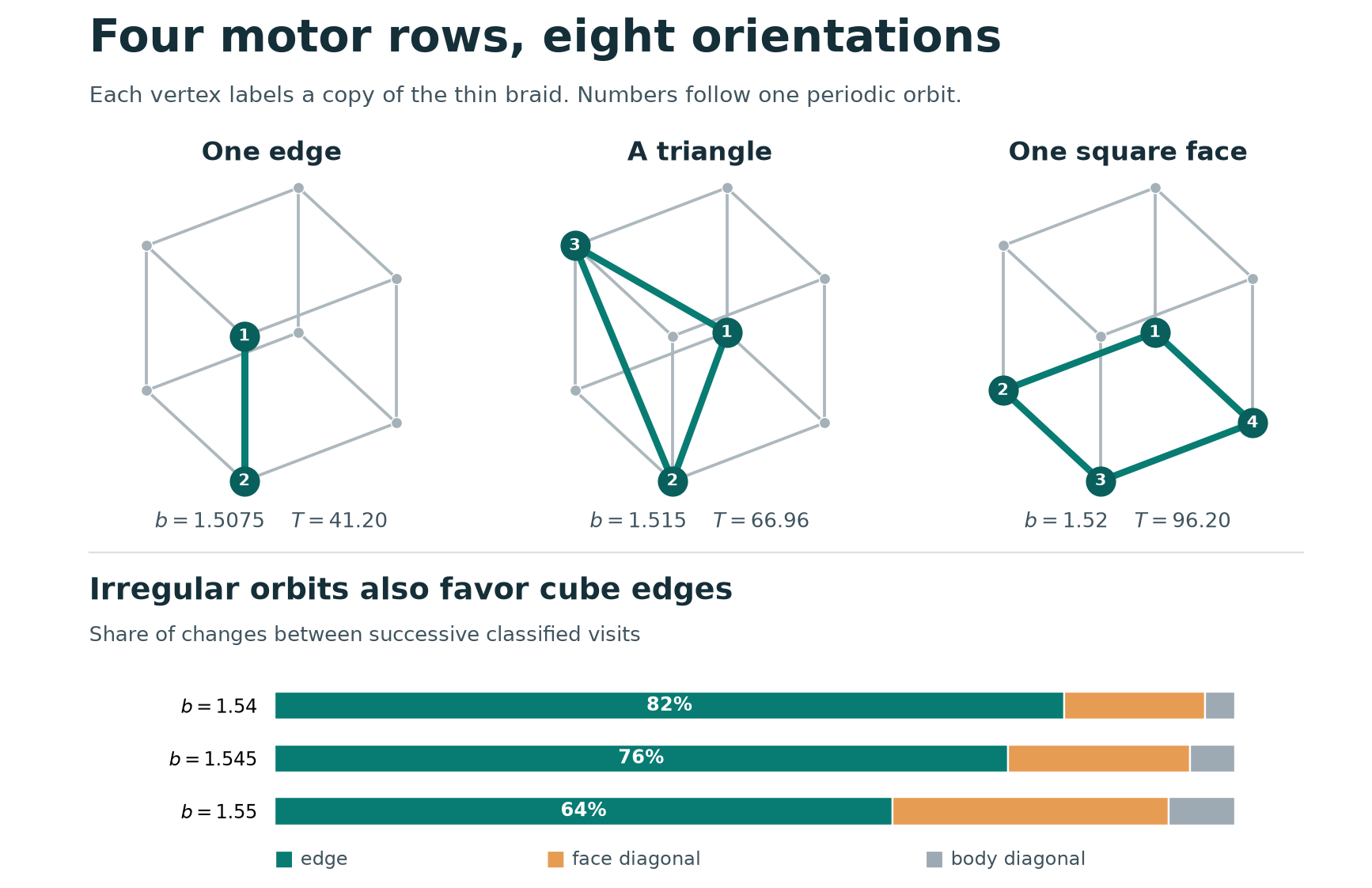
Changing one coefficient in the four-row motor equations selects three numerically attracting cycles. Two rows exchange roles after half a period in the first cycle. Three rows rotate roles every third of a period in the second, and all four every quarter-period in the third. A second integration of the original force equations recovers each relabeling within 6 × 10⁻¹¹ in every coordinate.
| Rate asymmetry | Route | Period | Largest transverse multiplier modulus |
|---|---|---|---|
| 1.5075 | Edge and back | 41.19809 | 0.53730 |
| 1.515 | Triangle of face diagonals | 66.95911 | 0.69685 |
| 1.52 | Square face | 96.20199 | 0.50701 |
How to read the cube. At , 32 independent starts gave eight orientations of a thin braid. The four body diagonals stand for the four possible distinguished rows. Their two ends distinguish even and odd relabelings of a reference braid. The cube records which orientation a trajectory visits next. The equation has eleven independent state coordinates.
Which visits count? Sample each upward crossing of mean cosine occupancy zero. Compare its full state with the eight permuted reference clouds, using the scaled physical metric fixed at . Keep the closest label when its distance is below 0.075 and the runner-up is over twice as far. Repeated labels count as one visit. All 3,441 held-out crossings of the reference braid keep one label.
The three periodic routes persist across three section levels and three separation thresholds. In the three 60,000-unit irregular histories, all eight labels recur. Cube edges account for 1,232/1,498, 785/1,028 and 385/598 label changes. The classifier retained 10.3%, 4.9% and 2.4% of crossings, respectively. Unclassified intervals can hide intermediate visits. The bifurcation connecting these regimes remains open.
Reproduce
The fixed parameters are and . The two-direction scout selected the three periodic windows after 34 runs. Cycle states, two starts per window and full-state checks reproduce the orbits above. Archived DOP853 histories and independent RK4 runs at step 0.01 and step 0.005 include section and threshold controls.
python research/motor_symmetry_passages.py --step .01 --output comparison.json
python research/motor_symmetry_cycles.py --scout --output selection.json
python research/motor_symmetry_cycles.py --output cycles.json
python research/motor_symmetry_figure.py results/motor-symmetry-passages
The original model is due to Alouges et al.. Chossat and Golubitsky studied symmetry-increasing bifurcations of chaotic attractors. Haugland and Krischer connected differently symmetric solutions in four coupled oscillators.