Seven coexisting cycles in the Case 180844 angular flow
Two branches of asymmetric period-two orbits meet near axial coefficient −0.356574826410. One branch has a stable interval ending in a period doubling near −0.356571312071. The interval is about 3.51434 × 10⁻⁶ wide. Seven symmetry-related cycles are numerically attracting inside it. The seven rotating-frame nodes stay separated at the turn, with a maximum distance of 0.04732 from their centroid. The branch curvature, unit multiplier and change of stability support a numerical saddle-node interpretation. The separate symmetric orbit remains unstable at the sampled interior coefficient. Event refinements · Continuation · Independent Poincaré sections
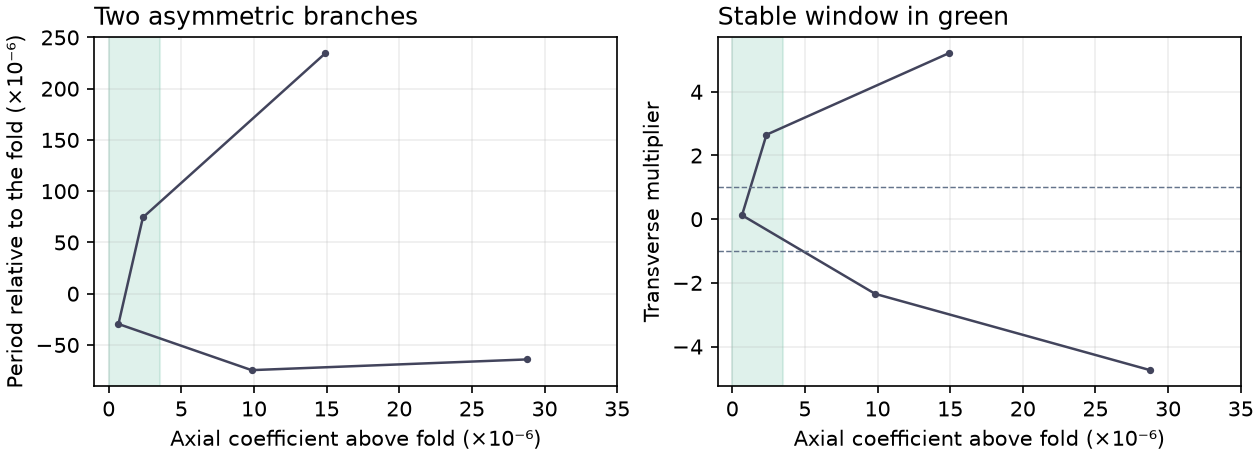
| Axial coefficient or event | Period | Dominant transverse multiplier |
|---|---|---|
| Saddle-node, −0.356574826410 | 53.37208 | +1 |
| Attracting orbit, −0.356572981504 | 53.37204 | −0.45000 |
| Unstable partner at the same coefficient | 53.37215 | +2.46156 |
| Symmetric orbit at the same coefficient | 53.37873 | −48.36367 |
| Unstable partner at the original chaotic coefficient, −0.353834134784 | 53.38447 | −210.74352 |
At the interior sample, all 28 tested perturbations returned within 1.25 × 10⁻⁶ RMS of some family member. Ten returned to the starting copy. The trials covered seven rotations, two initial displacement radii and two RK4 steps. Every pair of positive y = 0 section sets had a nonzero Hausdorff distance. The smallest was 0.00387 in native coordinates. State-only DOP853 and RK45 section derivatives at a displacement of 10⁻⁷ RMS gave multipliers −0.450003 and −0.450012. Basin tests · Section checks
Two other initial states at exactly this coefficient retained positive growth in all fifteen windows of 4,000 time units. An independent adaptive integration of one start gave a spectrum of (0.03977, 0.00165, −1.88706). A third start gave regular dynamics in one of the long replays. Initial conditions and step size matter for assigning a basin in this narrow interval. The finite-time calculations leave asymptotic chaotic attraction unresolved. Long runs and adaptive spectrum · Matched-step replays
At the original chaotic coefficient, the unstable partner has seven distinct rotations. Two solvers give a minimum pairwise section-set Hausdorff distance of 0.00416. Its period and multiplier differ from both the seven earlier asymmetric copies (+220.09) and the symmetric order-two orbit (−236.51). Including the earlier order-one, order-four, order-eight and order-sixteen cores gives numerical evidence for at least 19 distinct periodic orbits at the same parameters. The registry stores one representative per new rotational family. Cloud registry · Earlier symmetry controls
Period doubling
At an axial coefficient 10⁻⁷ above the asymmetric flip, direct integration and independent shooting gave a period-four daughter with period 106.74405 and multiplier +0.88635. The cloud and diagnostics include the fractional-period test and the full return residual. Post-flip trials
The symmetric main cascade also continues beyond the 16T stage. At axial coefficient approximately −0.3574933891, the order-sixteen orbit passes a transverse multiplier of −1. At −0.357491110988 the next attracting orbit has period 853.85685 and multiplier +0.34439. A state-only RK45 control closed the rotated sector to 2.1 × 10⁻¹¹ native units. The order-thirty-two trace contains 65,536 native points. The smallest all-phase separation for a candidate repeated traversal occurred at half its period and was 0.00179 orbit RMS. 32T continuation and orbit
The order-thirty-two branch then crosses −1 near coefficient −0.35746338265. At −0.357462927026, its attracting order-sixty-four daughter has period 1707.71796, dominant multiplier +0.37162, a DOP853 sector closure of 4.32 × 10⁻¹² and an independent RK45 closure of 6.80 × 10⁻¹¹. The most competitive repeated-traversal test was again half the period, with a maximum 19-phase separation of 0.0005614 orbit RMS. The 65,536-point cloud replayed bit for bit. 64T continuation, controls and cloud reference
Equations and checks
All runs use the same angular-resonance equation and coefficient ordering as the earlier study. Only the ninth coefficient, the axial drive, varies. The continuation coordinate f is related to that coefficient by e = −0.4297716347835525 + 0.0759375 f. For seven rotating-frame nodes and one fixed coordinate section, the shooting equations are
Here R rotates by 8π/7, and the seven nodes are independent unknowns on the asymmetric branch. A symmetric branch needs one node. Pseudo-arclength continuation follows the curve around the parameter turn. The state transition matrix and coefficient derivative are integrated over each sector. Independent Poincaré maps use state-only event localization near one full period and two mutually perpendicular transverse displacements. Two event refinements used relative solver tolerances of 8 × 10⁻¹¹ and 9 × 10⁻¹³. Numerical convergence and the independent return estimates support the bifurcation interpretation. Rigorous smooth-orbit and basin enclosures remain open. Earlier equation · Source code
Reproduction
$flow = 'research/shape_search_20261121/extension/flows'
$packet = 'results/shape_search_20261121/extension/flows'
python "$flow/replay.py" --manifest "$packet/manifest.json" --id stable --out D:/attractor-replay/seven-stable.npz
python "$flow/replay.py" --manifest "$packet/manifest.json" --id final_partner --out D:/attractor-replay/partner.npz
python "$flow/replay.py" --manifest "$packet/manifest.json" --id coexisting_chaotic_cloud --out D:/attractor-replay/second-basin.npz
python "$flow/replay.py" --manifest "$packet/manifest.json" --id period_32 --out D:/attractor-replay/order-32.npz
Each registered case has a cloud-relative cache location, SHA-256, coefficients, initial state or sector nodes, and a reconstruction method. The NPZ files contain an N × 3 float64 array named points. All relative cloud locations resolve from the campaign cache root. Branch identifiers refer to the Case 180844 parameter path. Individual physical coefficients are recorded with each cloud.