Homoclinic-tangency hypotheses and partial formal verification
Abstract
We examine whether the quadratic homoclinic tangency certified near β = 14.30635909996146, at α = 9, m₀ = −8/7 and m₁ = −5/7, supports an application of the parameter version of the Newhouse–Robinson theorem. The local numerical hypotheses reproduce at 80 and 100 decimal working digits. The subsequent localization proof confines the generated sinks and all their intermediate returns to the Chua domain. Infinite simultaneous coexistence is now a theorem consequence of the interval hypotheses and that analytical argument. This audit continues to distinguish it from the smaller Lean-verified statements.
A separate Lean formalization proves that four boundary-sign conditions imply an interior stationary zero of a continuous function with the stated derivatives. It also verifies ten rational graph-transform inequalities. The Chua interval evaluator, invariant-manifold construction and Newhouse–Robinson theorem remain outside this formalization.
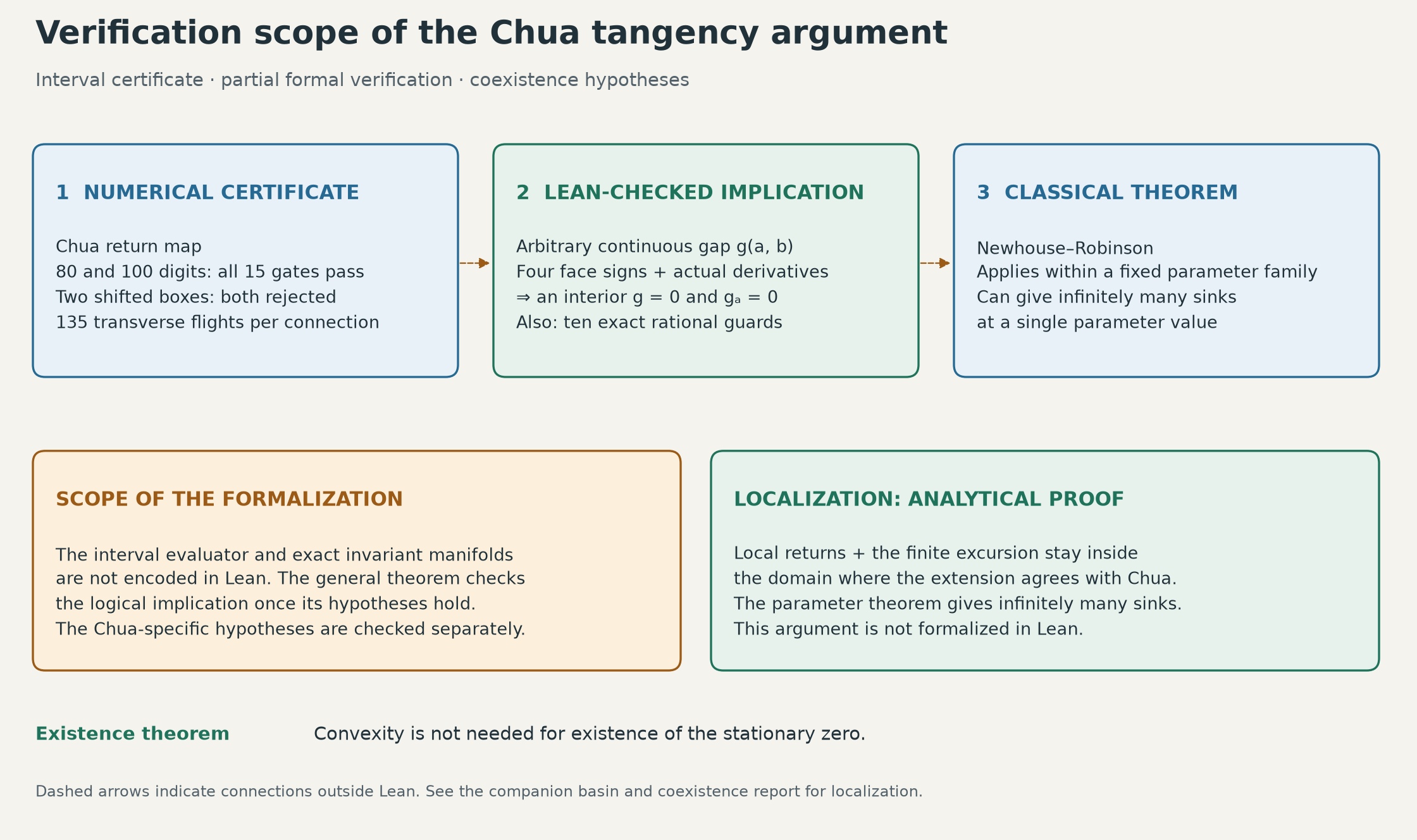
Figure 1. Dependencies of the numerical, formal and classical arguments. Dashed arrows indicate connections not verified in Lean. Localization is established analytically in the companion report.
1. Window accumulation and simultaneous coexistence
The cascade report concerns infinitely many attracting windows at different parameter values. That statement alone does not imply coexistence: an infinite collection of intervals can be pairwise disjoint.
The stronger question is whether, for every sufficiently small neighborhood of the tangency parameter, some single β in that neighborhood supports infinitely many distinct attracting periodic orbits. The β may depend on the neighborhood. It need not equal the tangency parameter, and the theorem does not identify it by a finite decimal expansion.
The parameter version of the Newhouse–Robinson theorem is the appropriate result. For a sufficiently smooth family of surface diffeomorphisms, a generically unfolding quadratic homoclinic tangency of a dissipative saddle produces nearby parameter intervals with infinitely many simultaneous sinks on a dense set of parameters. Thus the theorem is stronger than an arbitrary perturbation in the space of all maps. See Robinson (1983) and the explicit formulation in Theorem 2.6 of the Catsigeras–Cerminara–Enrich author manuscript, p. 6, subsequently published in DCDS.
The cited formulation uses diffeomorphisms of a compact surface. Its density statement is not a statement of positive probability under random parameter sampling. Neither that statement nor our audit provides a finite scan guaranteed to find a parameter with infinitely many sinks.
2. Hypothesis audit
Write H for the sign-reduced half return and P = H² for the ordinary upward first return. The numerical values below were recomputed from the certificate. The full records are in numerical-audit.json.
| Requirement | Chua evidence or argument | Status |
|---|---|---|
| A fixed one-parameter family | Only β varies; α = 9, m₀ = −8/7, m₁ = −5/7, γ = 0 | Exact specification |
| A smooth family near the relevant orbit | Affine matrix-exponential flights, transverse event equations, fixed admissible itineraries | Analytical argument using interval path checks |
| A continued saddle | Uniform Krawczyk inclusion and derivative bounds | Interval checks pass |
| Positive saddle multipliers for P | Unstable in [2.7134317828, 2.7134317831]; stable in [1.02745 × 10⁻⁹, 1.02747 × 10⁻⁹] | Interval checks pass |
| Dissipation at the saddle | det DP in [2.78792 × 10⁻⁹, 2.78794 × 10⁻⁹], strictly between zero and one | Interval checks pass |
| An actual homoclinic excursion | Exact invariant-graph bounds, 27 half returns, departure from the local square, endpoint on the stable graph | Computer-assisted argument in the existing report |
| Quadratic contact | Normal second derivative in [2.0956 × 10¹³, 2.1447 × 10¹³] | Interval checks pass |
| Nonzero parameter unfolding | Normal parameter derivative in [3.3728, 3.3731] | Interval checks pass |
| Contact for P, rather than only H | Append one local H iterate: H²⁸ = P¹⁴; a local diffeomorphism preserves contact order and nonzero unfolding | Analytical argument |
| The theorem's domain and localization of its sinks | The implemented return is defined on certified neighborhoods, not on an entire compact surface | Analytical localization proof |
| Attracting map cycles correspond to attracting flow cycles | A periodic first-return sink gives a stable periodic flow orbit, provided every return stays in the valid domain | Follows with the completed localization argument |
Both 80- and 100-digit runs pass all 15 final gates, all local gates and all graph-transform guards. Each global connection covers 135 flights and 12,534 accepted time cells. Shifting the box by +10⁻¹⁰ or −10⁻¹⁰ fails the required parameter-face sign, as expected. A rejected box is not a proof that no other tangency exists nearby.
Local regularity of the return map
The vector field is continuous and piecewise affine, with derivative jumps at x = ±1. A global smooth-flow theorem cannot simply be applied to that field.
On each flight, however, the solution is an analytic matrix-exponential expression. The crossing time is an analytic implicit function when the crossing speed is nonzero. Composition along a fixed transverse itinerary therefore gives an analytic event map on an open neighborhood. The certificate checks the itinerary for complete time intervals, including endpoint collars. Reversing the flights gives a local inverse. This supplies the needed local smoothness without claiming that the entire Chua flow is globally smooth.
Localization of the generated sinks
The earlier audit left this obligation open because its numerical checks concern local return branches. The companion proof, §3, now supplies the missing argument. It constructs a compact extension of the return-map germ and tracks the local-return and finite-excursion domains used in the parameter theorem. Every intermediate iterate of every generated sink remains in the region of agreement. The extension therefore introduces no extra orbit into the Chua conclusion.
This yields parameters arbitrarily close to the certified tangency with infinitely many simultaneous attracting flow cycles. The value need not equal the tangency parameter. Neither a specific decimal witness nor a probability under random sampling is supplied. The numerical audit files retain their earlier conditional status as historical records; the current application audit states the completed argument's dependencies.
This report assesses the application of established homoclinic-tangency theory to the explicit certificate in this repository. Historical priority for the parameter-specific result has not been established.
3. Statements verified in Lean
The source is TangencyBox.lean. Its central theorem, ChuaProof.tangency_box, takes an arbitrary real function g(a,b), continuous on a closed rectangle, and an actual state derivative gₐ. Its four uniform sign assumptions are:
It proves the existence of an interior pair satisfying
The proof minimizes g over the compact state interval. The minimum depends continuously on b and changes sign between the parameter faces. A minimizer at the zero cannot lie on either state boundary because of the derivative signs. Fermat's theorem then gives the zero state derivative. The witness is obtained from these hypotheses within the formal proof.
An additional theorem, quadratic_contact, includes the actual second state derivative and parameter derivative, positive throughout the rectangle. The same interior witness has positive curvature and nonzero parameter derivative. The HasDerivAt hypotheses specify their relation to g.
Strict convexity is not required for this existence argument. It can be used in a separate uniqueness argument; uniqueness of the tangency is outside the present formalization.
Guards.lean also proves the ten rational graph-transform inequalities with the exact published constants. This checks the arithmetic of those guards, not the graph-transform construction or the bounds on the actual Chua map.
4. Scope of formal verification
| Part | Checked by Lean? |
|---|---|
| Four face signs imply an interior stationary zero | Yes |
| Positive curvature and parameter derivative at that witness, under the stated derivative hypotheses | Yes |
| Exact rational graph-transform guard inequalities | Yes |
| Construction and smoothness of the exact Chua invariant manifolds | No |
| Matrix-exponential enclosures, event times, jets and all-time itinerary checks | No; executable Python/FLINT certificate |
| The connection between the interval output and the hypotheses of the Lean theorem | No |
| Newhouse–Robinson and the completed analytical localization | No |
The formal check record records the toolchain, source hashes, build result and transitive axiom dependencies. Accepted dependencies are Lean's standard propext, Classical.choice and Quot.sound. The checker rejects additional axioms and incomplete proof placeholders. The formalization is limited to the statements listed in the table; infinite coexistence is not a Lean-verified conclusion.
Reproduction commands and the exact pinned dependency revisions are in formal/README.md. The numerical checks and argument diagram can be reproduced using the evidence guide.