Well switching at large α in Chua’s circuit
Can the stability of a periodically forced scalar equation predict when the full circuit moves between wells? On the archived trajectory at , the answer depends on the direction of travel. The amplitude at the first turn spanning both wells came within 0.0046 of the frozen one-well fold on all 16 excursions. On the way back, the trajectory kept visiting both wells until its amplitude was 0.128–0.137 below the frozen central stability threshold. Large-parameter survey, row 2198
| Direction | Threshold at frozen amplitude | Amplitude at start of first turn with the new itinerary |
|---|---|---|
| Negative well to both wells | 1.734219, one-well fold | 1.733354–1.738743 |
| Both wells to the negative well | 1.545278, central response changes stability | 1.408769–1.416786 |
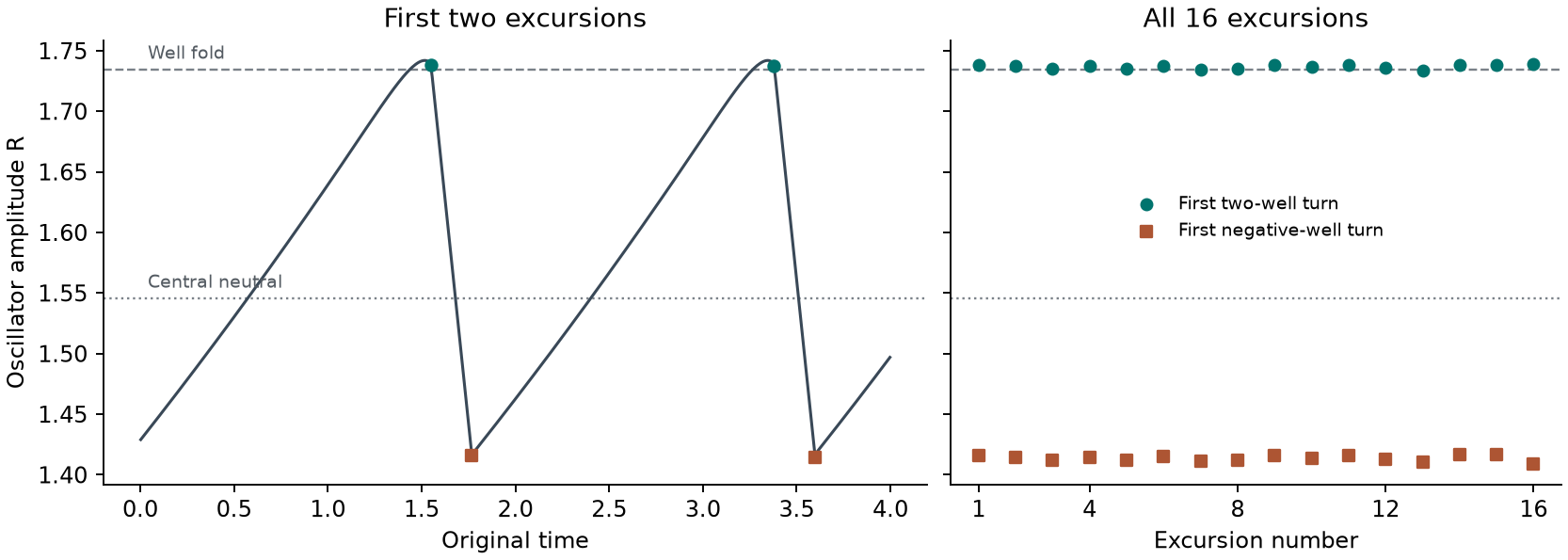
The two frozen thresholds
Write , and . In the limit , the oscillator amplitude is constant. The remaining equation is , with and . The slope of is inside the breakpoints and outside. The forcing period is . Scaling equations
Each threshold requires only two affine flights. For the half-wave symmetric response, follow to in time , then follow the positive outer branch back to at . Central inversion supplies the second half. For the positive-well response, both flights start and end at and . In either case the multiplier over the full period is
At this fixes . Each endpoint equation is linear in , giving the tabulated thresholds directly. The central response stabilizes as increases, with at the crossing. The one-well branch reaches a local maximum with and fixed-phase return derivative . Inversion gives the negative well the same fold. These derivative values are numerical evaluations of the matched affine solutions. Independent DOP853 integrations verified both crossing orders and closed to within . The same formula recovers the five archived central amplitudes from their independently integrated multipliers within .
What the full trajectory did
We took each complete interval between rising crossings in the 30-unit CPU record. A two-well turn visits both and . A negative-well turn visits and stays below . Of 3,686 turns, 433 visited both wells and 3,253 stayed on the negative side by this rule. Taking every fourth saved sample and requiring a 0.05 margin at the breakpoints preserved every label. Independent Radau integration of the two turns straddling each switch reproduced all 32 changes. The thresholds describe stability at fixed . Assigning the lower switching amplitude to a particular delay mechanism would require varying or the starting state.
Berkolaiko and Grinfeld studied coexisting responses in periodically forced bistable equations, including a three-segment example. Here the comparison is between the two thresholds for the atlas slopes and the switching amplitudes of one finite- trajectory. Earlier scalar bifurcation study, §4 and concluding remarks · All switch times, thresholds and controls
For controlled positive-well starts at eleven values of , the finite-rate fold study compares the section crossing and the first turn spanning both wells with two distinct delay predictions.
Regenerate the records and plot from the repository root with python research/chua_fiber_switching.py. Output goes to outputs/chua-fiber-switching/. Analysis script