Long transients just outside three Chua periodic windows
How long can motion look periodic after a stable cycle has disappeared? We initialized a trajectory at the entrance to each of three saddle-node bottlenecks. At a distance of window widths beyond each fold, passage took 1,522 to 3,599 model time units. The original atlas survey discarded 300 units and measured four consecutive 200-unit windows. A single local passage can therefore outlast the entire survey run. Original scan settings and starts · GPU integration schedule · Fold continuation
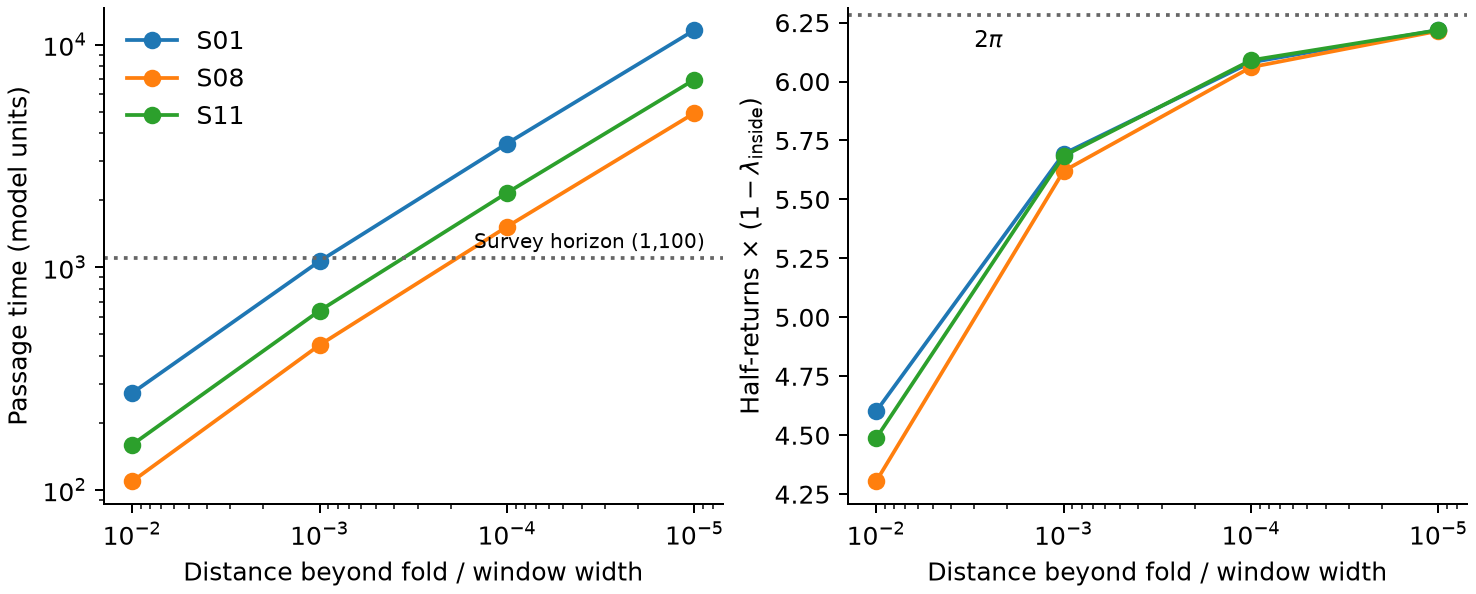
Three folds on the classical slice
Fix , , and . Each row uses the same absolute offset . A half-return goes from an upward crossing of to the next downward crossing, followed by central inversion. The time column sums the actual flight times. The last column is a prediction from derivatives at the fold.
| Family | Peaks per full cycle | Fold | Half-returns to exit | Elapsed model time | Predicted half-returns |
|---|---|---|---|---|---|
| S01 | 9 | 14.2599633533 | 25 | 295.94 | 25.13 |
| S08 | 5 | 14.3306519686 | 324 | 1,767.98 | 324.17 |
| S11 | 5 | 14.3595337664 | 203 | 1,471.98 | 202.19 |
Predicting the delay
Let denote the signed half-return at the fold point in section coordinates . Let and be its right and left unit-multiplier eigenvectors, with and . Define and , choosing the sign of so that . In the leading center dynamics give . Start at and count half-returns until , with . Integrating the leading drift gives
Across the table and twelve additional passages at , this predicts the count to within one half-return. Here is the fold-to-symmetry-breaking width of the symmetric branch. A second check uses the attracting half-return multiplier at the matching parameter . Since , the product should approach . At it is 6.215–6.219 across the three families. The return counts at that offset are 904–983.
An unsplit DOP853 integration agreed on the exit counts for all three families at . The records also give the derivative step checks, an independent 48-digit calculation of , and passages with narrower and wider gates. Data · Reproduction script
Do ordinary survey starts reach the bottleneck?
We also launched the three archived survey starts at each off-grid setting . We used DOP853 with relative tolerances and and a maximum step of 0.1. For S08 at , the start spent 769 and 795 of the 800 observation units, respectively, between successive crossings near the vanished cycle. Both endpoint crossings had to satisfy and . Other starts were sensitive to tolerance. For S01 at , gave 793 and zero units, respectively. These runs illustrate the difference between reaching a bottleneck and predicting a passage once inside.
The inverse-square-root delay at a saddle-node and experimental intermittency in Chua’s circuit are established. This calculation gives the coefficients and finite observation times for the three atlas folds. The long-time frequency of reinjection into these neighborhoods remains open. Pomeau and Manneville · Chua and Lin
From the repository root, run python research/chua_fold_passage.py with the CPU dependencies. The script writes to outputs/chua-fold-passage/.