When every bounded Chua trajectory approaches equilibrium
Which circuit parameters rule out sustained oscillations for every memoryless diode law? In the classical Chua circuit (), the exact answer is
This includes diodes with three equilibria. Outside the region one can construct a continuous piecewise-linear diode with an exact periodic orbit. The test below also covers nonnegative inductor loss. The slope-specific sector gives a complementary test when the slopes are known.
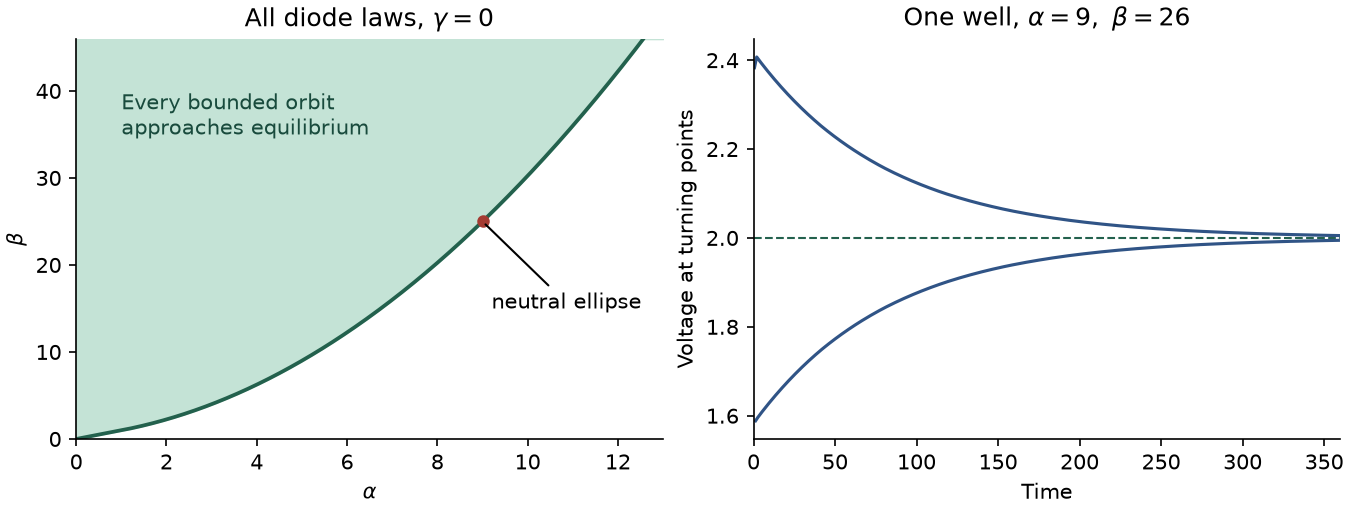
Left, the shaded region excludes bounded recurrent oscillations. Its boundary belongs to the region only for . Right, successive voltage maxima and minima approach from the initial state with diode slopes .
Run python research/chua_global_relaxation.py --classify 9 25 0 to test exact decimal or fractional inputs without integrating. Here it returns a periodic witness with and . At 9 19 1/4 it guarantees convergence to the equilibrium set for every bounded trajectory and every diode.
Criterion with inductor loss
Use , , , with , and locally Lipschitz . Set
Theorem. The parameters guarantee convergence of every bounded forward trajectory to the equilibrium set for all such if and only if for every . Equivalently, either and , or and . In this region isolated equilibria imply convergence to one point. All initial states give bounded trajectories when
For the atlas diode , with saturation at , suffices for this last condition.
Proof
Write , and . The change has determinant . Direct substitution gives
If , choose . In the included equality case take . Define with
Substitute into . Completing the square gives
The same algebra for the filter driven by gives equal to this right-hand side. Its free trajectories decay exponentially since . Integration to infinity therefore gives off the origin. In the equality case a zero integral would force , hence affine in time, and exponential decay forces .
On a bounded trajectory tends to a finite limit. It is constant on the compact invariant -limit set. In the strict case the identity gives there. In the equality case there, bounded forces , and then is constant. Bounded forces . Both cases leave only equilibria. The -limit set is connected, hence a singleton for isolated equilibria. Coercive makes proper with compact sublevel sets and thus bounds every trajectory.
For necessity, failure of the test gives a positive root of , since . Put , and . The linear subsystem maps a harmonic to with gain . Since , the root gives . Set on . Then , , solves the full equations with given by the gains . Any continuous piecewise-linear continuation outside the central segment preserves that orbit. Finally gives the classical region above.
Two uses in the atlas
Certifying a basin. At , . Thus prevents a voltage sign change and excludes convergence to the origin. For and the equilibria have . On , for . Each such start converges to the equilibrium of its sign.
Pruning the quadratic scan. On , , every excludes bounded oscillations for . Indeed this gives , also sufficient at . The classical test covers 160 of the 1,890 archived parameter tuples, accounting for 480 integrations and zero preliminary positive candidates. At the cutoff is . The remaining scaling question includes , outside this exclusion.
| Frozen check | Numerical outcome |
|---|---|
| Twelve starts, | All reached the predicted signed well within in maximum norm at . |
| Boundary , | Twelve periods of the exact ellipse of period . Largest sampled full-state error . |
| Three starts, , | All reached an equilibrium within at . |
The independent integration uses the original equations. Run python research/chua_global_relaxation.py with NumPy, SciPy, SymPy and Matplotlib. Predictions committed before the integrations · Numerical results · Generator
Related results
Chua and Huynh (§3.1) give the lossless imaginary-eigenvalue locus , . With , positive frequency requires . The supremum of over this interval gives precisely the lossless boundary above, including the change at . Escudero et al. (Eqs. 9–11) give for two distinct critical differential conductances. The storage identity establishes global convergence on the indicated side. Chua & Huynh (1992) · Escudero et al. (2024)
Brayton gave a necessary and sufficient condition on the linear part of a system with one memoryless nonlinear resistor for bounded global stability. The specialization here supplies the loss-dependent equality case, an explicit basin subset and a cutoff for the atlas scan. Martini et al. give a different sufficient nonoscillation condition for Chua's circuit using second additive compounds and slope bounds (§4.1). Brayton (1971) · Martini et al. (2025)