Layer, periodic orbit and knot type
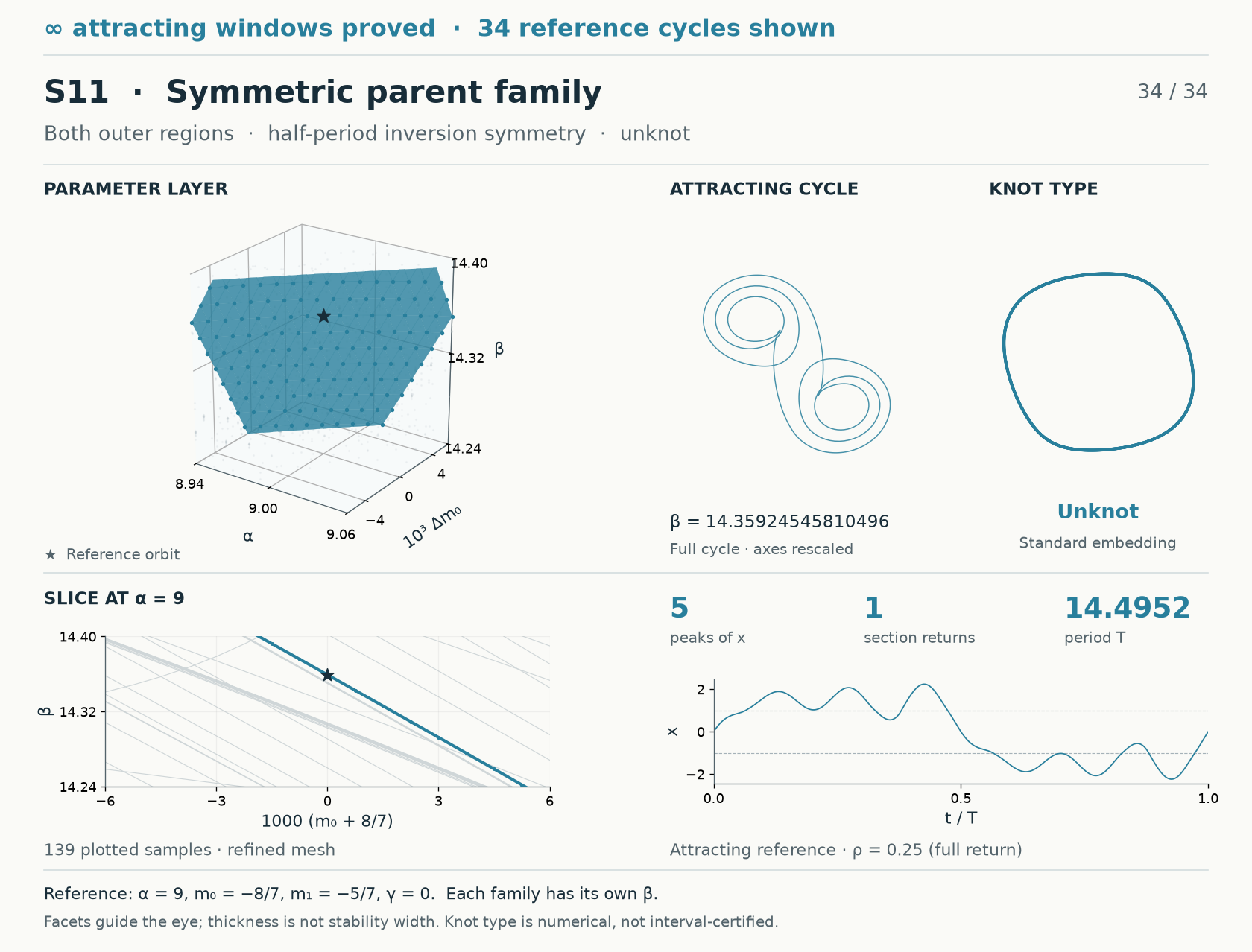
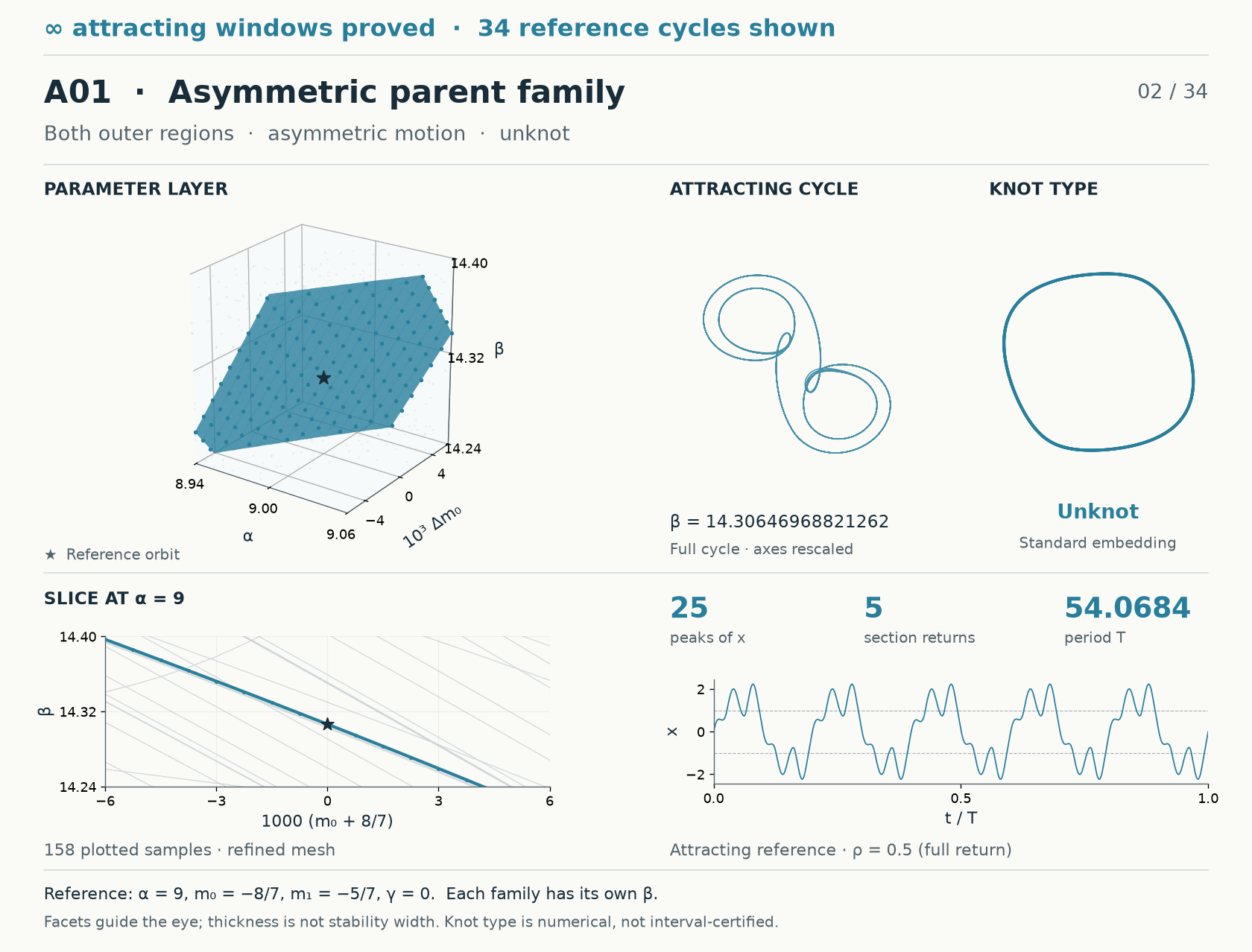
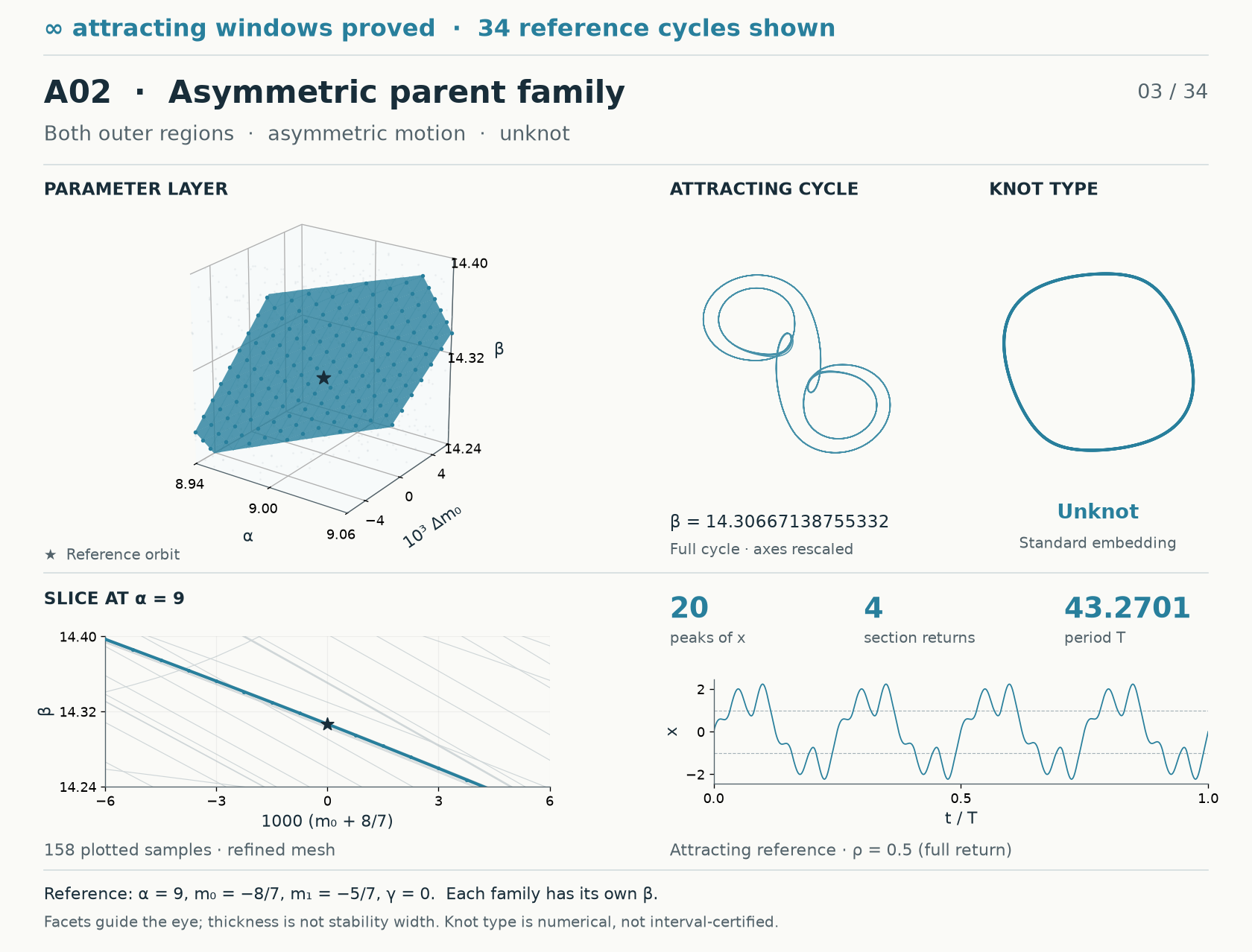
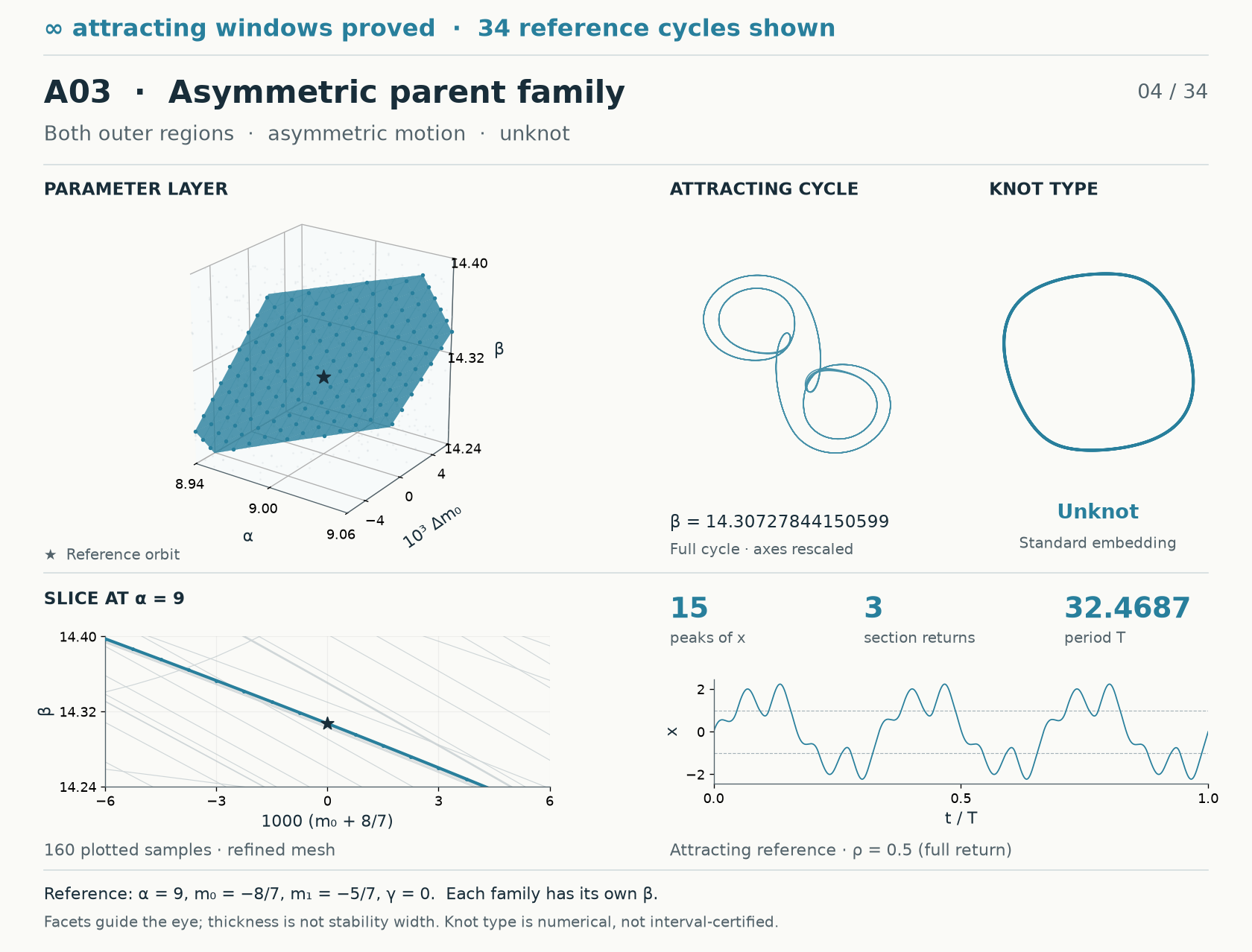
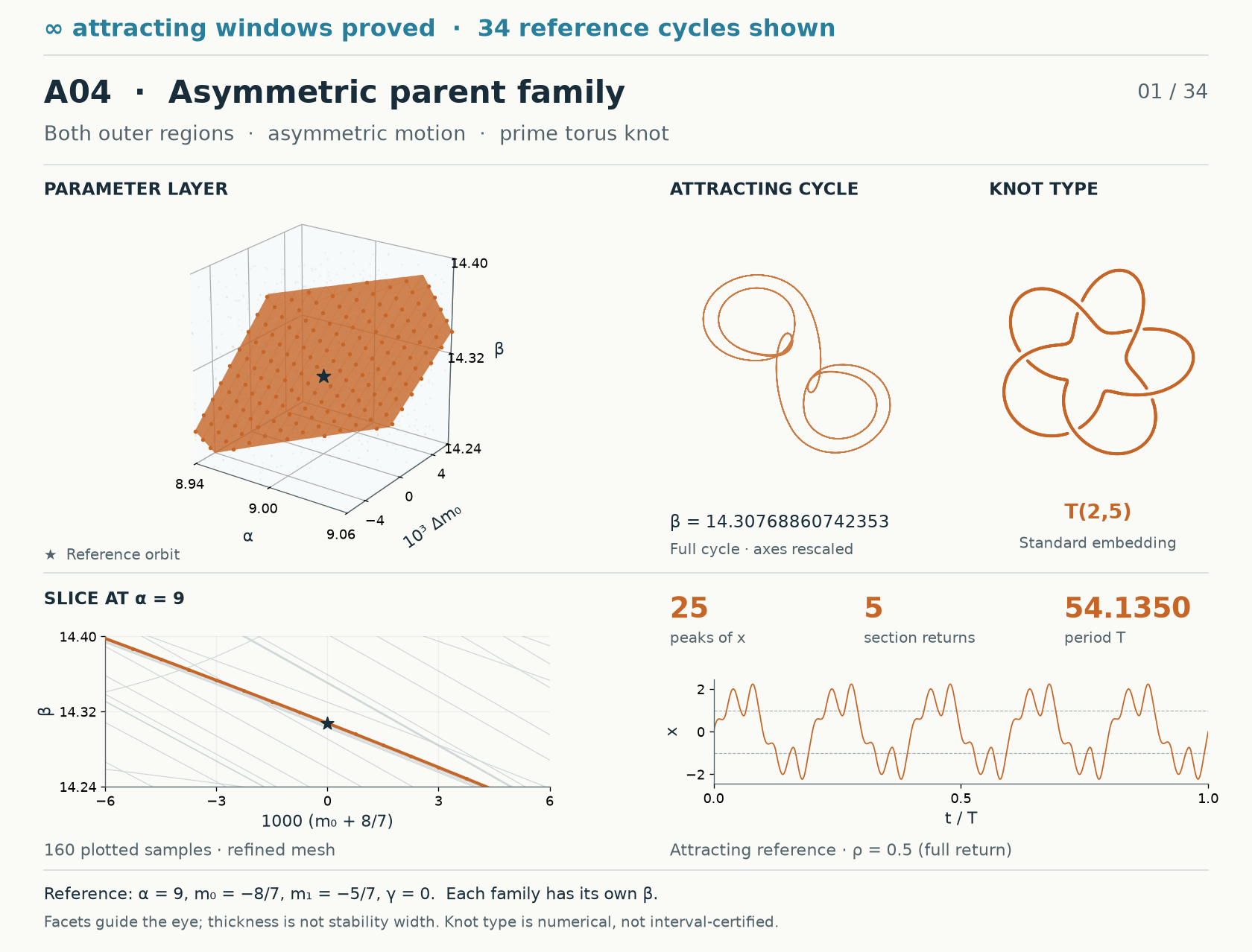
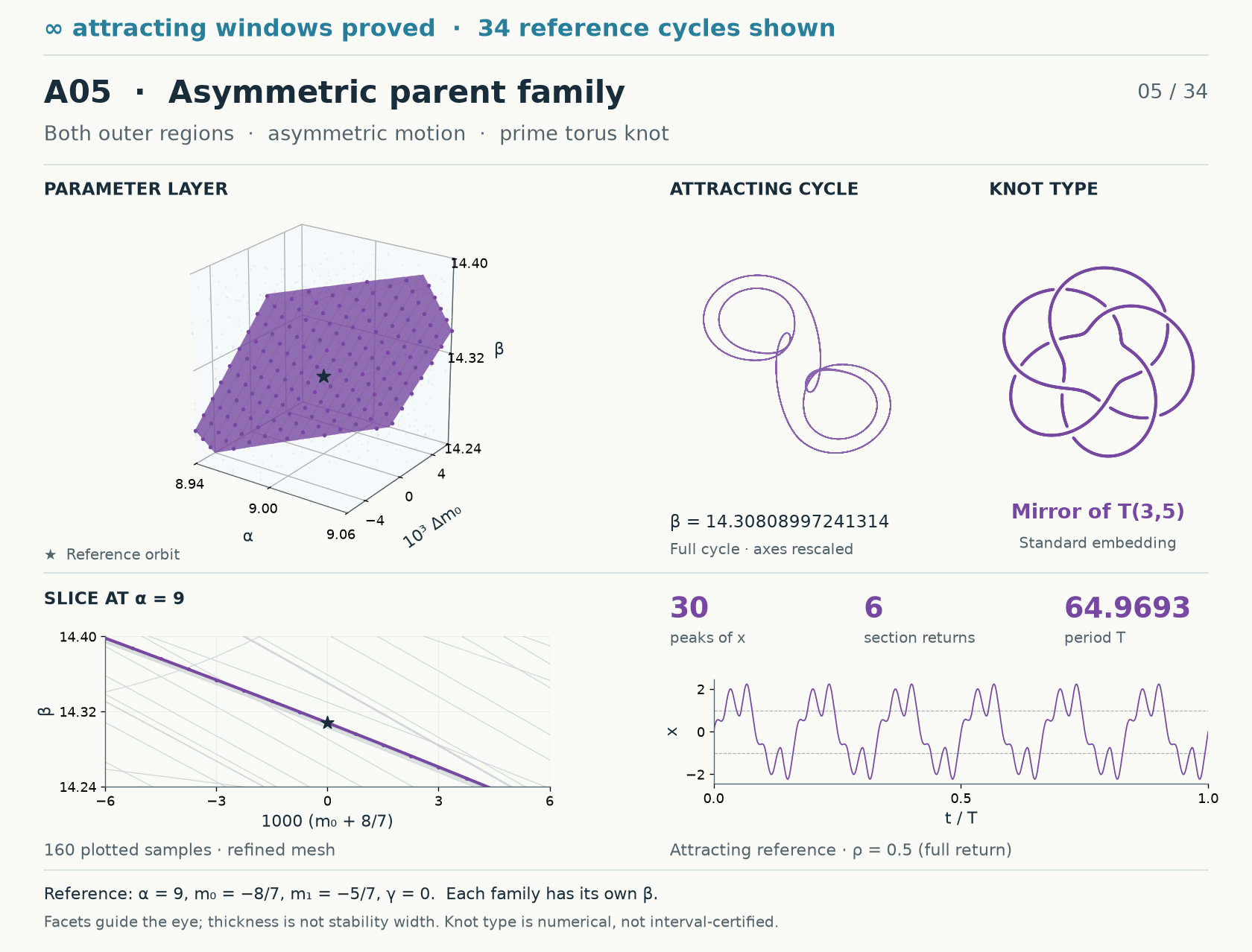
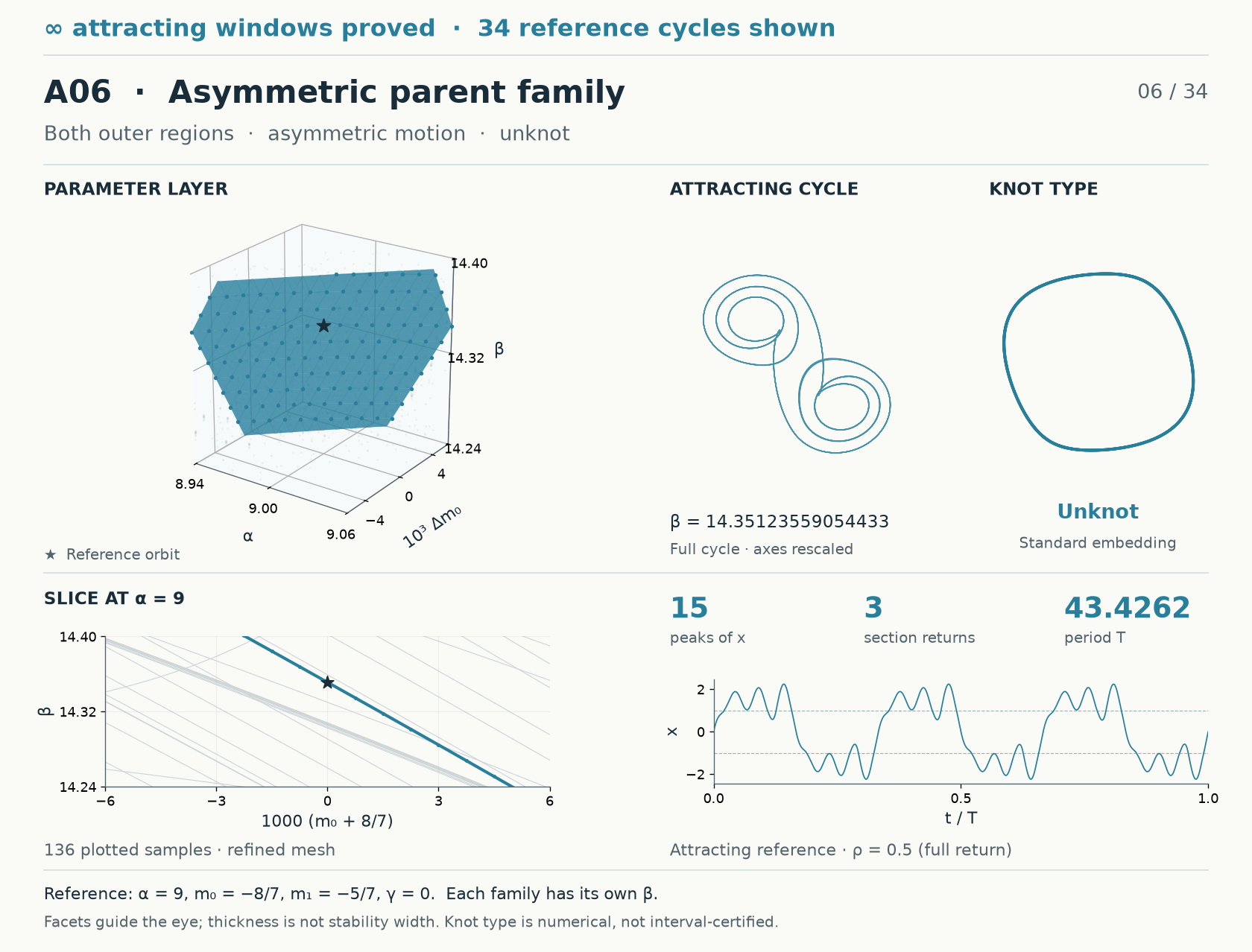
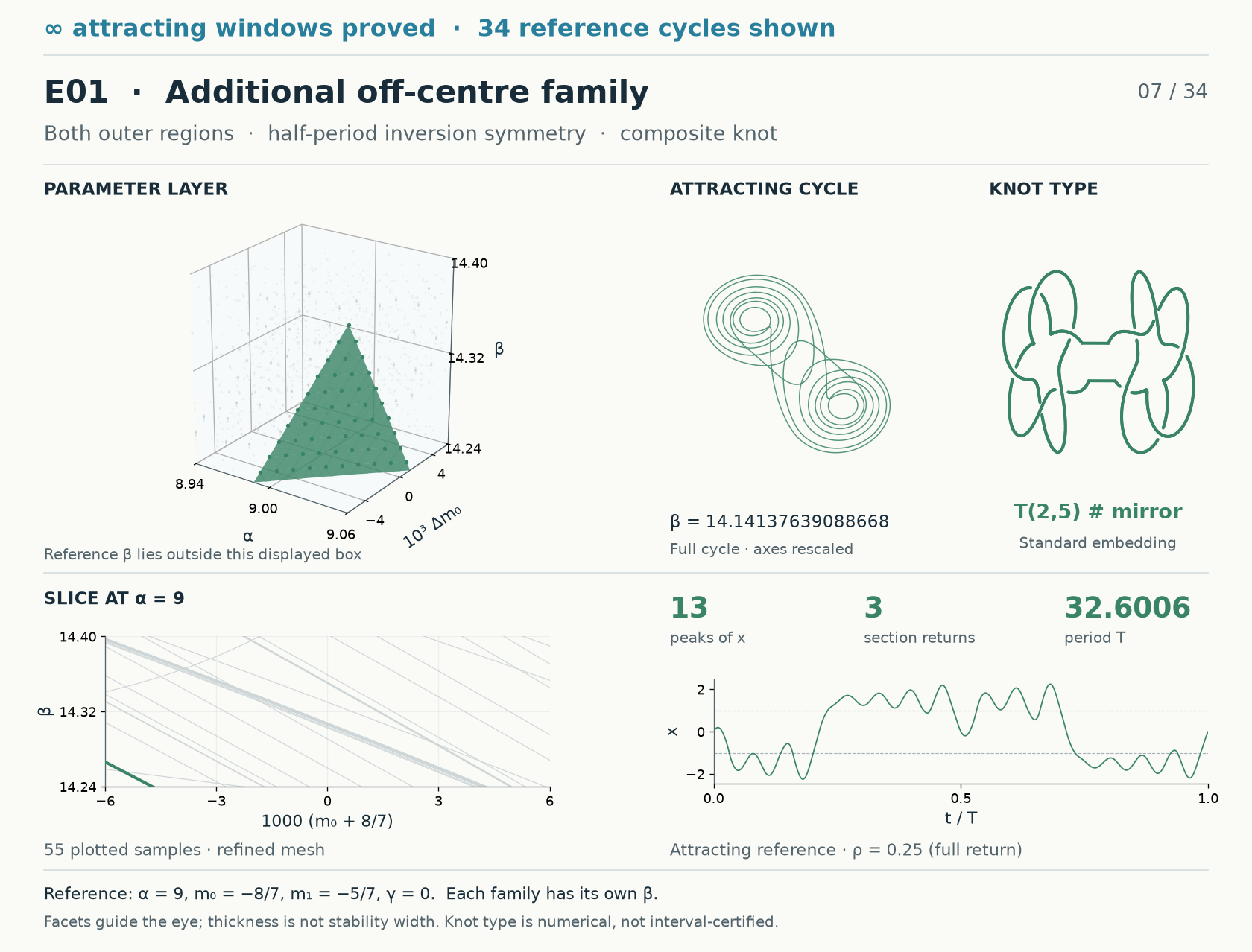
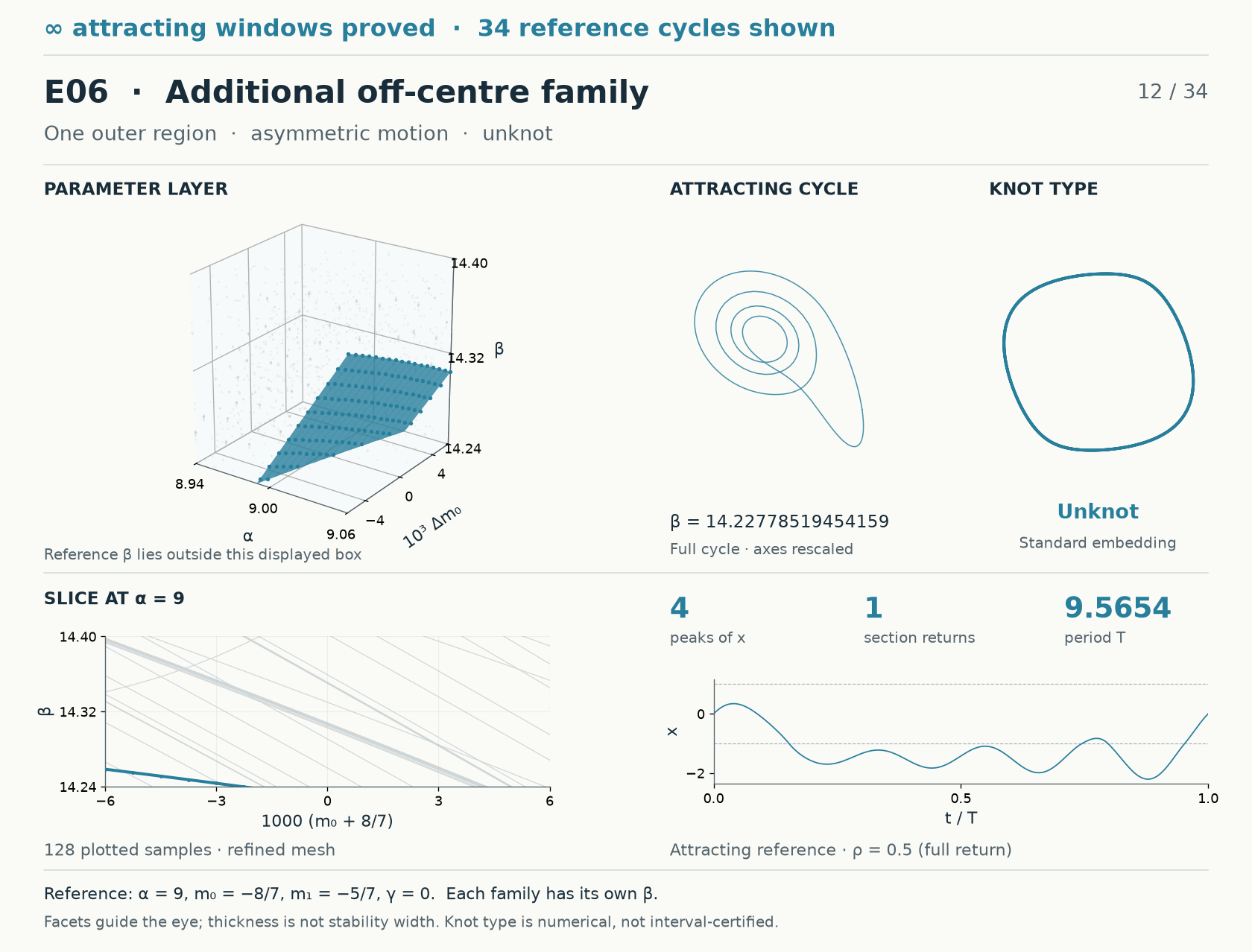
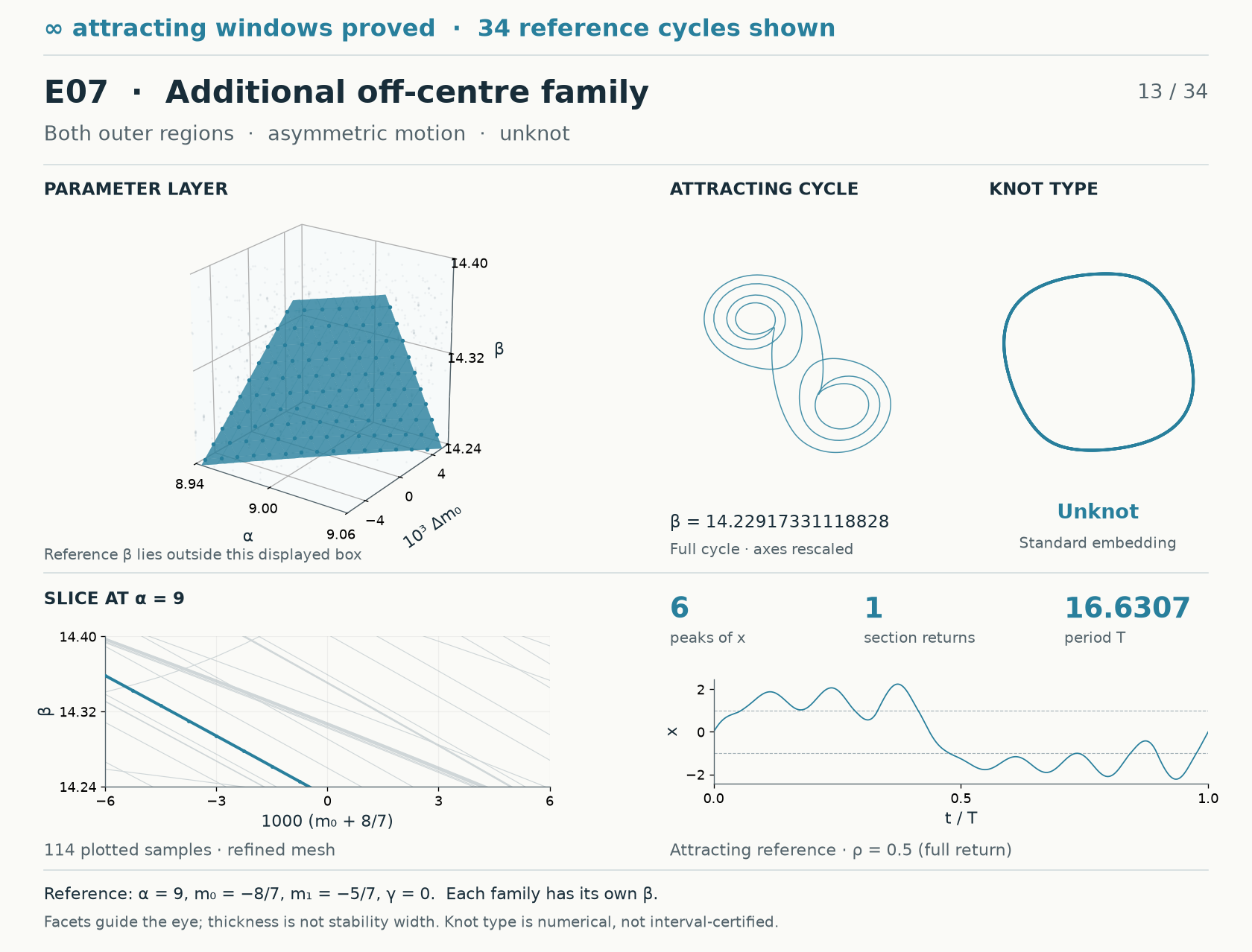
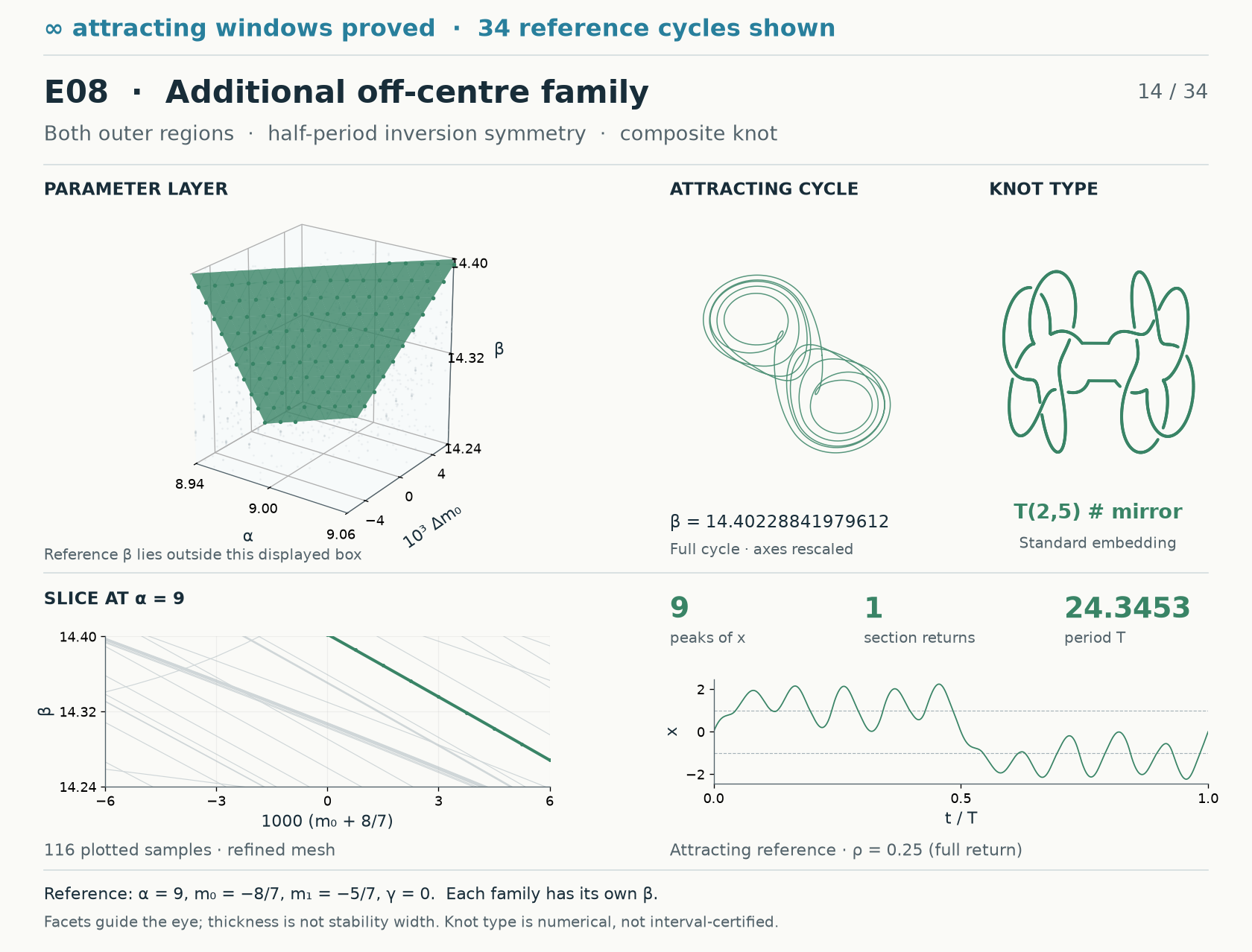
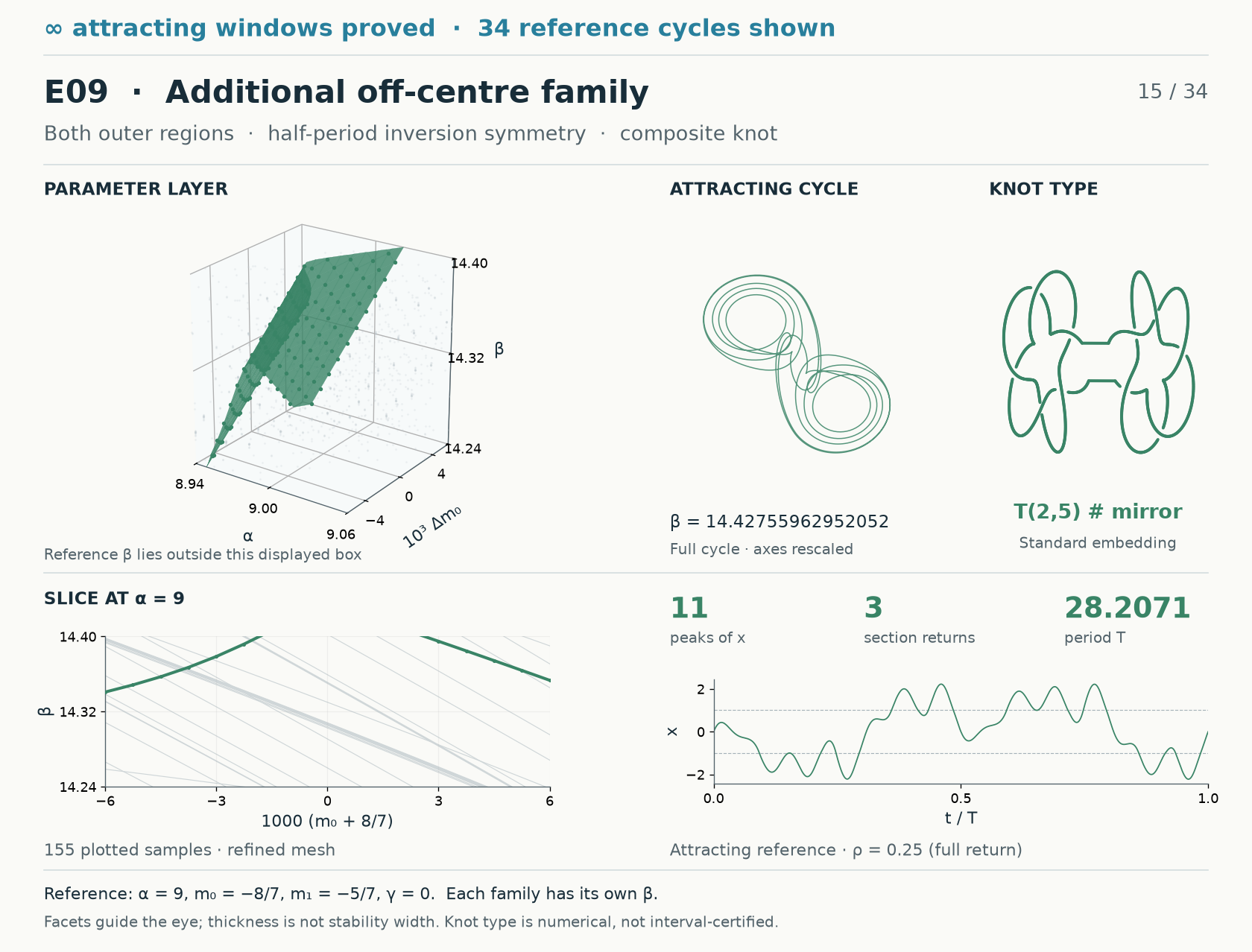
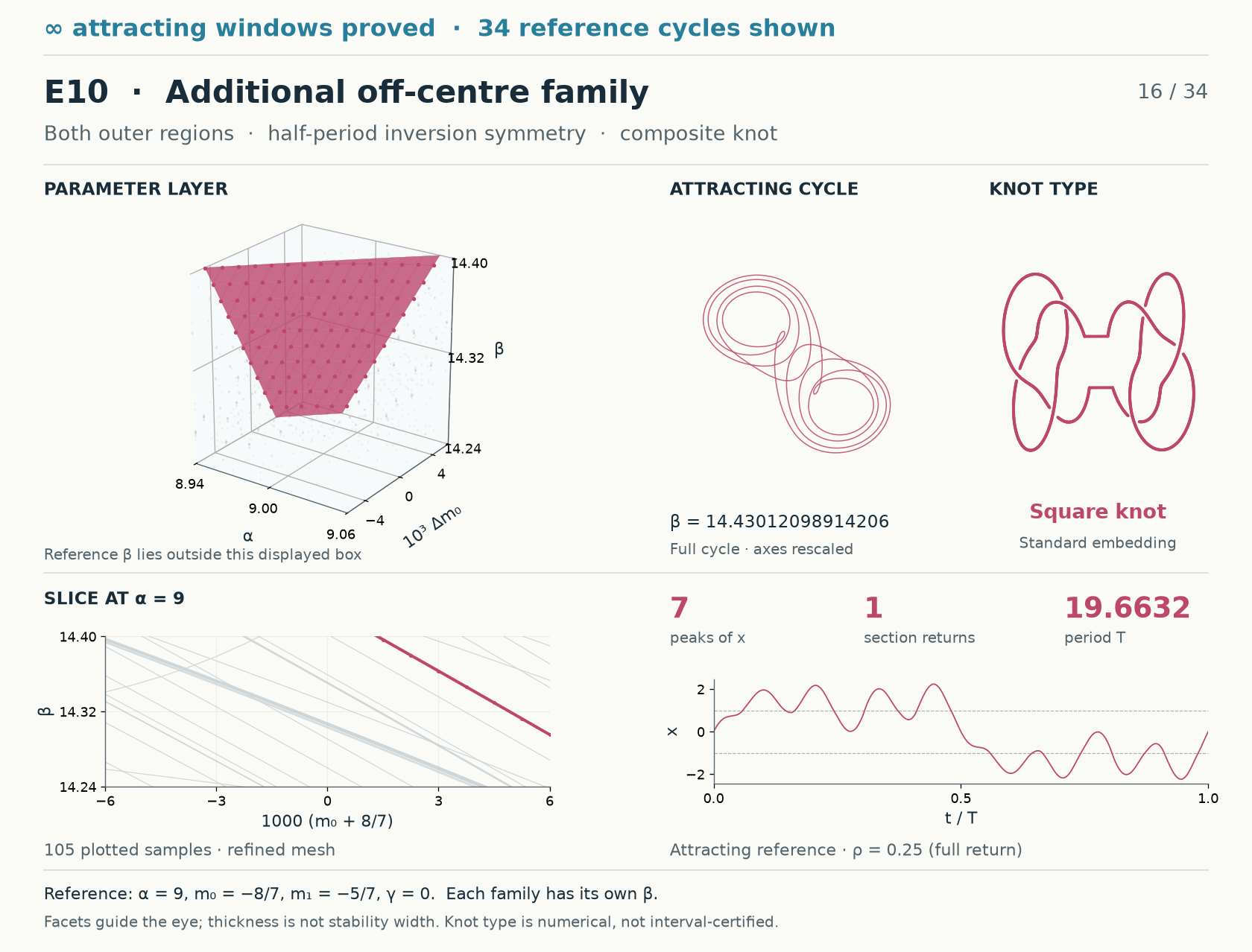
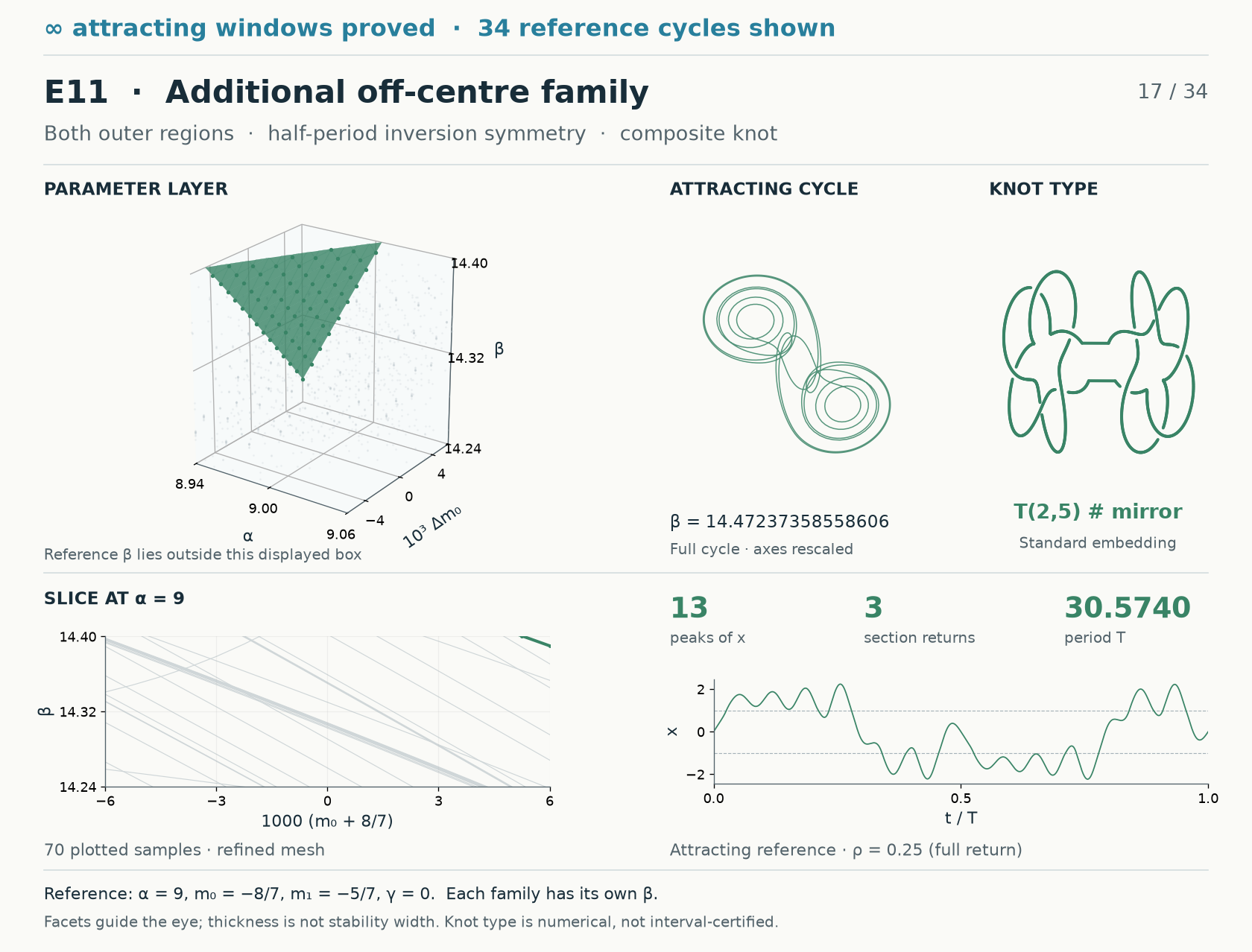
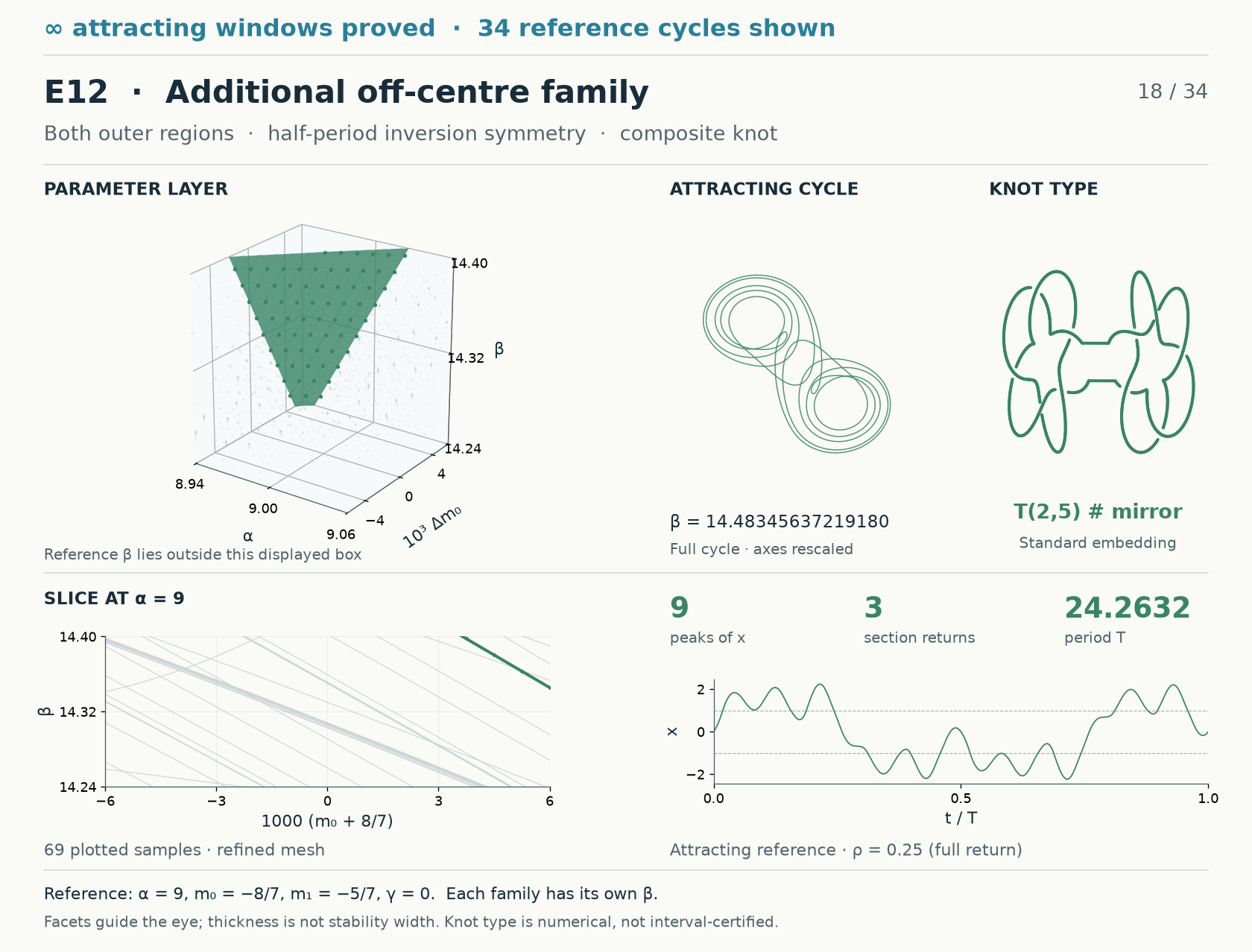
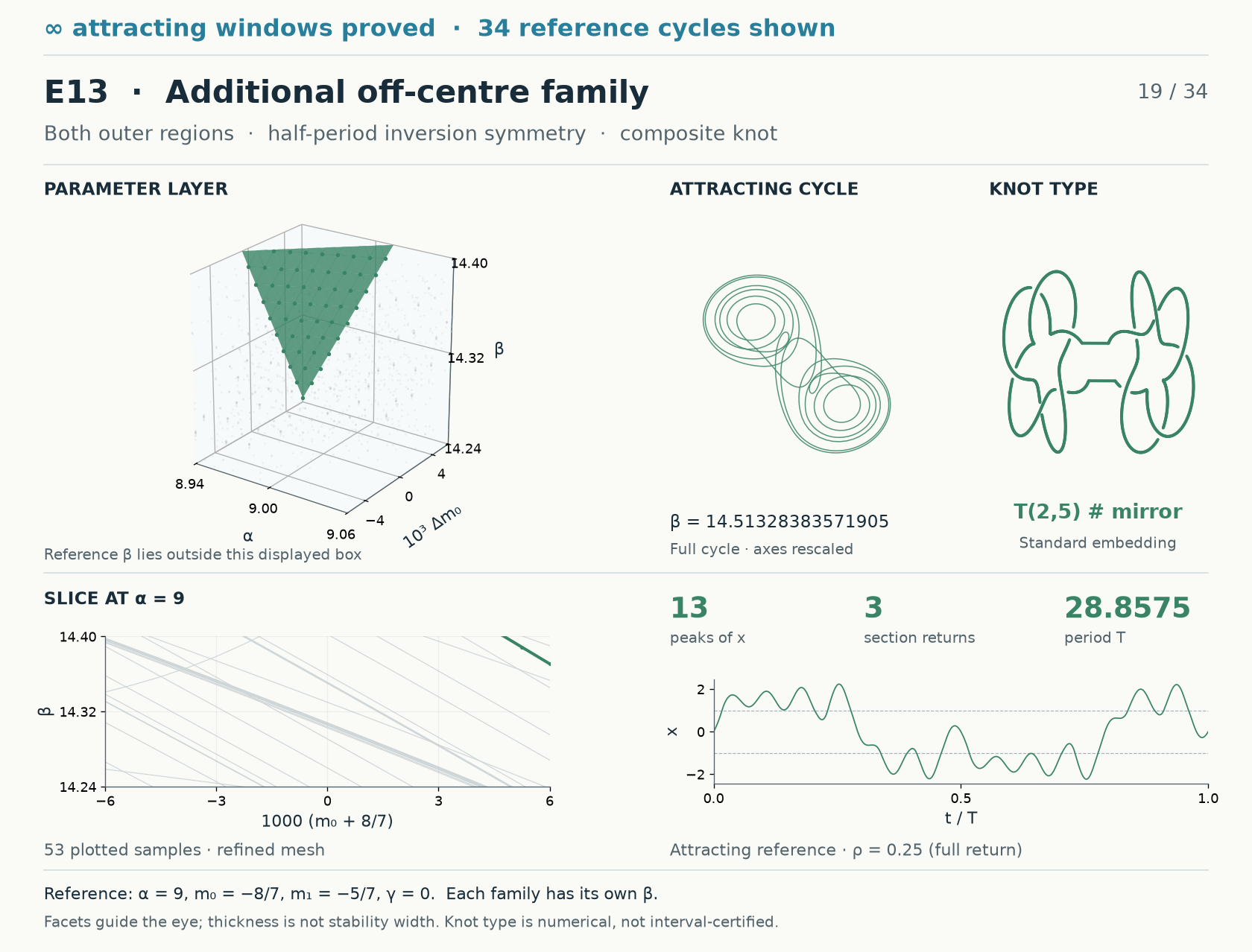
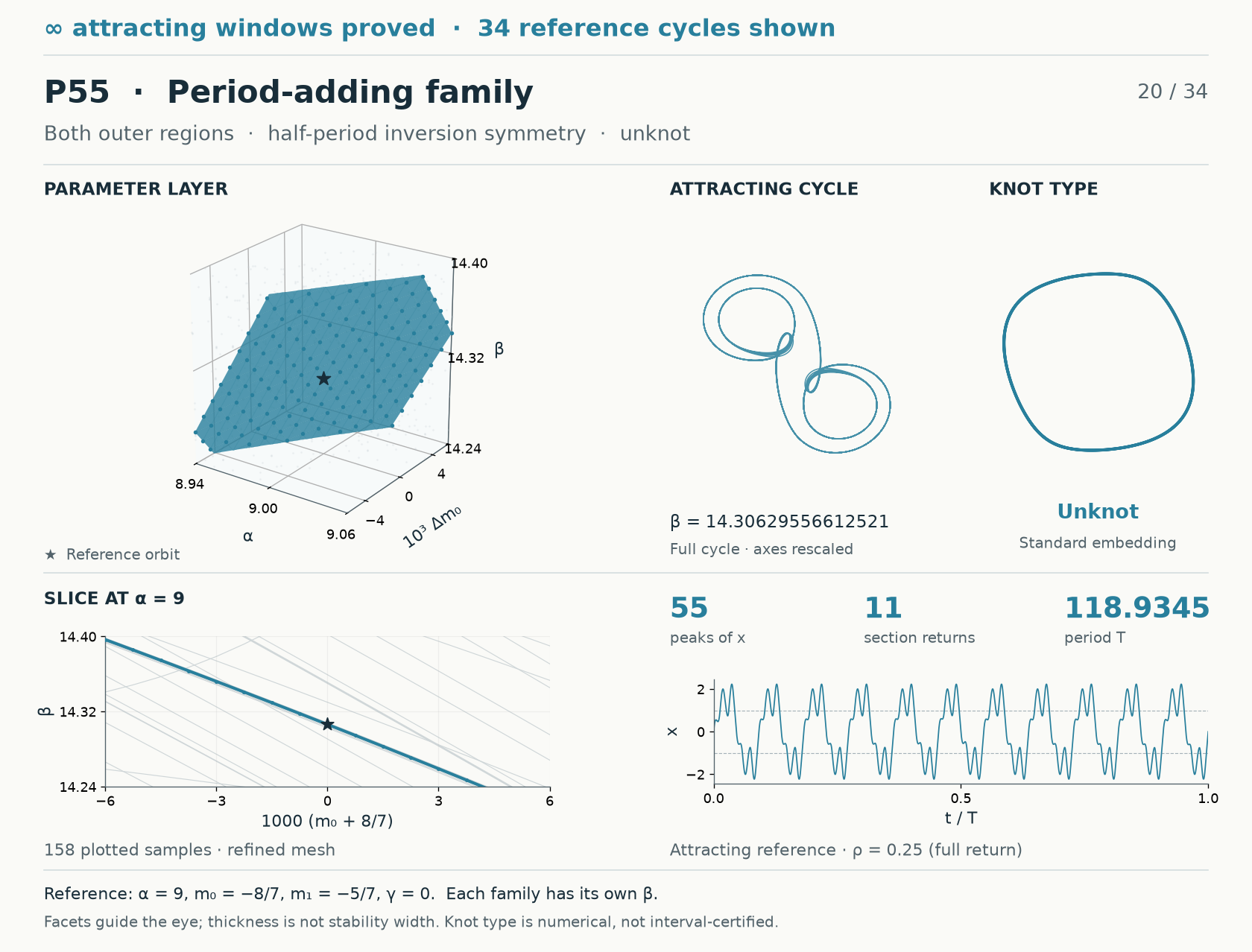
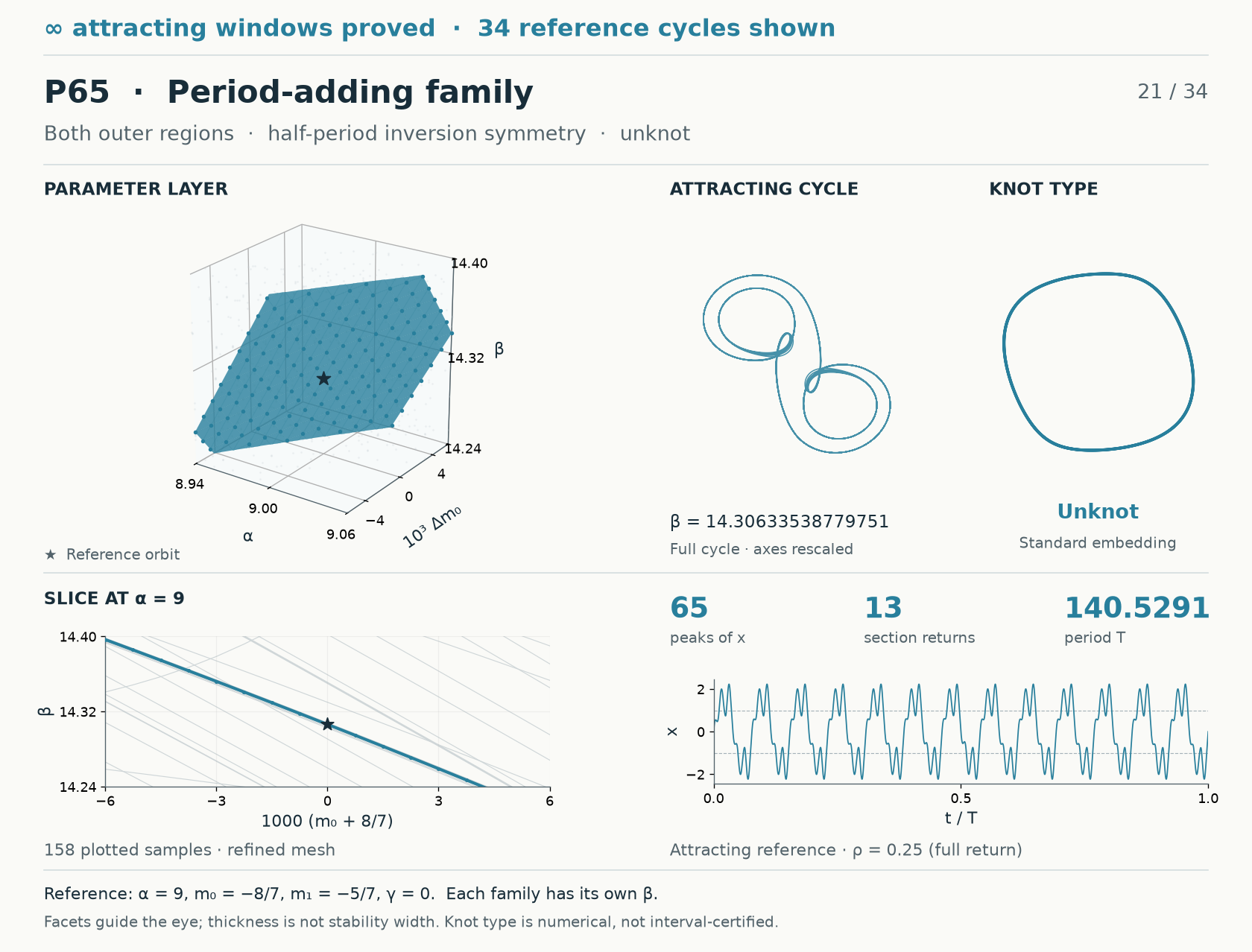
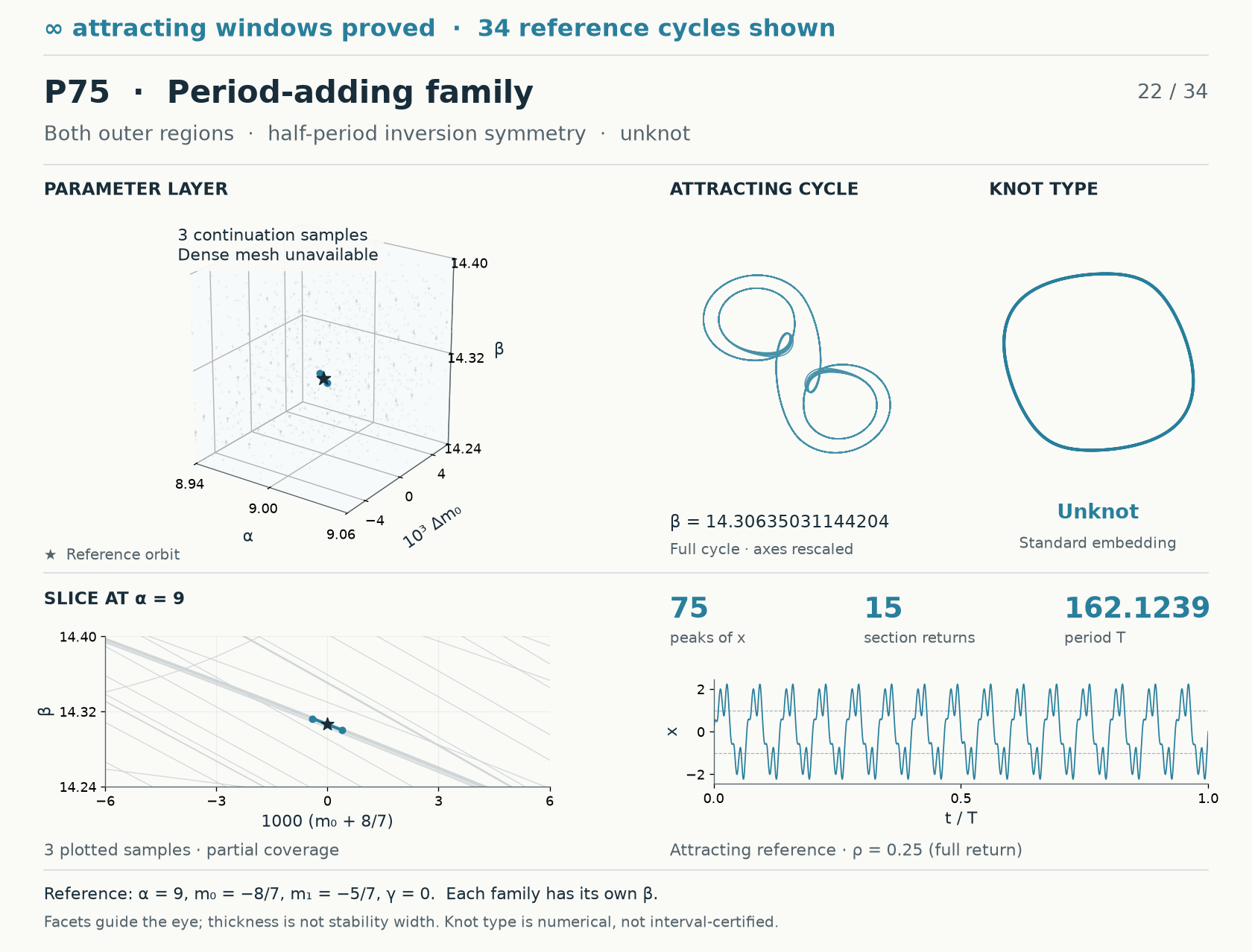
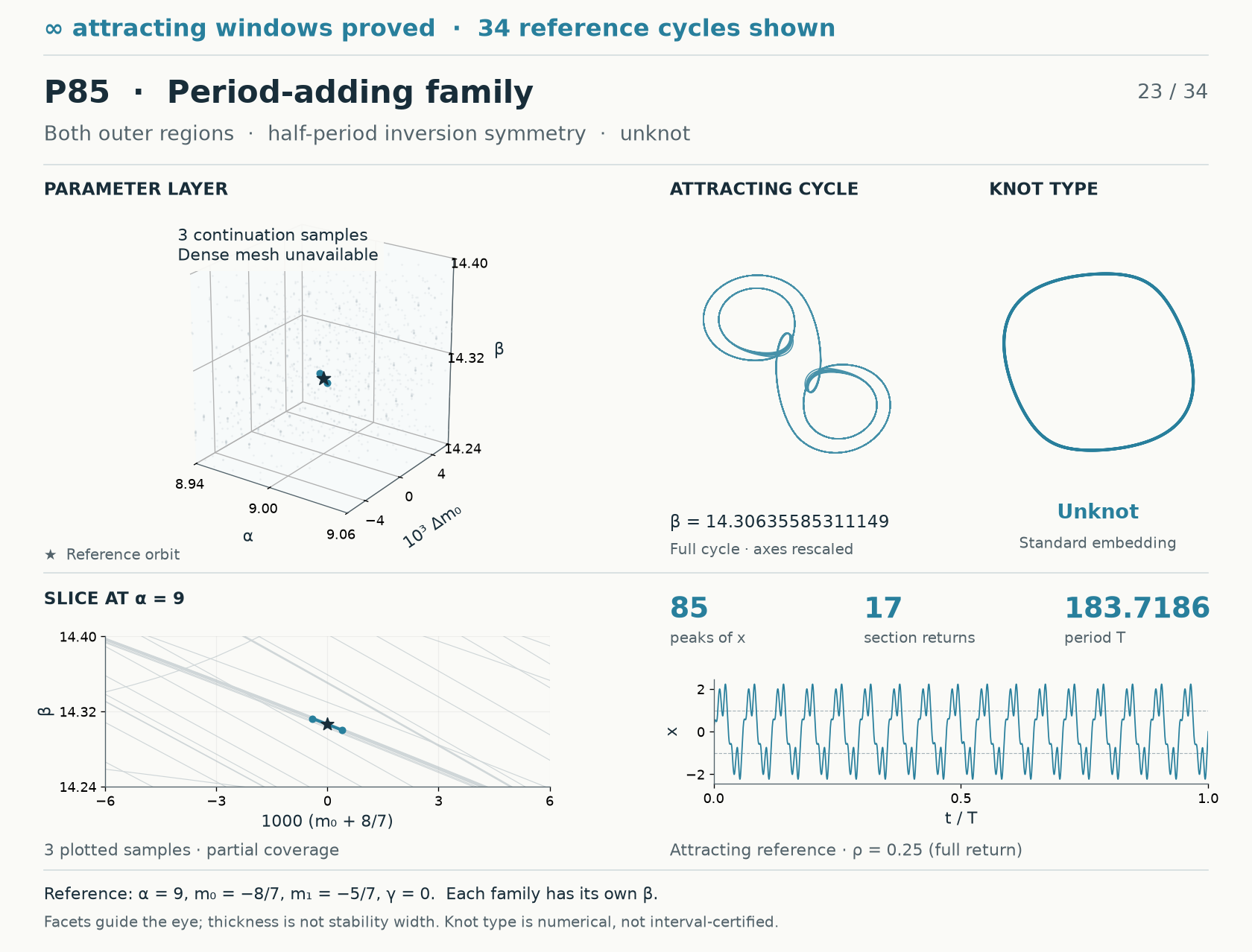
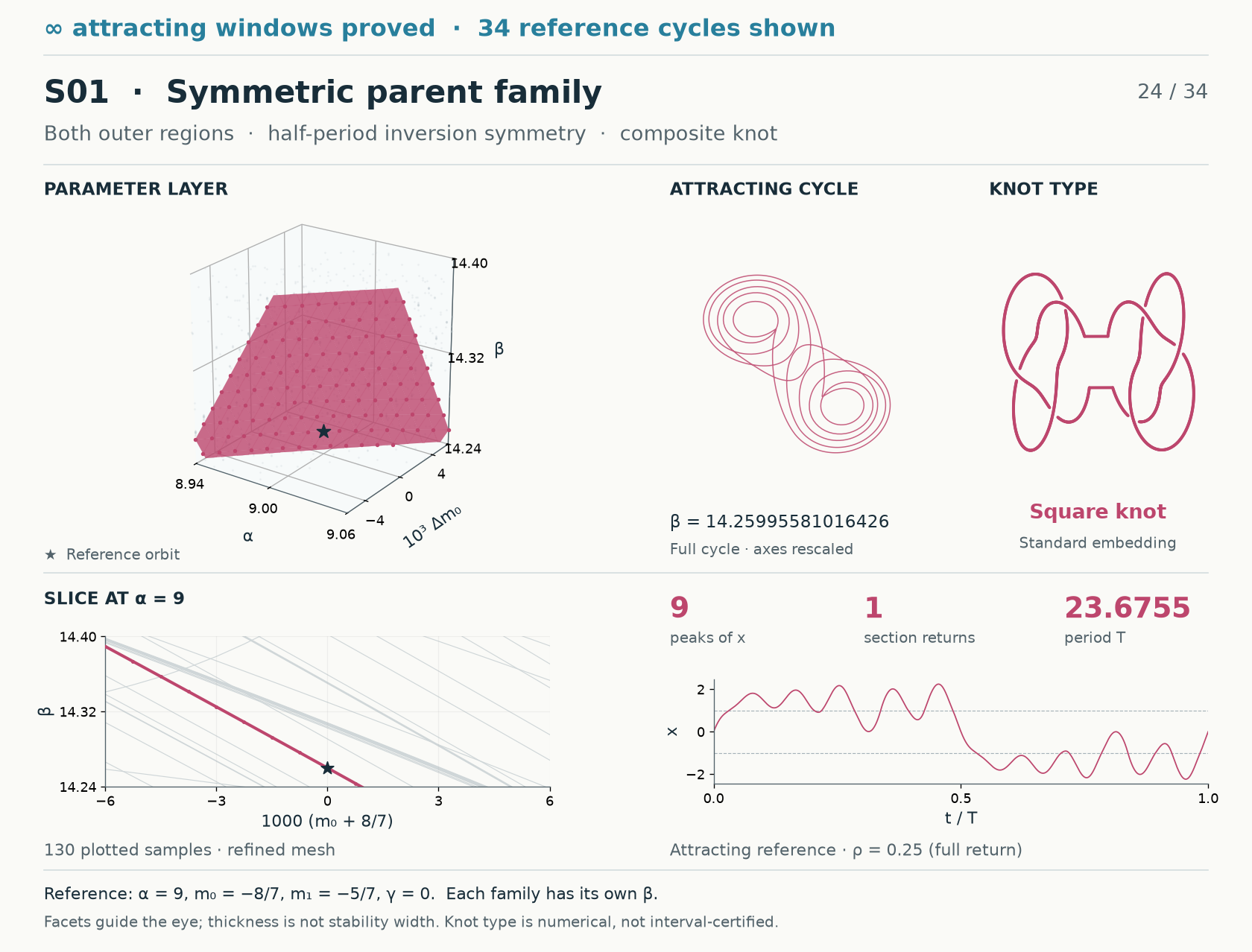
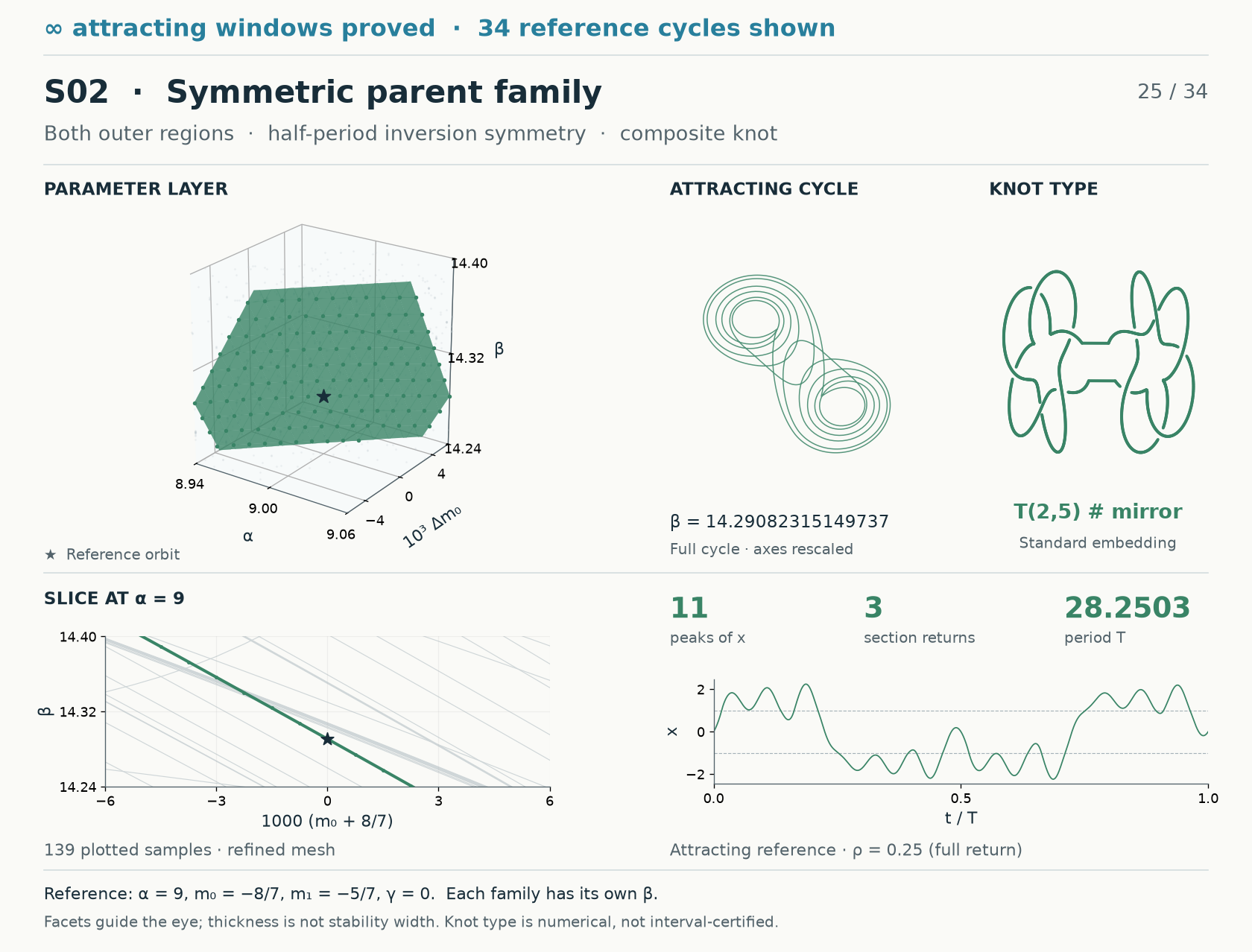
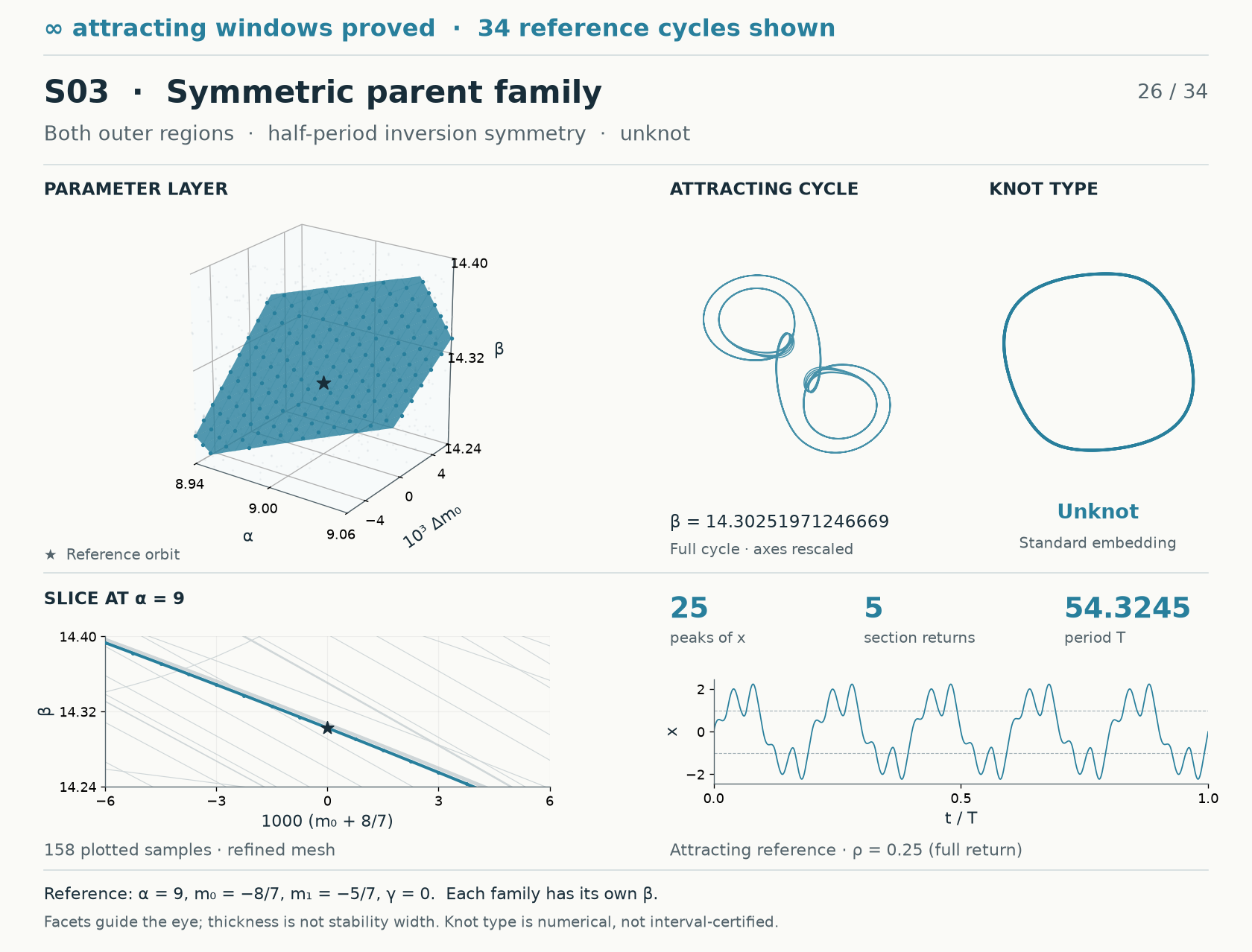
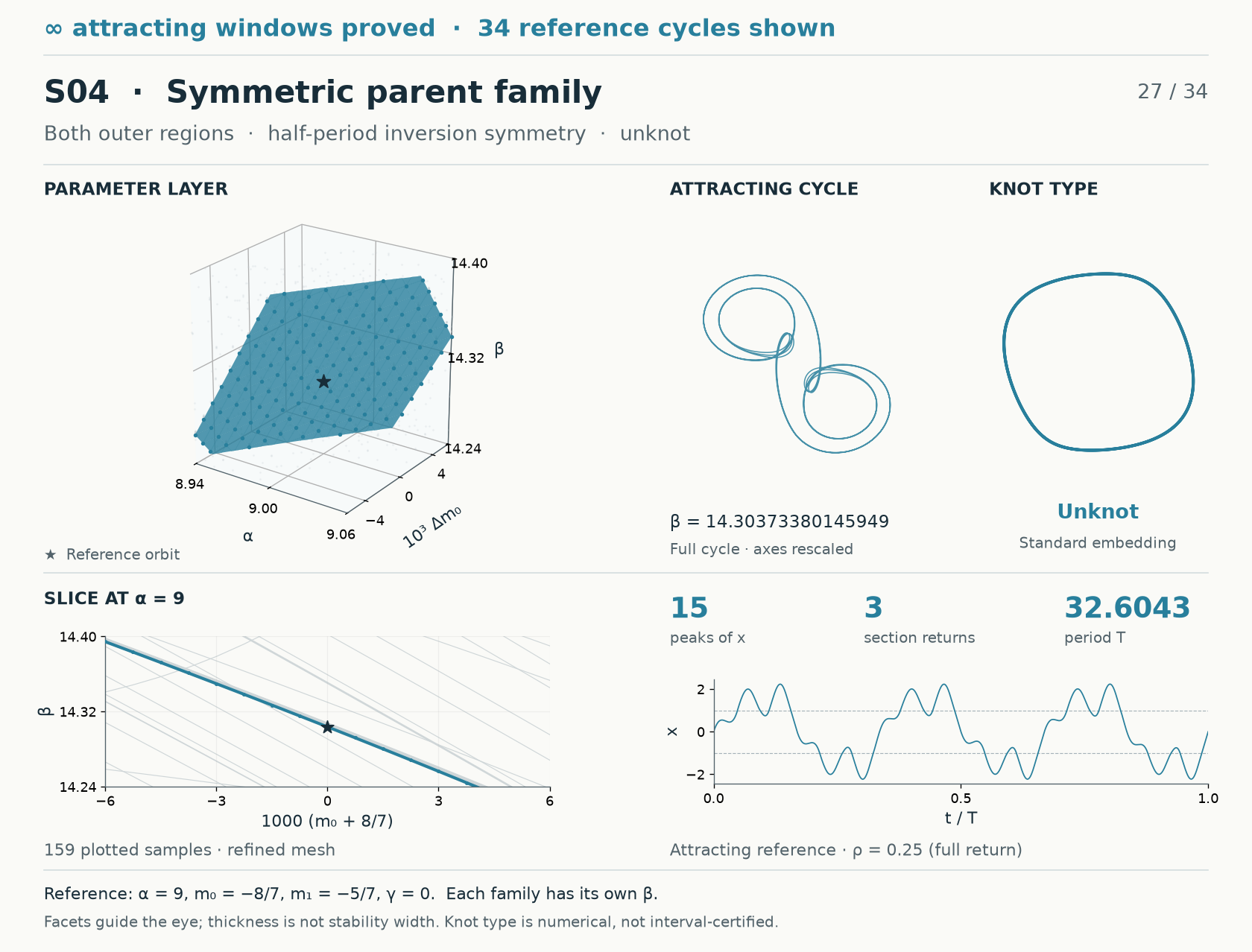
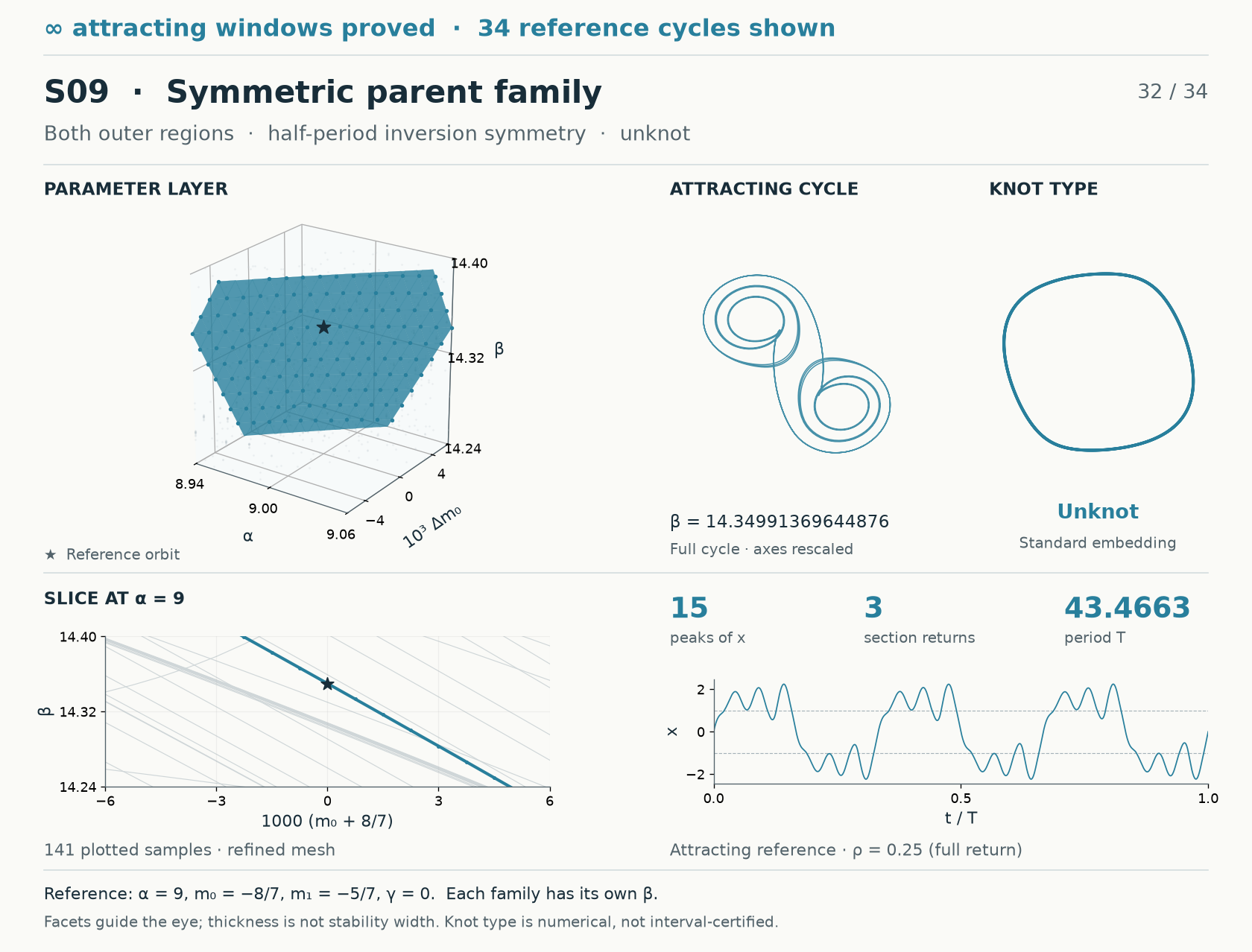
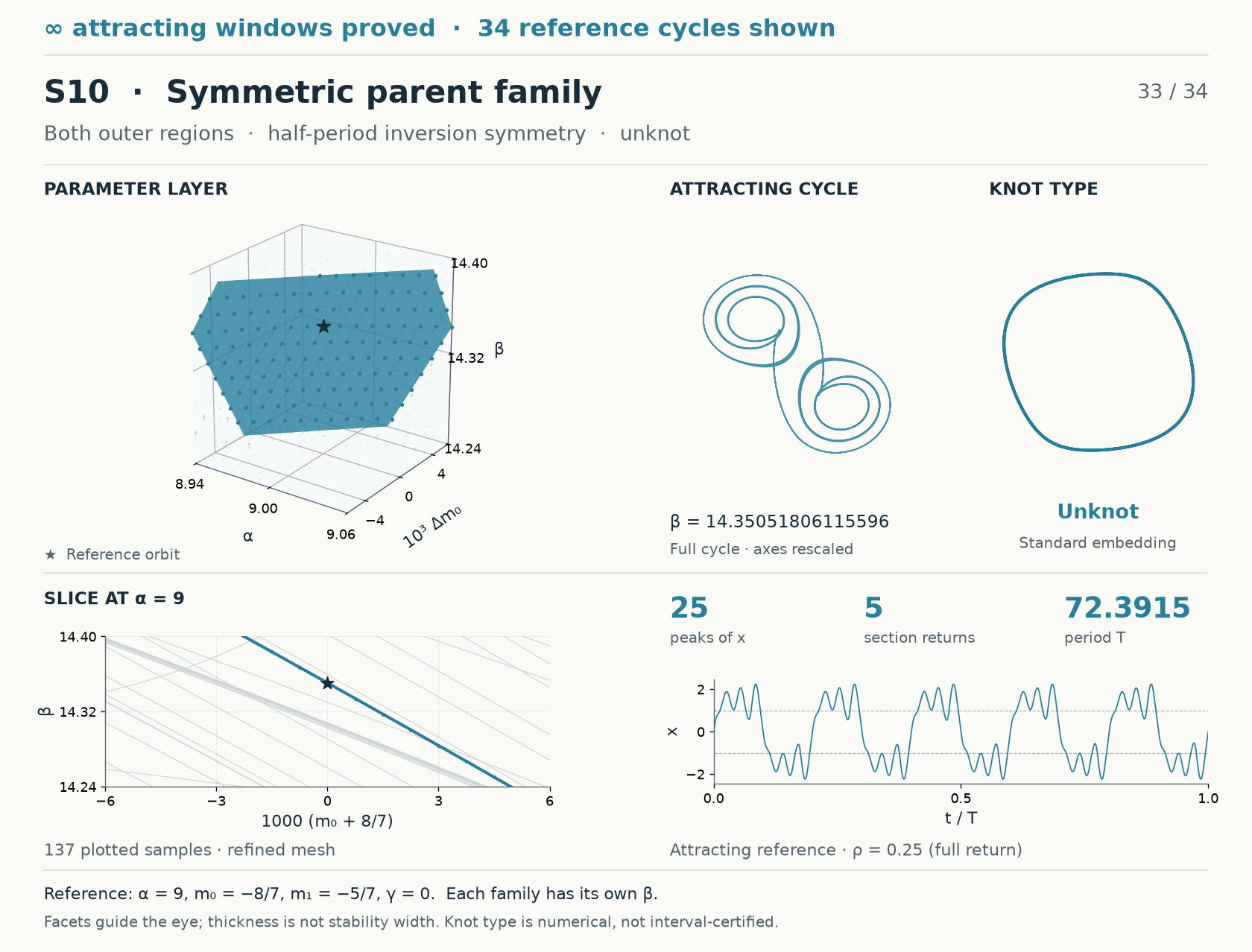
Each card joins a sampled parameter layer to one reference attracting cycle, its waveform and its numerically identified knot type. The 34 reference cycles use different β values; they are not 34 simultaneous attractors. Play the lossless WebP animation, watch the video with pause and seeking, or choose a static card below. WebP is an animated image and has no native playback timeline; the video below provides playback controls.

34 is the number of displayed examples, not the total number of periodic motions. On the transect α = 9, m₀ = −8/7, m₁ = −5/7, γ = 0, infinitely many attracting periodic windows are proved to accumulate at β* in (14.30635909996140, 14.30635909996152). The result combines an interval certificate with the classical sink-cascade theorem. These windows have local extensions in parameter space, but their global connections have not been classified: the result is not a count of disconnected layer surfaces. The animation starts with this distinction and retains an infinity banner on every family card. Its introductory frame is also available separately.

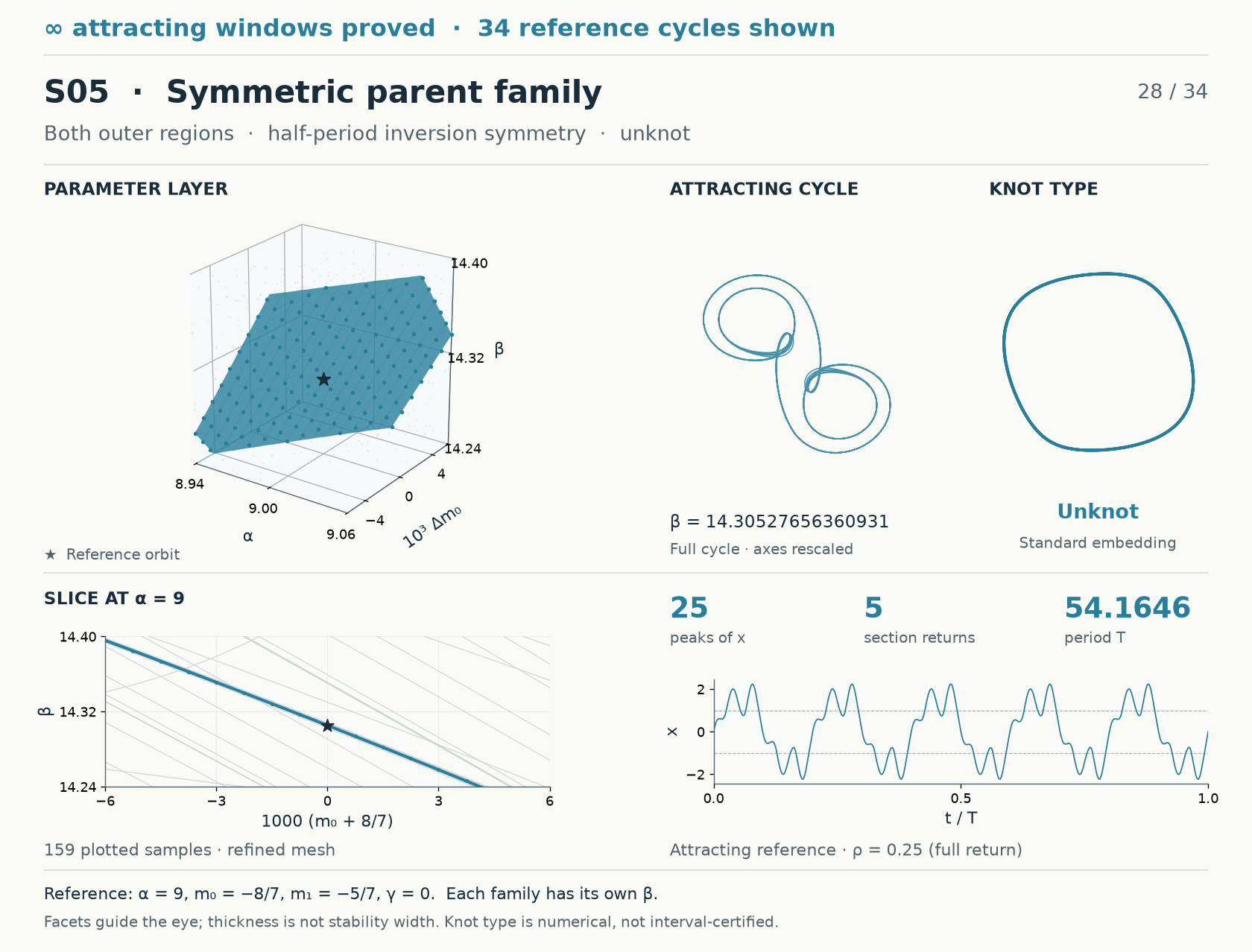
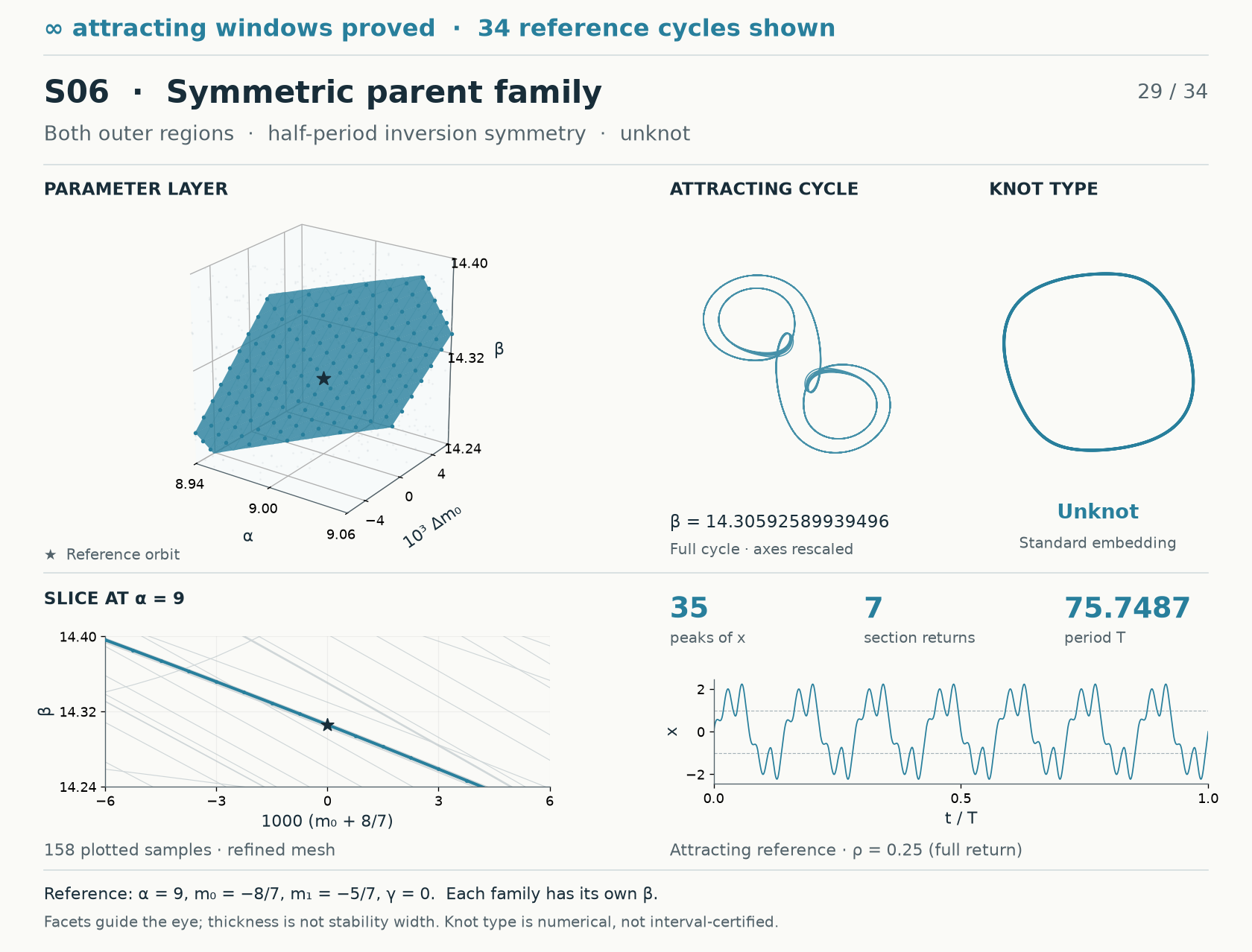
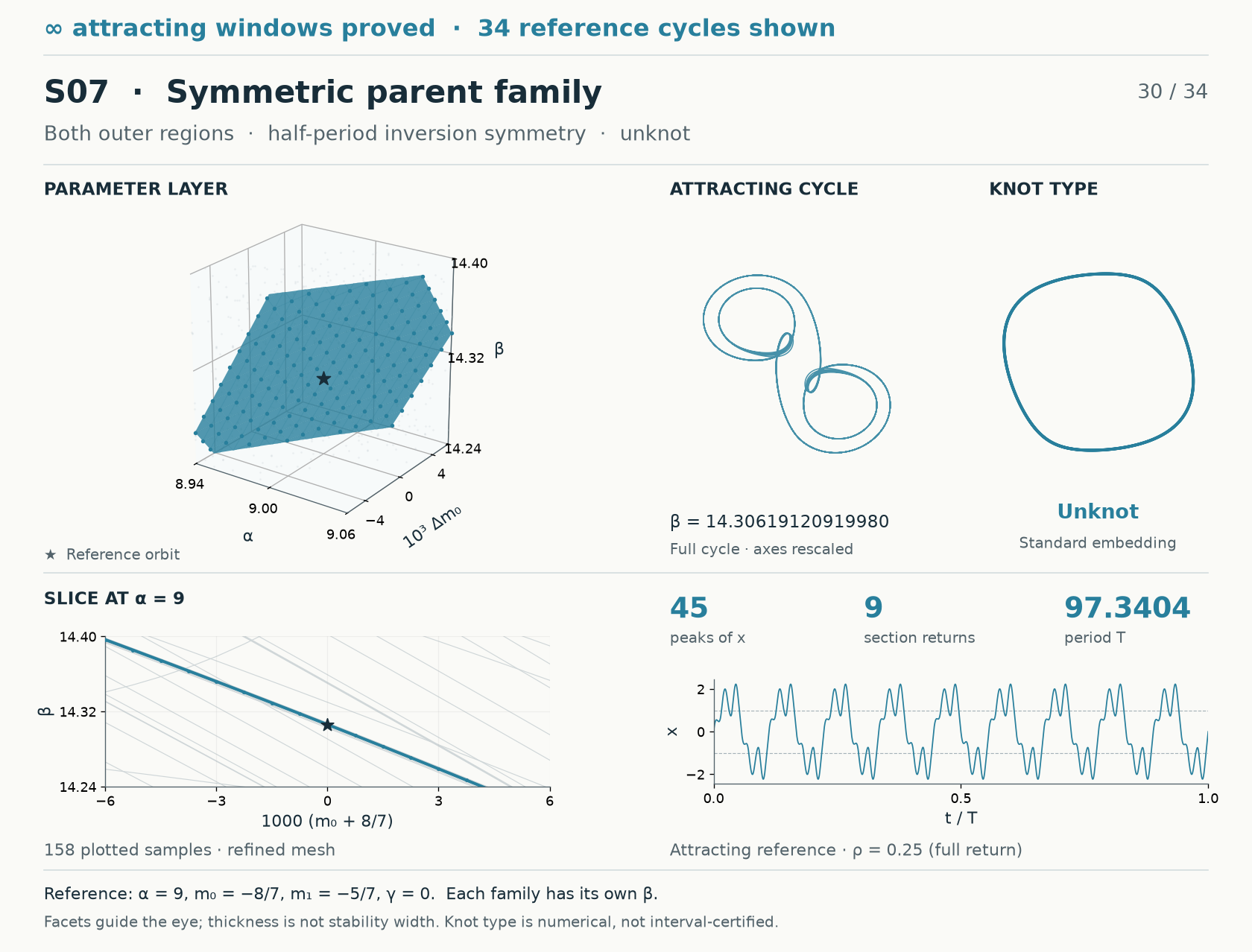
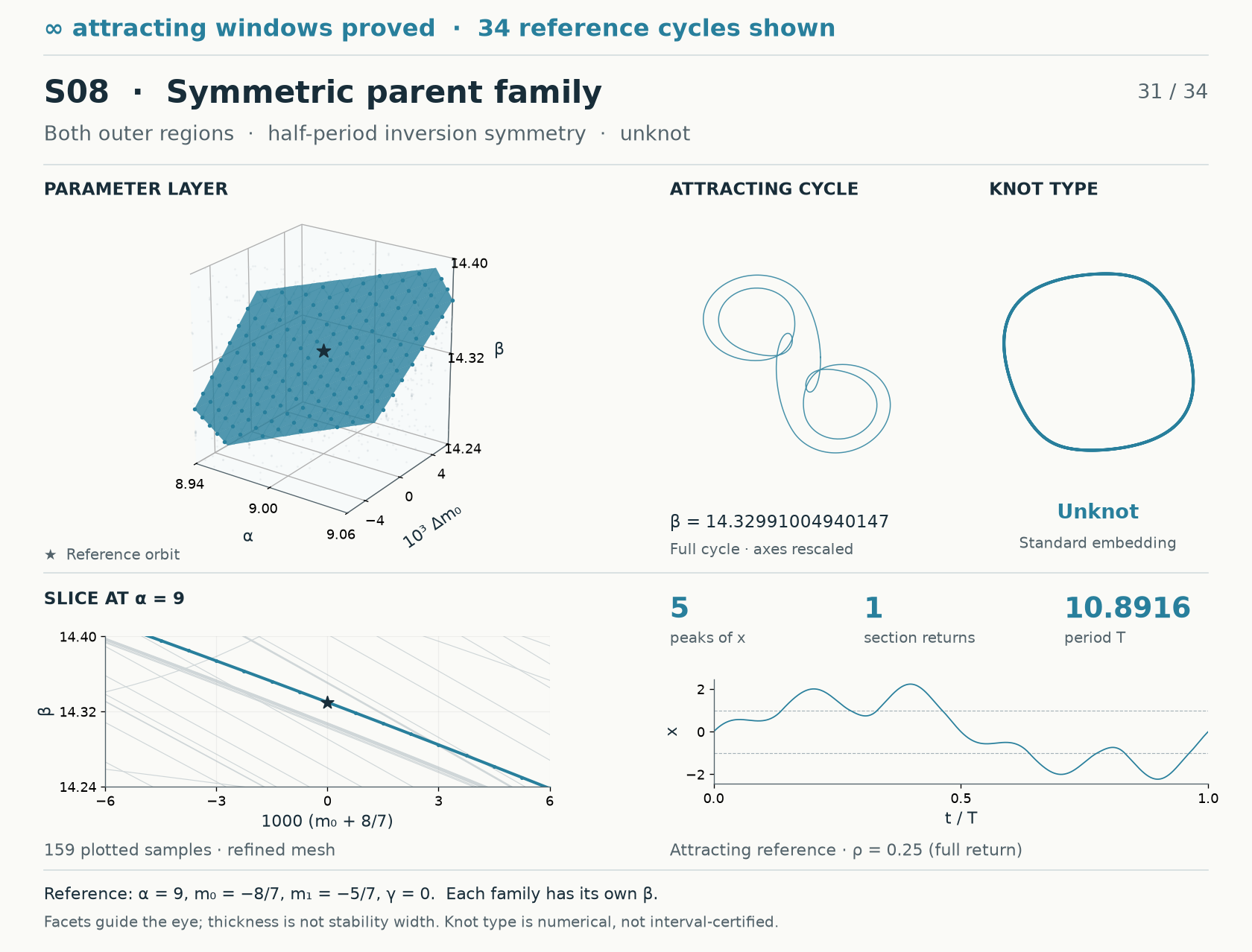
The 32 original families have refined meshes. P75 and P85 show only three existing continuation samples at fixed α and m₁; no dense sheet is inferred for them. Grey points and lines retain the other families as context. The star marks the reference parameters when they lie in the displayed box. The orbit and waveform use the reference parameters printed on the card, not every point of the highlighted surface.
Video
Use the player's timeline to move between cards; playback is initially paused. The introduction lasts 12 seconds; each of the 34 family cards lasts 8 seconds, for a total of 4:44. A04 starts at 0:12 and A01 at 0:20; the remaining entries follow in identifier order. Open the MP4 directly.
https://github.com/user-attachments/assets/ecbd0449-a11e-487e-b4fa-a719d9e6d122
Reading a card
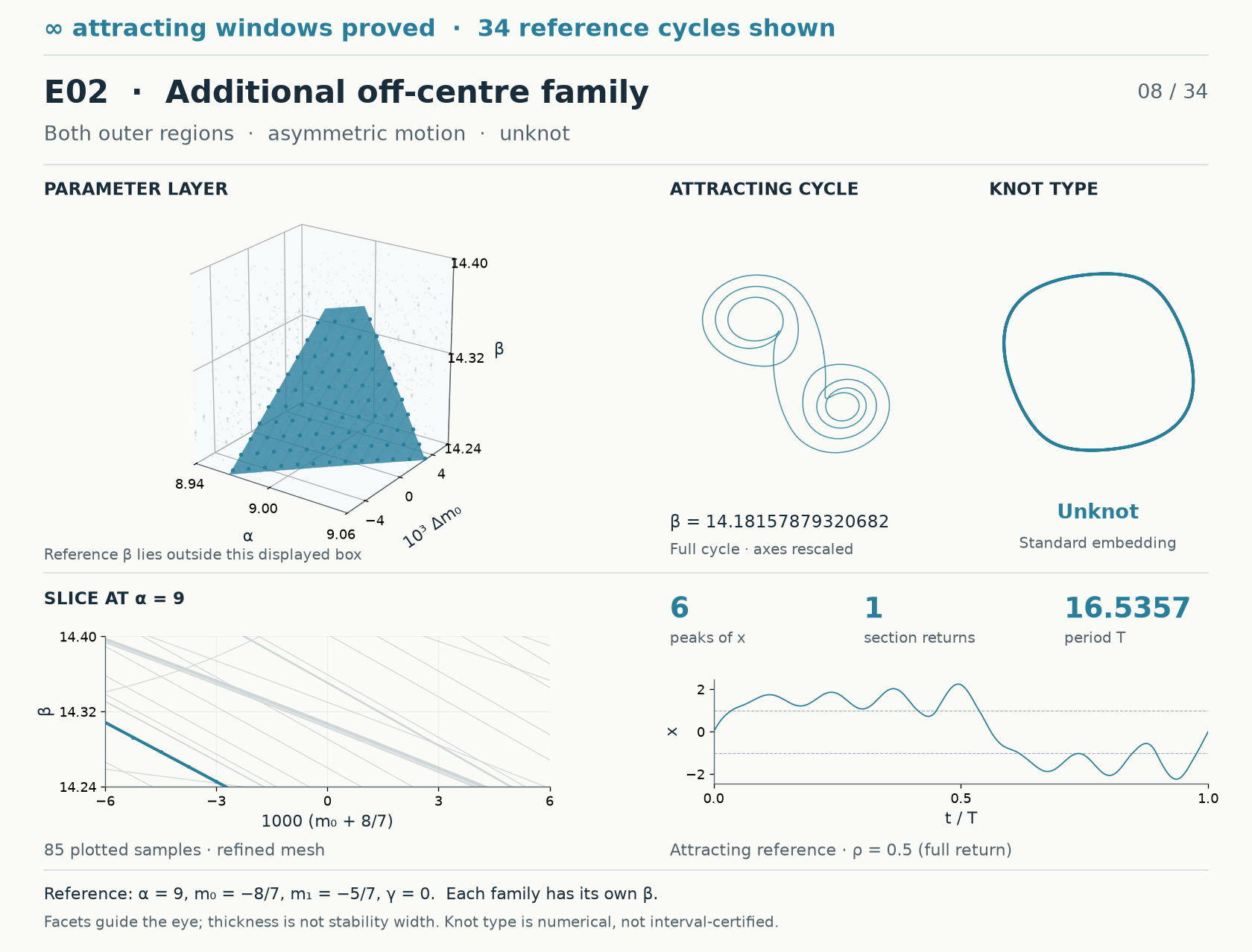
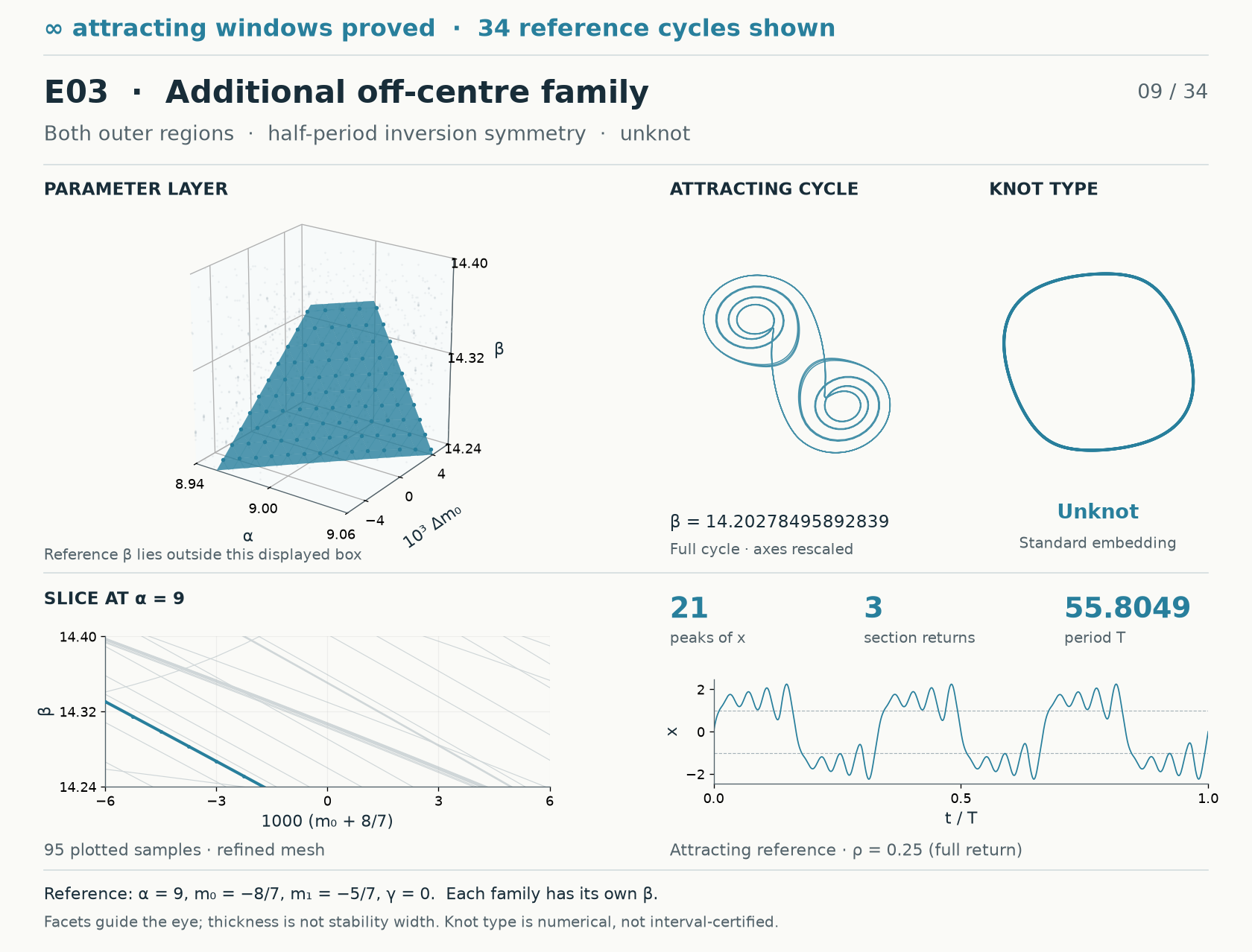
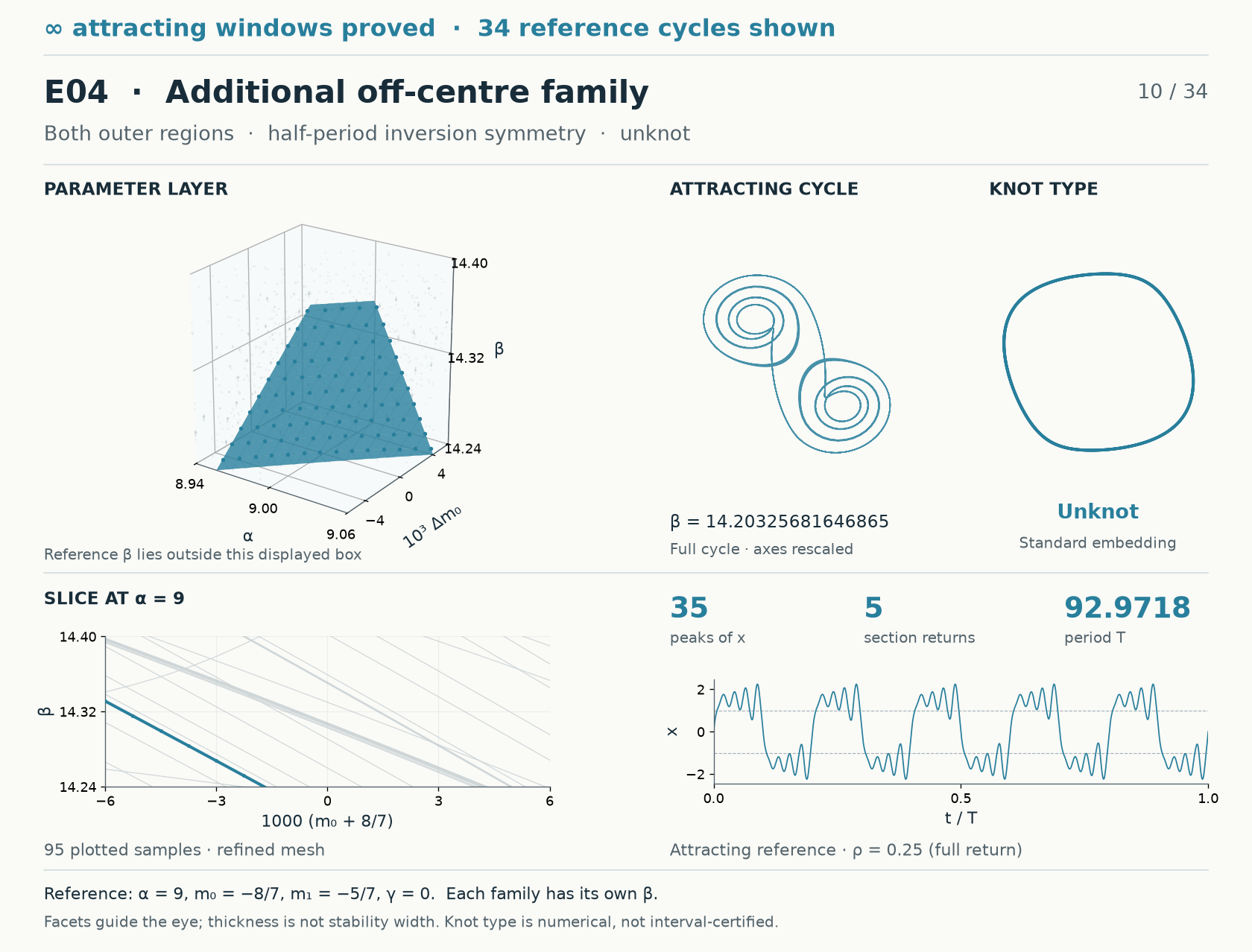
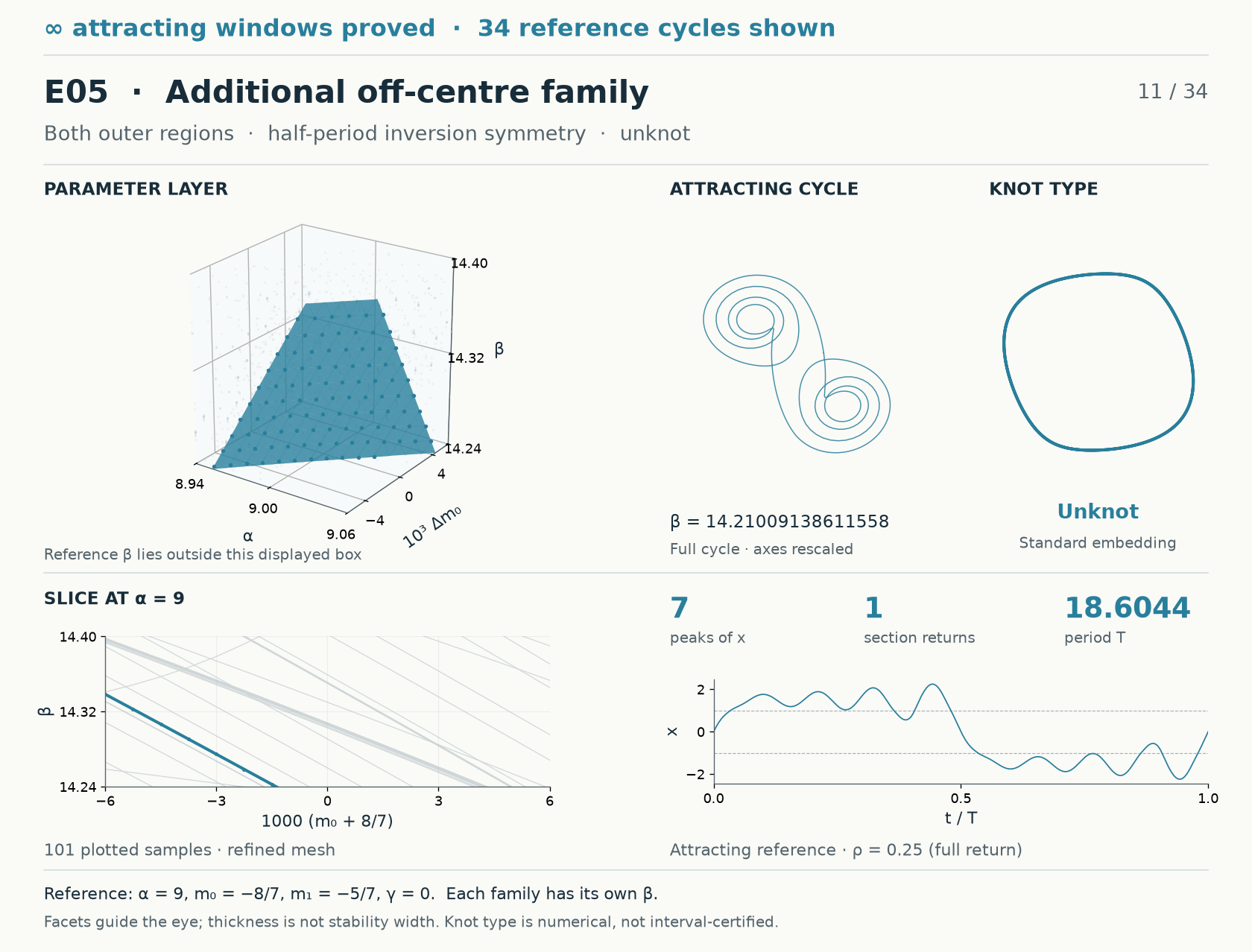
- Catalogue group: S denotes the original symmetric parent families; A the asymmetric parents; E the additional families found away from the central transect; P the later period-adding entries. These labels record catalogue provenance. The symmetry line describes the actual reference motion. S04–S07 also belong to the period-adding sequence.
- Motion: the orbit visits one or both outer affine regions, x < −1 and x > 1. Half-period inversion symmetry means u(t + T/2) = −u(t). An asymmetric cycle has an inversion-related partner; the partner has the mirror knot type.
- Counts and period: peaks are local maxima of x over one full cycle. Section returns count upward crossings of x = 0. T is the dimensionless full period. The waveform shows one period, with dashed lines at x = ±1. Orbit coordinates are independently rescaled to reveal shape. The layer's slope offset is Δm₀ = m₀ + 8/7.
- Stability: ρ is the spectral radius of the transverse full-period return map. Its values 0.25 (symmetric) and 0.5 (asymmetric) follow the selected reference normalization; they do not rank whole families by stability. P65's displayed mesh retains a different reference multiplier, as documented in the mesh audit.
- Knot: the drawing is a standard embedding of the identified knot, not another circuit trajectory. Orbit topology remains numerical. Exact diagram invariants and the sampling checks are in the knot report. Equal knot types, peak counts or catalogue groups do not identify a family uniquely.
Facets and straight segments indicate sample adjacency. They neither certify the unsampled interior nor measure a stability interval's width. Reference parameters outside the plotted β range are labelled explicitly. Values printed on a card are rounded; source records and reproduction retain the full precision.
Choose a family
A01 · A02 · A03 · A04 · A05 · A06 · E01 · E02 · E03 · E04 · E05 · E06 · E07 · E08 · E09 · E10 · E11 · E12 · E13 · P55 · P65 · P75 · P85 · S01 · S02 · S03 · S04 · S05 · S06 · S07 · S08 · S09 · S10 · S11
A01
A02
A03
A04
A05
A06
E01
E02
E03
E04
E05
E06
E07
E08
E09
E10
E11
E12
E13
P55
P65
P75
P85
S01
S02
S03
S04
S05
S06
S07
S08
S09
S10
S11