REPRODUCIBLE NUMERICAL RESEARCH • CHUA CIRCUIT
One family is not always one attracting motion.
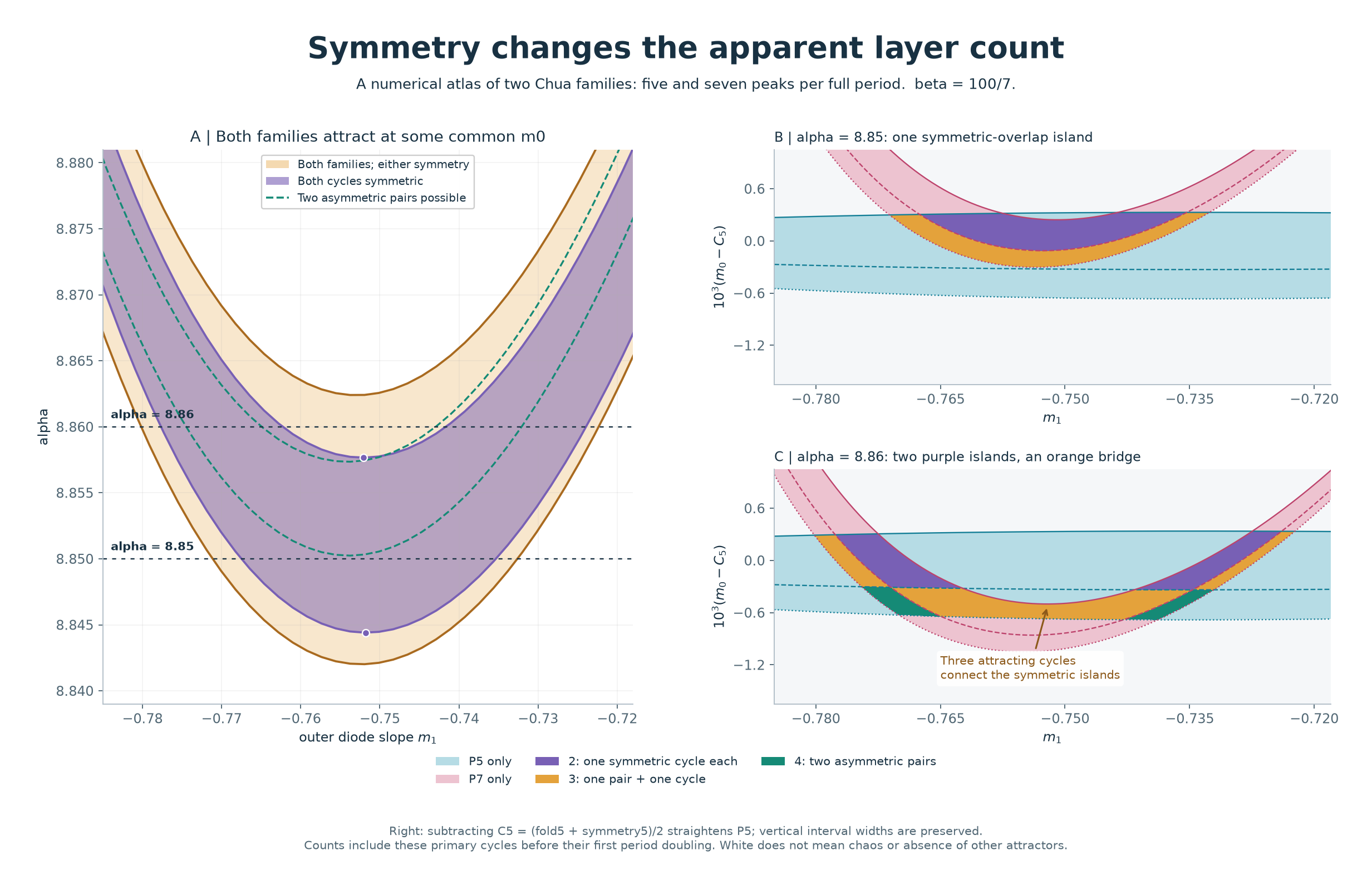
Two tracked families, with five and seven peaks, overlap. Each family can contain either a symmetric cycle or a pair of asymmetric cycles. This changes both the number of attractors and what a two-dimensional slice looks like.
Move the section
Choose a directly calculated alpha section. The other fixed parameter is beta = 100/7.
The vertical coordinate is 1000(m0 - C5), where C5 is the midpoint of the P5 symmetric interval at each m1. Subtraction straightens the band without changing its thickness. Colored cells interpolate corrected boundaries; white does not imply chaos. “P5 only” or “P7 only” can include an asymmetric pair.
See the actual motions
Within each column, all displayed trajectories use the same parameters. Every orbit has an independent closure and stability check.
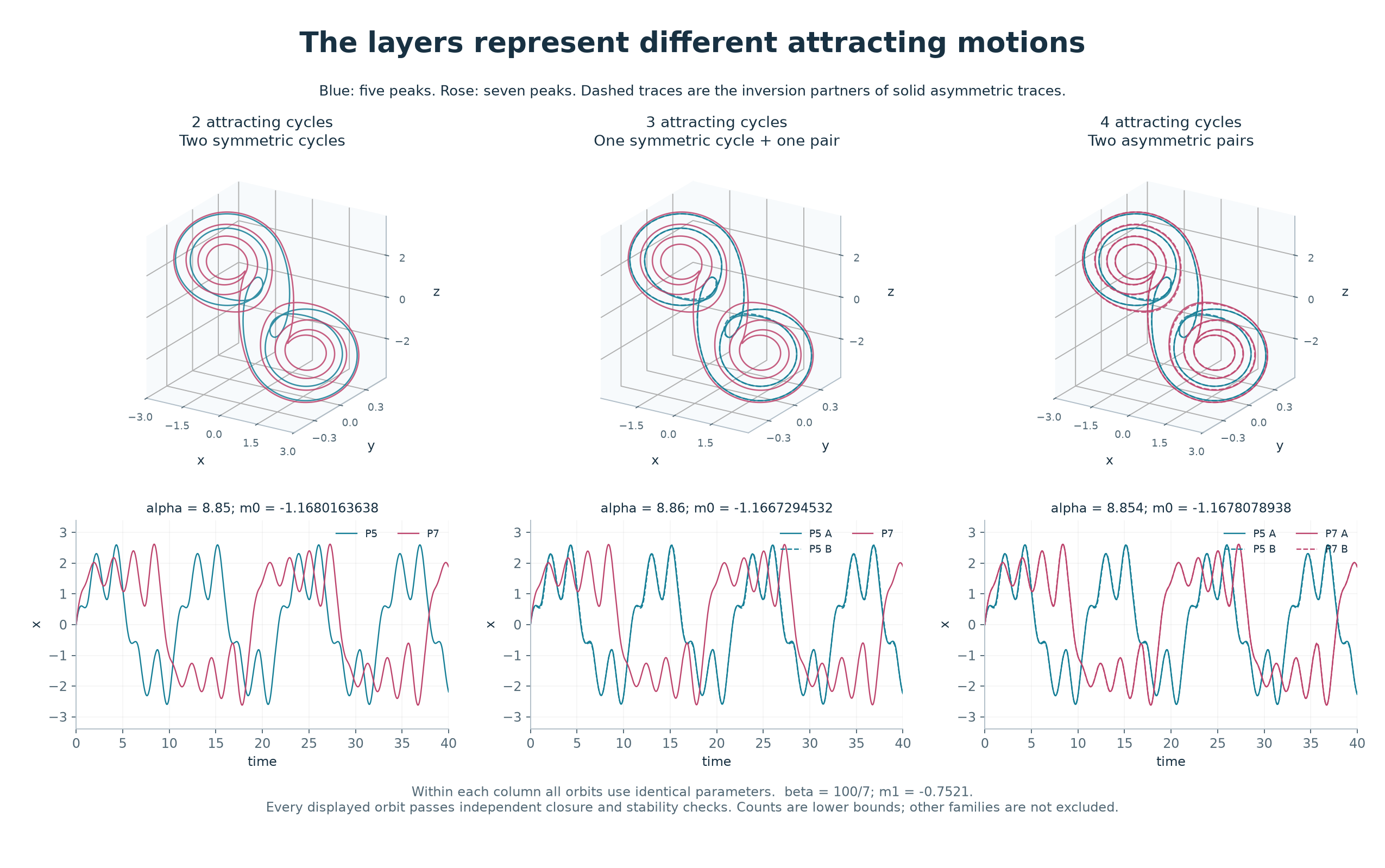
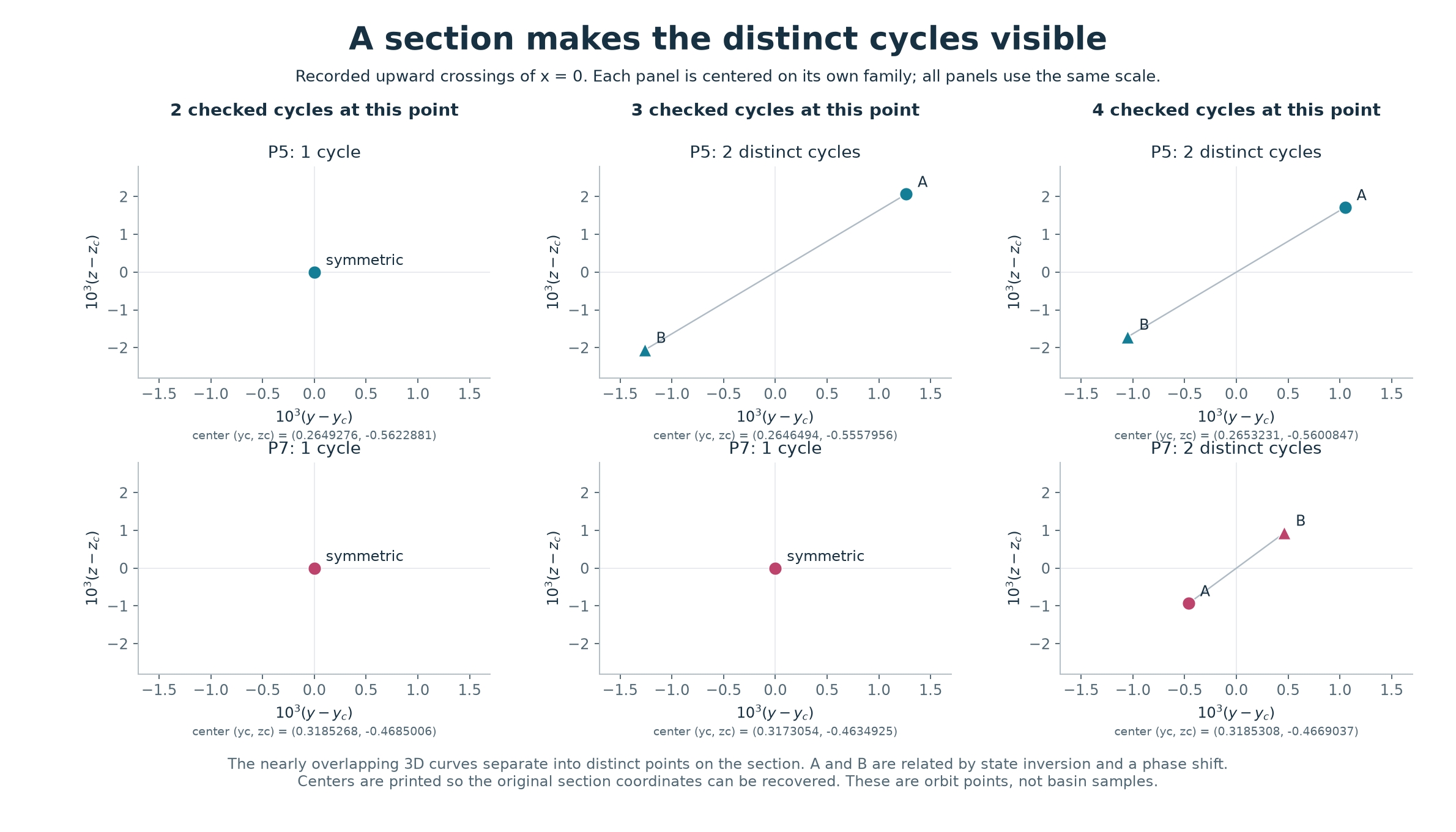
The mirrored cycles almost coincide in the broad orbit view. Their recorded section crossings separate them clearly:
Make a prediction, then check it
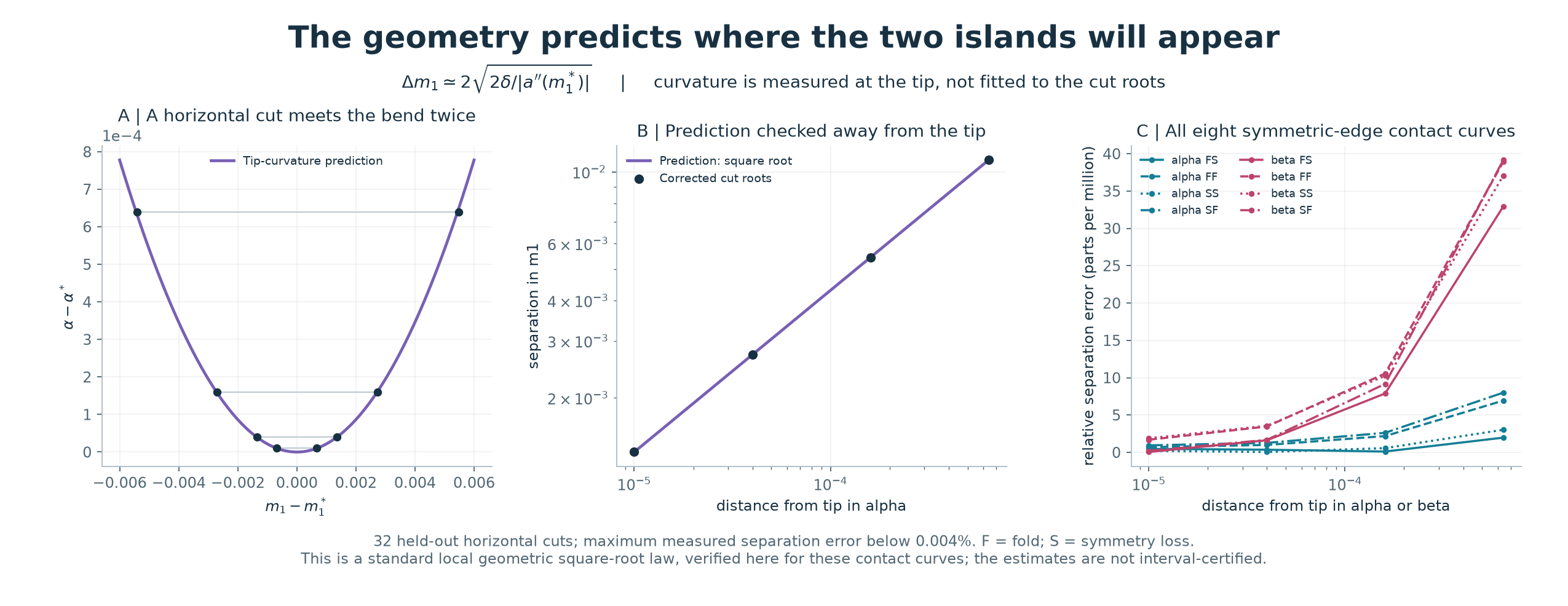
A smooth bend predicts a square-root separation of the two cut intersections. We used the curvature at the tip to predict 32 held-out cuts, then solved the intersections separately.
The original three-dimensional coordinates
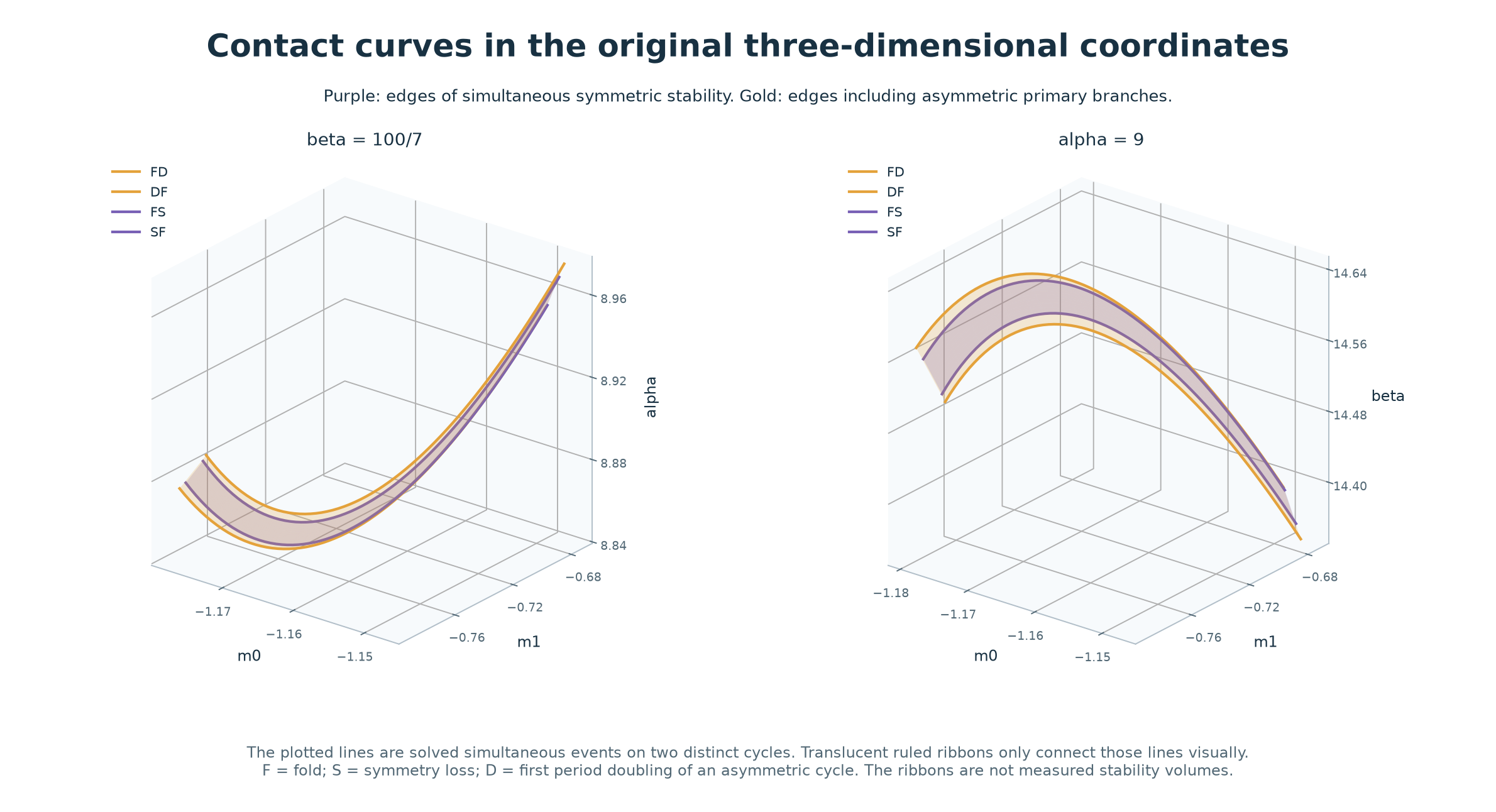
Scope: two selected primary families through their first period doubling. These are numerical results, not an exhaustive attractor count or a proof of scientific priority. The square-root law and the underlying bifurcation mechanisms are established mathematics.
Read the research report, equations, literature comparison and reproduction instructions