Can a residence count distinguish two noise sources?
Near the saddle in the voltage-start experiment, a small error grows by a factor of 2.213 per circuit. An error at launch and a succession of smaller disturbances can produce nearly identical exit counts. This matters when interpreting the 11 simulated turns and eight measured turns in Fig. 10 of the circuit experiment.
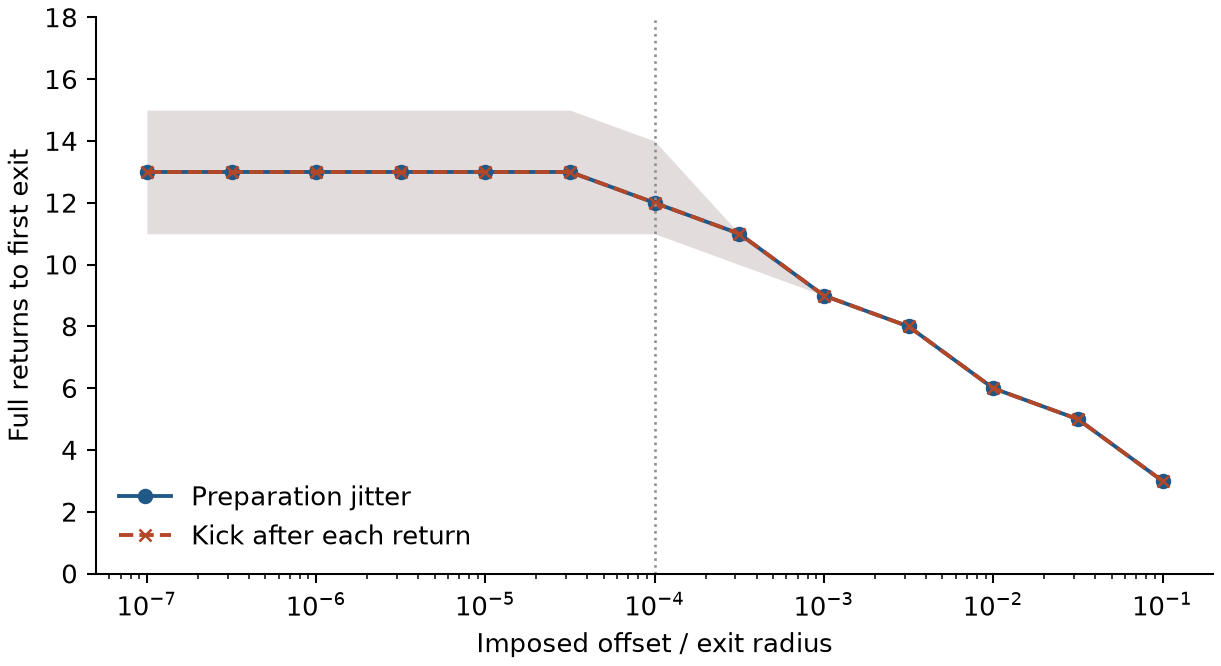
At zero imposed displacement both models give a median of 13 turns, with the middle 80% between 11 and 15. The vertical line marks the chosen rms preparation error. Below this scale, tightening the nominal launch has little effect. These noise levels are illustrative.
Calculation
Let be displacement in the left unstable direction after full returns, divided by the exit radius (0.02 in the section coordinates). Set and , with independent zero-mean Gaussian preparation error and per-return kicks . The exit count is the first such that . Iterating gives
At long residence times a kick of rms size contributes the same input variance as preparation jitter of size . This equality concerns the unconstrained displacement. We computed the plotted first-exit distributions by stopping each realization at its first crossing.
The preparation-only run uses rms error of the exit radius. The kick-only run uses per return. Each plotted point uses 65,536 realizations per model. In a second check we added the same kicks, along the unstable eigenvector, to the nonlinear two-dimensional Chua return. Of 288 paired trials, 285 had identical exit counts and three differed by one turn. The perturbations are discrete section kicks. A circuit noise spectrum would require a model of where the noise enters the circuit.
To separate the sources on a bench, record the actual precharge at release and the section coordinates on successive turns. In the linear model the residual removes the amplified preparation error. Applying that test to data also requires a measurement-noise estimate.
Reproduce
python -m pip install -r requirements-certificate.txt
python research/chua_residence_noise.py --output outputs/residence-noise
Quantiles and means · Section, seed and paired counts · Simulation