Toy vehicle physics
A runnable mathematical model for printed toy vehicles with N wheels, plus
independent buoyancy, parent-contact and cleaning comparisons. This calculator
lives under vehicles/toy-physics/ in Mathematical models.
Run commands from this folder. Printable kits remain in
3d-Models.
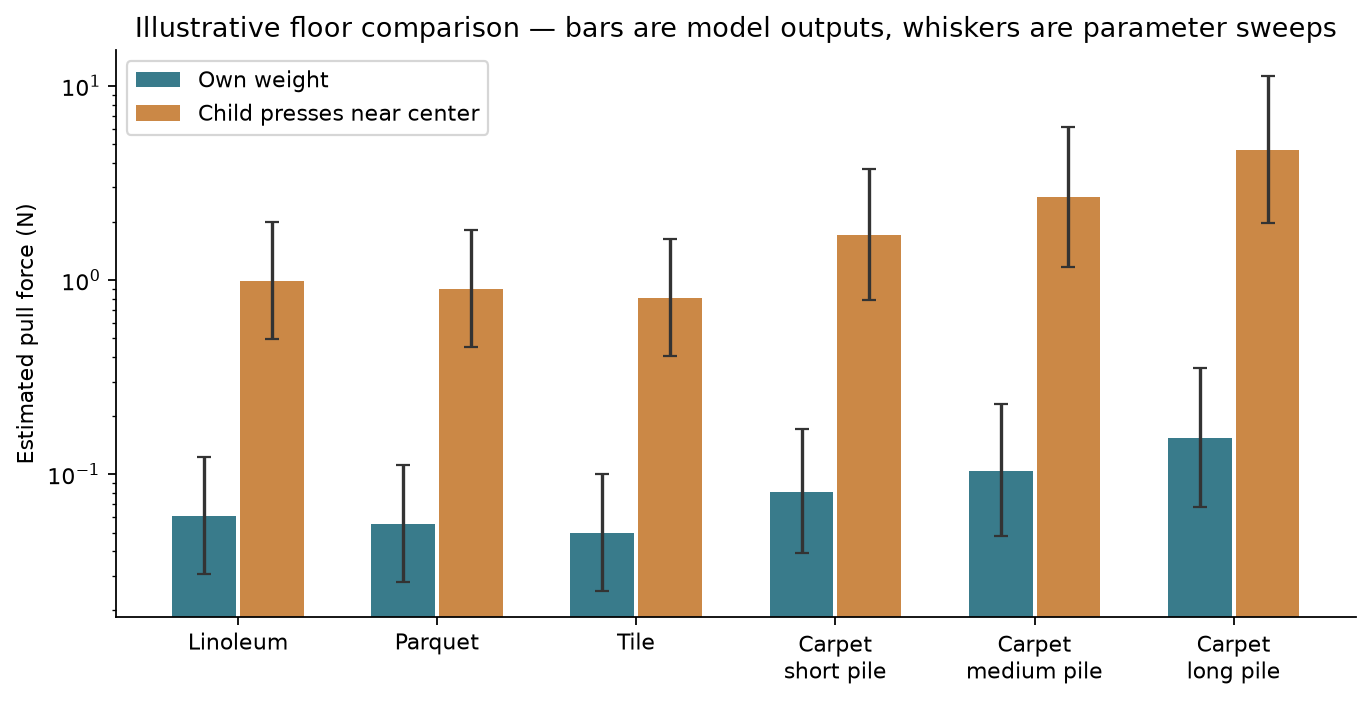
Open the example report locally, or inspect the numerical results on GitHub. The report includes linoleum, parquet, tile and short-, medium- and long-pile carpet examples.
Run
Python 3.11 or newer, with the dependencies in requirements.txt:
python -m pip install -r requirements.txt
python -m unittest discover -s tests -v
python run.py
python run.py --material PETG --output reports/petg
All computation uses SI: meters, kilograms, newtons, pascals, joules and radians. JSON keys contain units. Report figures convert selected outputs to mm, g or MPa. No paid services, API keys or network access are needed to run the model.
PLA is the default (1.24 g/cm³); the PETG reference profile uses 1.28 g/cm³.
Use --density-g-cm3 for your spool's value. Material selection updates
volume-based mass, contact elasticity, axle bending estimates and buoyancy.
The report compares both profiles and shows local axle stress utilization under
the child-load scenarios. See MATERIALS.md for manufacturer
sources, print direction, editable strength factors and override rules.
To change the toy or a scenario, edit the JSON files in examples:
| Input | Purpose |
|---|---|
material.json |
PLA/PETG, print axis, strength/modulus reductions, safety and stress concentration factors; optional density/property overrides |
vehicle.json |
Per-part polymer volumes/CG or fixed mass, plus arbitrary wheel list; geometry, contact properties, support stiffness, bearing friction and axle beam sections |
six_wheels.json |
Demonstrates more than three wheels and one wheel over a depression |
surfaces.json |
Floor properties; carpet pile, foundation stiffness, backing and losses |
loads.json |
Downward force or child mass × weight fraction, contact position and optional horizontal push |
buoyancy.json |
Separate floating bodies, shell thickness/infill, polymer density, flooding and optional ballast |
events.json |
Kick and step mechanics: speed, effective mass, stopping distance and contact area |
cleaning.json |
Brush/dirt size, gaps, pockets, drainage, layers and disassembly effort |
python run.py --inputs examples --output reports
python make_examples.py /path/to/3d-Models/vehicles/dune-trike/TRIKE_MINI_v06
The checked-in examples use v06. For the second command, use the complete v06 kit at CAD commit a53de1c, for example from a checkout of that commit. The CAD repository's current branch now contains v07; its v06 folder is a history pointer. Existing calculator results have not been silently updated to the revised geometry.
The second command regenerates all example inputs, including the trike's
mass/CG estimate from current meshes and plate object masses. Save customized
inputs elsewhere first. It does not edit the 3D model. run.py stores hashes of
every input JSON so the report can be traced to its inputs.
What is physical and what is assumed
- Force and moment balance: nonnegative wheel reactions, tipping, elastic load sharing for N > 3, wheel lift-off on uneven ground.
- Contact: cylinder-on-plane Hertz pressure for hard surfaces; a simplified compressible foundation for carpet. Printed tread is represented by a contact fraction, not resolved lug by lug.
- Motion: rolling-loss moment, journal friction, carpet deformation losses and an independent rigid-step climbing estimate.
- Child pressing: specified load and its position alter wheel reactions, pressures, axle stress utilization under assumed allowables, and tipping. This is a local beam screen, not a crush test or whole-toy strength check.
- Floating: actual clipped mesh volume and center of buoyancy, shell/infill mass, flooded voids, heave, roll, pitch and local restoring stiffness. The floating examples are independent boxes, not a claim that the trike floats.
- Parent contact: force, energy and pressure comparisons for a kick or step. There is deliberately no numerical pain or injury probability.
- Washability: a clearly labeled, adjustable heuristic for access, drainage, layer roughness and disassembly effort. No automatic mesh-based hygiene claim.
Floor presets and print reduction factors are illustrative, uncalibrated inputs. Material reference data come from the linked Bambu product sheets, with explicit specimen conditions; they are not measurements of this particular print. The half/double parameter sweeps are not confidence intervals. The model does not certify printed strength, impact safety or suitability for children aged 3+.
See MODEL.md for equations, geometry conventions, validity limits and primary references, and CALIBRATION.md for measurements that would make the estimates useful for this particular toy.