PITAYA v10: snag zones before printing
Next version: PITAYA v11 — revised fits and low tips. Both geometries were rechecked with 0.3.0 on the same 40 cases: 6 improvements, 0 regressions; straight and diagonal lifts under leaves still contact.
40 cases were checked with an additional radial allowance of 0.5 mm: 36 motions under six leaves (three routes, 2/4 mm diameters) and four full-turn platform checks with yarn near its rim.
Result: 8 clear with allowance, 30 with contact during motion, and 2 intersecting the body in the initial pose. These are deliberately chosen stress cases, not frequencies or probabilities of snagging during normal knitting.
What to revise or inspect in CAD
| Motion | 2 mm yarn | 4 mm yarn |
|---|---|---|
| Lift a loop straight up under a leaf | Contact, all 6 leaves | Contact, all 6 leaves |
| Lift diagonally outward | Contact, all 6 leaves | Contact, all 6 leaves |
| First outward at low height, then up | Clear with allowance, all 6 leaves | Contact with low tips, all 6 leaves |
| Yarn at the platform rim, full turn in both directions | Clear with allowance | Initial body contact |
The 4 mm yarn meets an obstacle even on the route that is clear for 2 mm yarn.
For leaf 1, the problematic surface is near
X=69.170, Y=45.457, Z=2.871 mm in the original cad/leaf_1.stl.
In assembly coordinates above the support surface, Z≈3.871 mm.
The case holds the center of the 4 mm yarn at 3 mm height during outward motion;
its nominal lower surface remains 1 mm above the support. The yarn's upper
surface meets the underside of the tip.
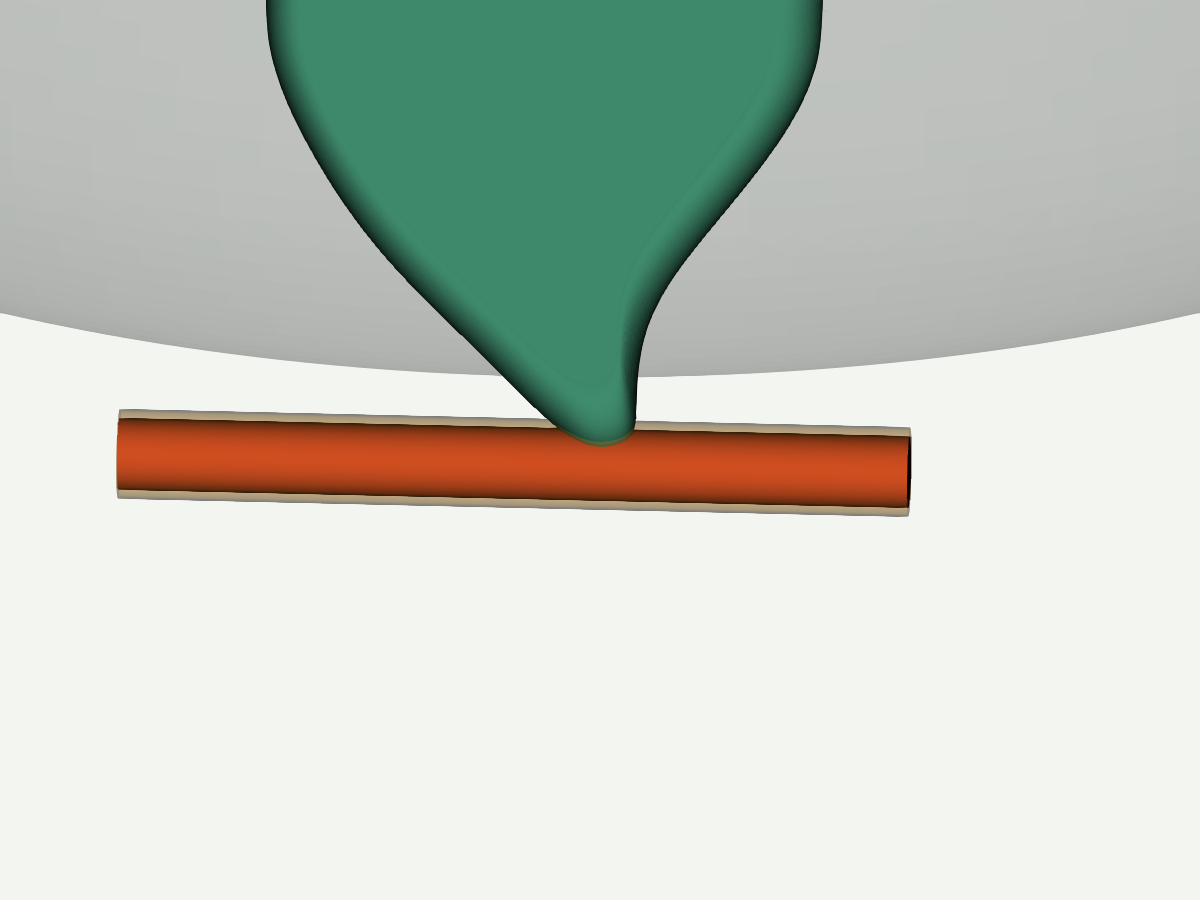
The red tube is yarn, the translucent envelope is the allowance, and green is the checked leaf. This prescribed pose shows a geometric obstacle, not a calculated deformation forcing yarn through the part.
Review the low tip and provide a continuous outward loop exit with sufficient clearance. Checking one fillet or only thin yarn cannot establish this. Repeat every saved route and diameter; changing leaf height also requires fit and strength checks.
The 4 mm yarn at the rotating rim already contacts the body in its initial pose. This does not prove rotational pinching or a successful release test. A valid initial yarn route near that rim must be determined separately.
Files
- HTML report and full JSON results.
- 40 original cases and assembly.
- Zone markers for importing over the corresponding STL.
python tools/run_snag_audit_parallel.py results/pitaya_v10_snags/scene.json results/pitaya_v10_snags/cases.json --out results/pitaya_new_revision --workers 3
python -m yarnstand snag-compare results/pitaya_v10_snags/audit.json results/pitaya_new_revision/audit.json --out results/pitaya_comparison.json
The check does not model automatic routing, yarn compression or friction, loop formation, or printed micro-snags. It identifies geometric risk zones and provides reproducible revision comparisons. Method and parameters.