PITAYA calculation results
All values below use assumed, unmeasured yarn and stand properties. Foot and platform dimensions come from CAD. These are guides for testing, not product certification.
Beside the hand on a desk
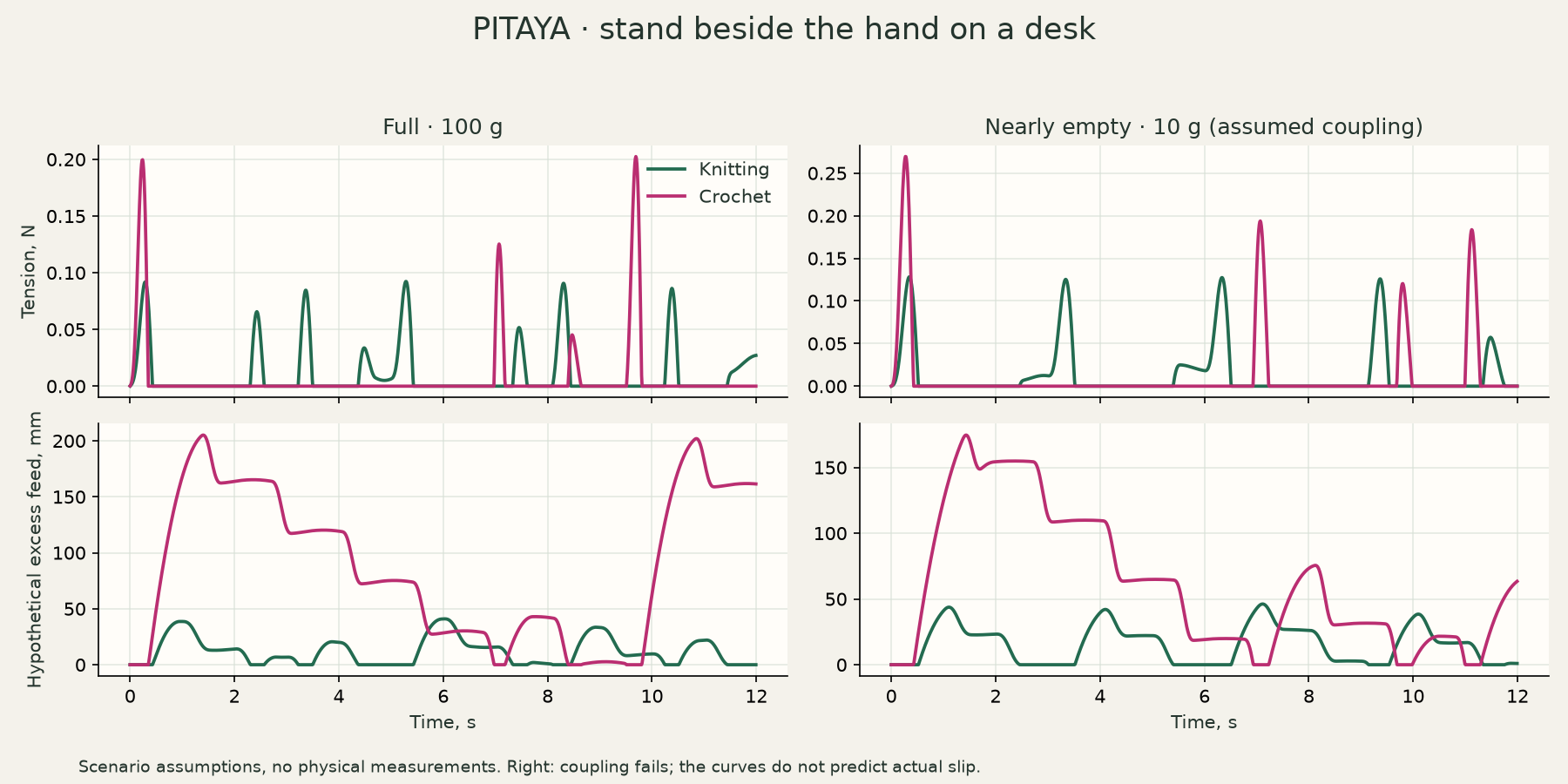
The working hand is 40 cm away horizontally and 20 cm above the surface under the feet. Stand mass: 230 g; full ball: 100 g; nearly empty ball: 10 g.
| Ball | Feed | Start, N | Coupled-model peak, N | Snag threshold, N | Traction throughout run |
|---|---|---|---|---|---|
| Full | Knitting | 0.029 | 0.092 | 1.34 | yes, under the assumptions |
| Full | Crochet | 0.029 | 0.203 | 1.34 | yes, under the assumptions |
| Nearly empty | Knitting | 0.040 | 0.128 | 0.97 | no; hypothetical peak |
| Nearly empty | Crochet | 0.040 | 0.270 | 0.97 | no; hypothetical peak |
The nearly empty ball lacks platform traction in the baseline scenario, so its dynamic peaks must not be presented as actual forces. Spindle fit is particularly important; the separate spindle_grip analysis shows the effect of additional retaining torque.
What the comparison shows
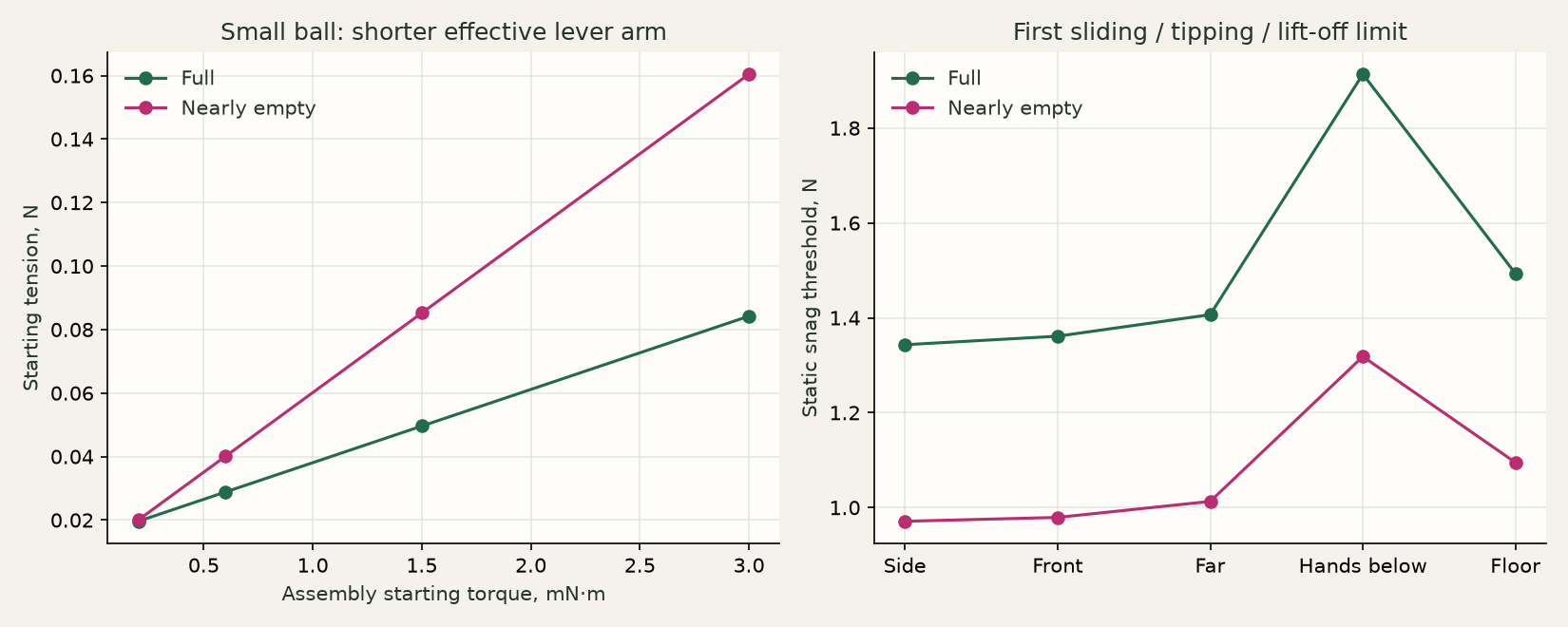
- A smaller ball radius increases starting tension at the same assembly resistance. Lower mass does not guarantee easy feed.
- Sharp pulses in the selected crochet scenario cause more acceleration and overrun. This follows from the prescribed rhythm, not an inherent property of crochet.
- With default parameters, no PITAYA sliding or tipping was detected during normal feed. The roughly one-newton threshold concerns snagging and is not a large margin against a strong hand pull.
- With hands below a tall stand, a low exit from a nearly empty ball can intersect the rim. Changing leaf shape does not remove this cause: relative hand and stand heights matter more.
- A steep upward pull reduces the effective lever arm and ball contact force. Yarn may unwind in a different mode outside this model.
- Wider support raises the tipping limit but does not fix slippery feet. Compare actual contact geometry, not the diameter of decoration.
Check coverage
- 80 stand × ball × rhythm × position scenarios.
- 69 sensitivity cases: assembly resistance, foot friction, yarn elasticity, layer peeling, and spindle fit.
- 864 geometric path checks: two leaf types, two balls, three positions, three exit heights, and 24 azimuths. This is a check grid, not probability statistics.
- Analytical tests for equilibrium, tangency, rotational invariance, integrated feed, configuration errors, and time-step convergence.
For physical testing, start by checking low rotational resistance and the fit of a nearly empty ball. A normal desk beside the hand is a reasonable starting setup. After printing, enter measurements following the calibration guide.