How a tiny segment unfolds into the serrated arch
A finite evolution experiment and complete inverse-image certificates in an existing algorithm. Historical uniqueness remains unresolved.
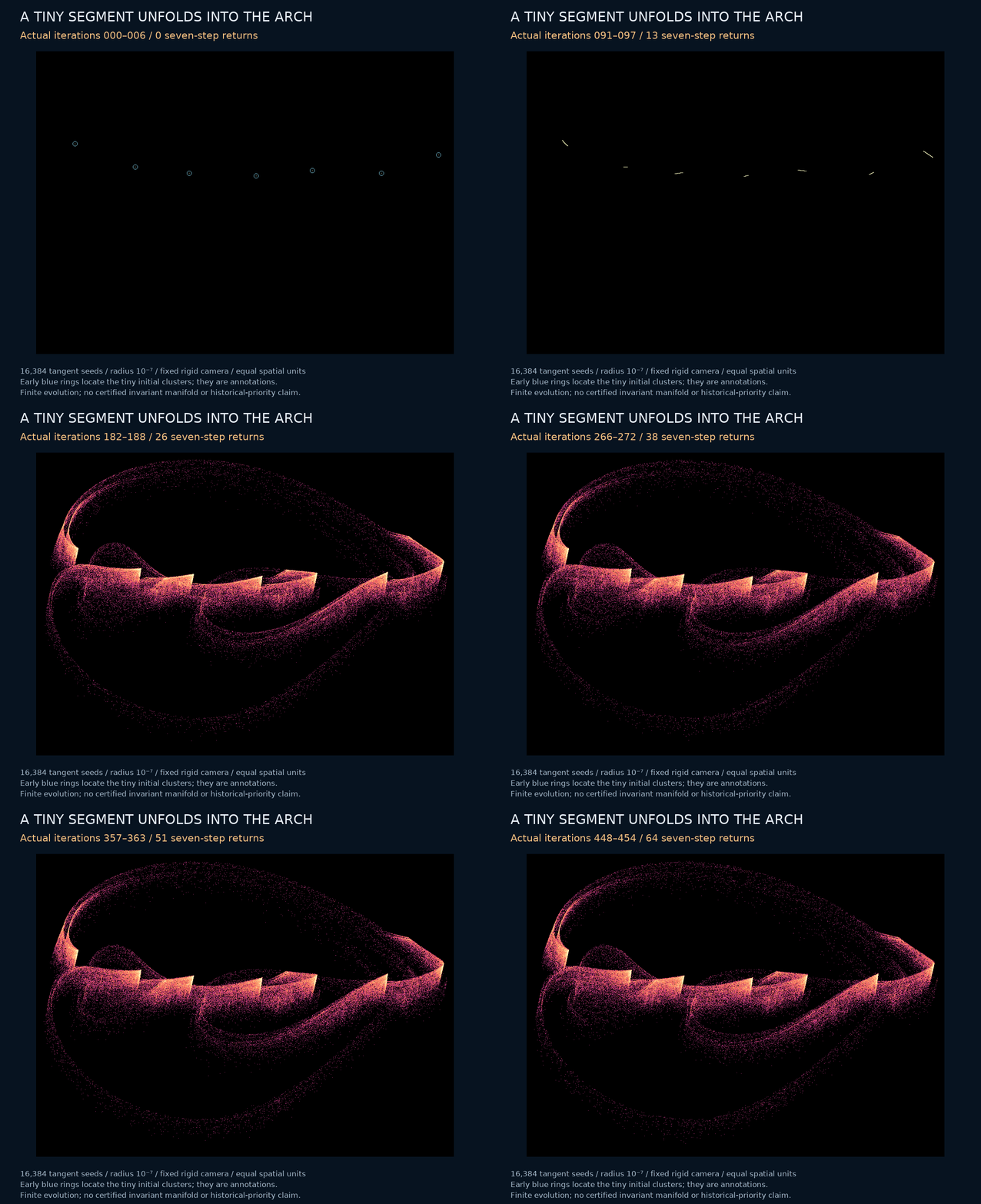
The animation shows actual states of the spatial-circle RAAR map. We start with 16,384 points on a straight segment of radius 1e-7, tangent to the unstable direction of its certified seven-cycle. Each frame combines seven successive phase offsets. The camera, spatial scale and density scale are fixed; the early blue rings only locate subpixel clusters. The frames run from iterations 0–6 to 448–454. No interpolation connects states into artificial continuous orbits.
Seven-page research note · Editable source and reproduction · Rotate the long-run cloud · Periodic structure · Priority audit

All six controls
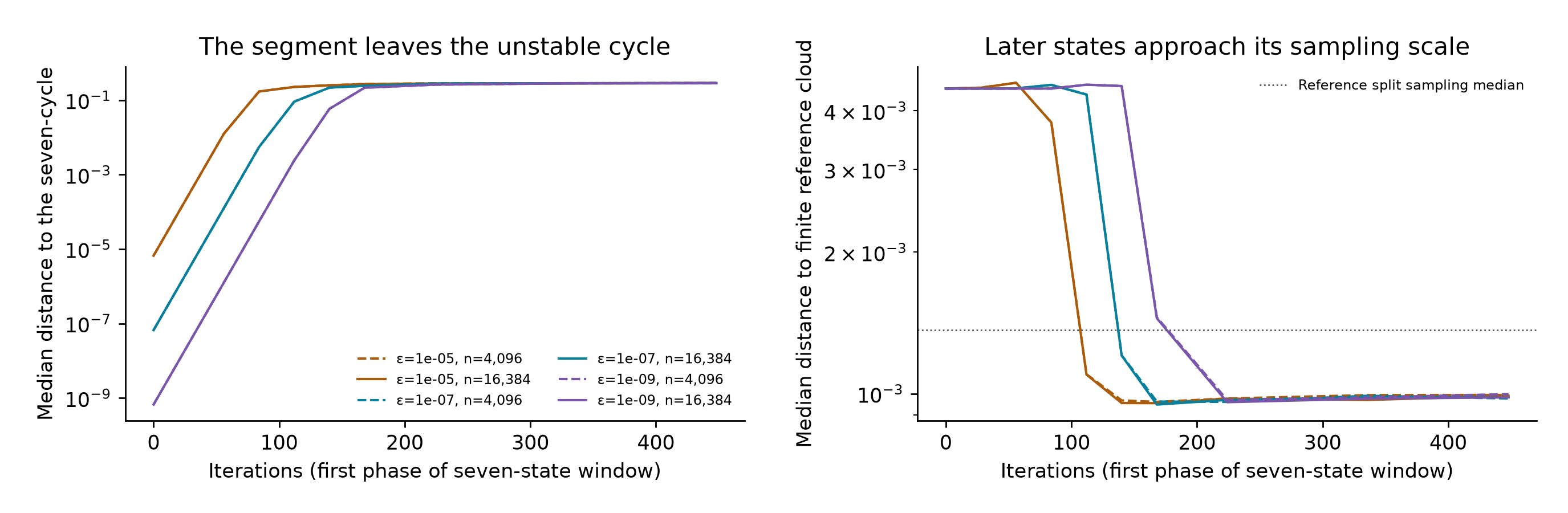
Three initial radii (1e-5, 1e-7, 1e-9) and two counts (4,096 and 16,384) give six runs. All 61,440 trajectories complete. Smaller radii delay the visible unfolding. Final median distances to the million-state reference are 0.00097658–0.00099755; the median distance between two half-reference samples is 0.00136408. These are unequal-density finite-sample comparisons, not proof of equality of invariant sets or asymptotic attraction.
The initial segment is a numerical tangent construction, not a certified invariant-manifold chart. All ten saved snapshots and all 65 original histograms reproduce exactly in the higher-resolution rendering replay. Every point contributes to the histogram; no count is clipped by the common crop. The final animation displays native histogram pixels, with density normalized by pixel area.
Exactly two or four preimages
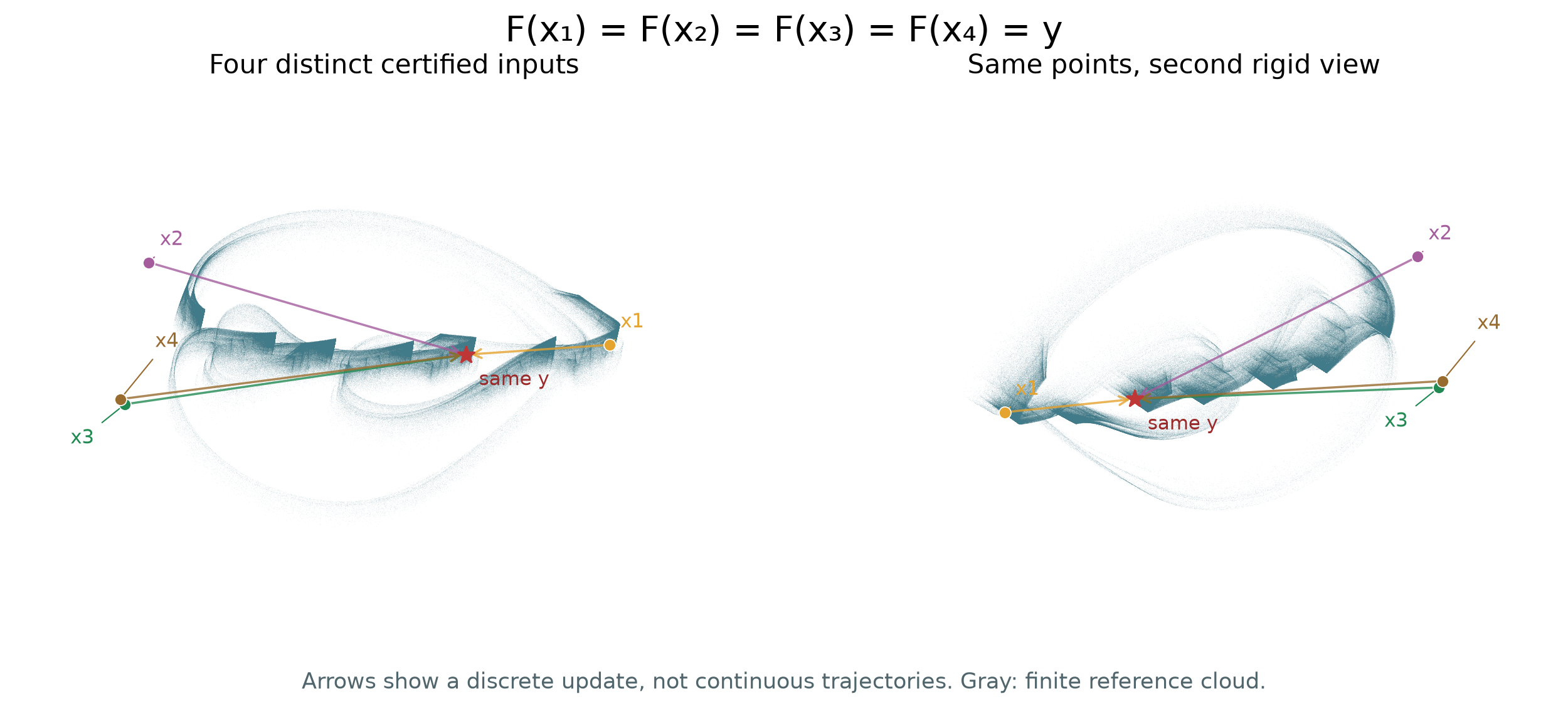
For 25 exact binary64 targets selected at evenly spaced indices of the reference cloud, an interval-Sturm calculation gives complete counts in the map's regular domain:
| Complete count | Targets |
|---|---|
| Exactly two preimages | 18 |
| Exactly four preimages | 7 |
| Total certified preimages | 64 |
The four-preimage indices are 254999, 499999, 540832, 826665, 867499, 908332, 949165. The figure uses target 254999; arrows denote a single discrete update. An independent nested-reflector map and derivative verify all 64 inputs by strict Krawczyk inclusion, positive projection-axis distances and containment in the corresponding Sturm boxes.
The proof reduces F(x)=y to a degree-eight polynomial in tan(γ/2). It isolates all real roots, removes extraneous sign branches using both nearest-projection radial tests, and excludes the omitted angle and zero-length exceptional case. The note provides the derivation. The packet retains numerical proposals, complete interval certificates, every revision and independent checks.
The initial near-cloud numerical search found one preimage per target. The subsequent global search found the extra inputs away from the finite reference sample. Both outcomes are retained. Thus the full map is noninjective, but noninjectivity of its restriction to an asymptotic attracting set is unproved. This excludes a global coordinate conjugacy to an injective map on a domain containing the certified inputs and common image. It does not distinguish the candidate from all known noninvertible chaotic maps.
A certified smooth fold near the sampled cloud
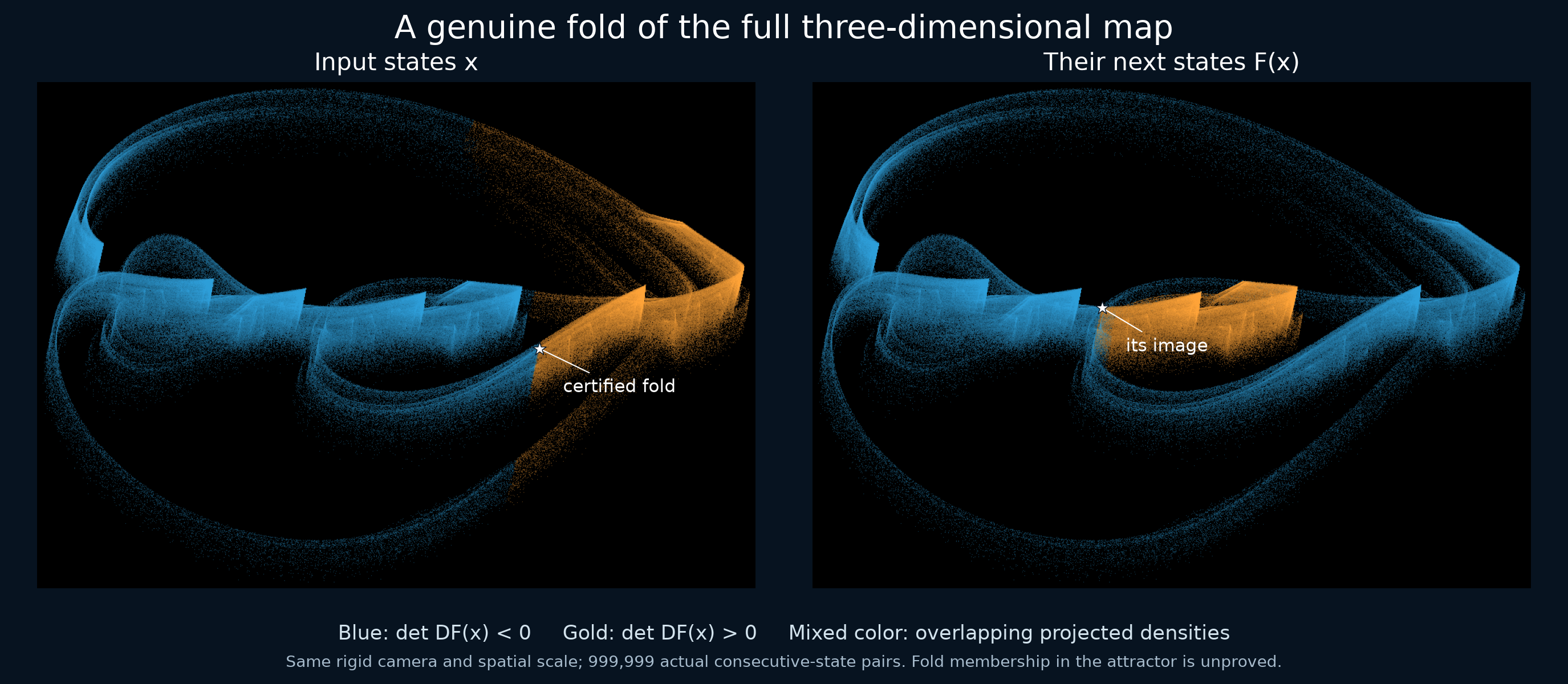
The figure follows all 999,999 consecutive-state pairs through one update. Blue and gold indicate the sign of the full three-dimensional Jacobian determinant at the input. The same colors follow the points to their outputs. Overlapping colors in this projection do not assert equality of three-dimensional states.
A 200-digit interval-Newton calculation certifies a critical point on the segment between exact reference states 857629 and 993053, less than 0.000042 from the latter. A strictly nonzero Jacobian minor establishes rank two. The determinant gradient dotted with a certified kernel vector lies in (-0.05230, -0.05228). Thus the critical hypersurface is smooth and the kernel is transverse to it: the standard smooth-fold criterion applies. Both projection-axis distances stay strictly positive.
A later membership theorem proves that a smooth fold belongs to the certified attracting set K. It does not identify that fold with the particular near-cloud point located here.
This is a local property of the full map, not an artifact of viewing a three-dimensional object in a flat picture. However, membership of the certified point in an asymptotic attractor is unproved, and this calculation does not identify the cause of the entire arch. Folds themselves are classical; the normal form uses different source and target coordinates and is not a dynamical conjugacy. The criterion is stated in Montgomery (2014), Appendix B. The complete packet retains the proposal, sampled determinants, both proof revisions, independent Hessian cross-check and both rendering revisions.
What this adds, and what remains open
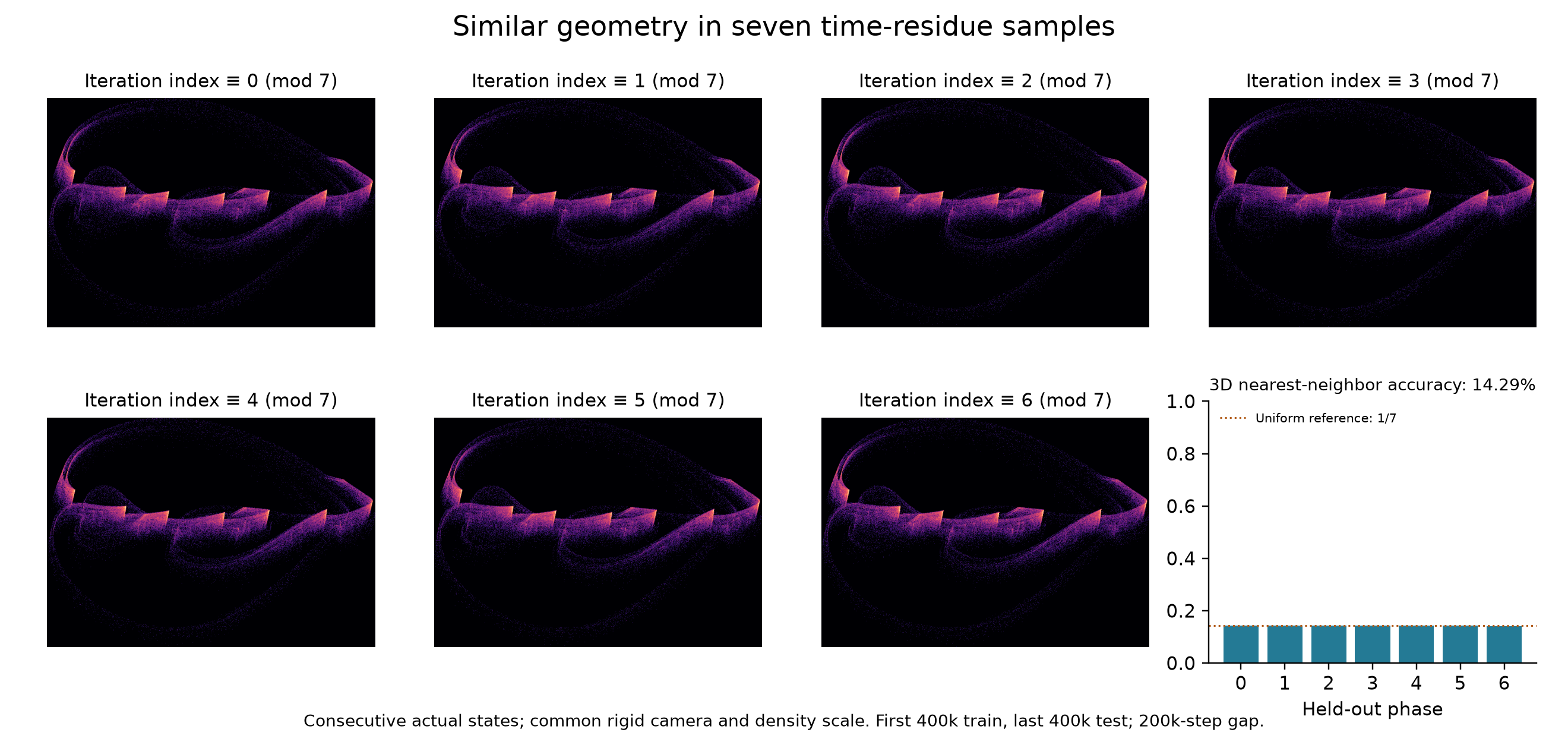
The seven visible tips do not give seven separable time-residue clouds in this finite diagnostic. Labeling each of the million states by its iteration number modulo seven produces similar density portraits. A nearest-neighbor classifier in the actual three coordinates predicts the phase of 400,000 held-out states with accuracy 0.1429225, close to 1/7. Training and test segments are separated by 200,000 steps. This is not an ergodicity, mixing or connectedness theorem. Complete arrays and source.
The result adds a visible formation process and exact inverse-image structure to the existing spatial-circle case study. It does not introduce RAAR, projection-search chaos, period doubling, noninvertibility or interval verification as new ideas. The main text of Elser, Rankenburg and Thibault (2007) is now reviewed; its supplement remains a gap. The new review record supplements earlier frozen reviews.
The extended priority audit also credits Elser's explicit 2001 attractor portrait and distinguishes the RRR relaxation from RAAR. The seven-page note includes the earlier citation, time-residue diagnostic and smooth-fold certificate.
No exact match has been located in the bounded review. Proving a new attractor class still requires a broader equivalence review and rigorous asymptotic dynamics. The current evidence supports an unusual, reproducible candidate, not the assertion that nobody has seen an equivalent attractor.