A fold belongs to the attracting RAAR set
A certified ambient-equivalence obstruction, with historical uniqueness still unresolved.
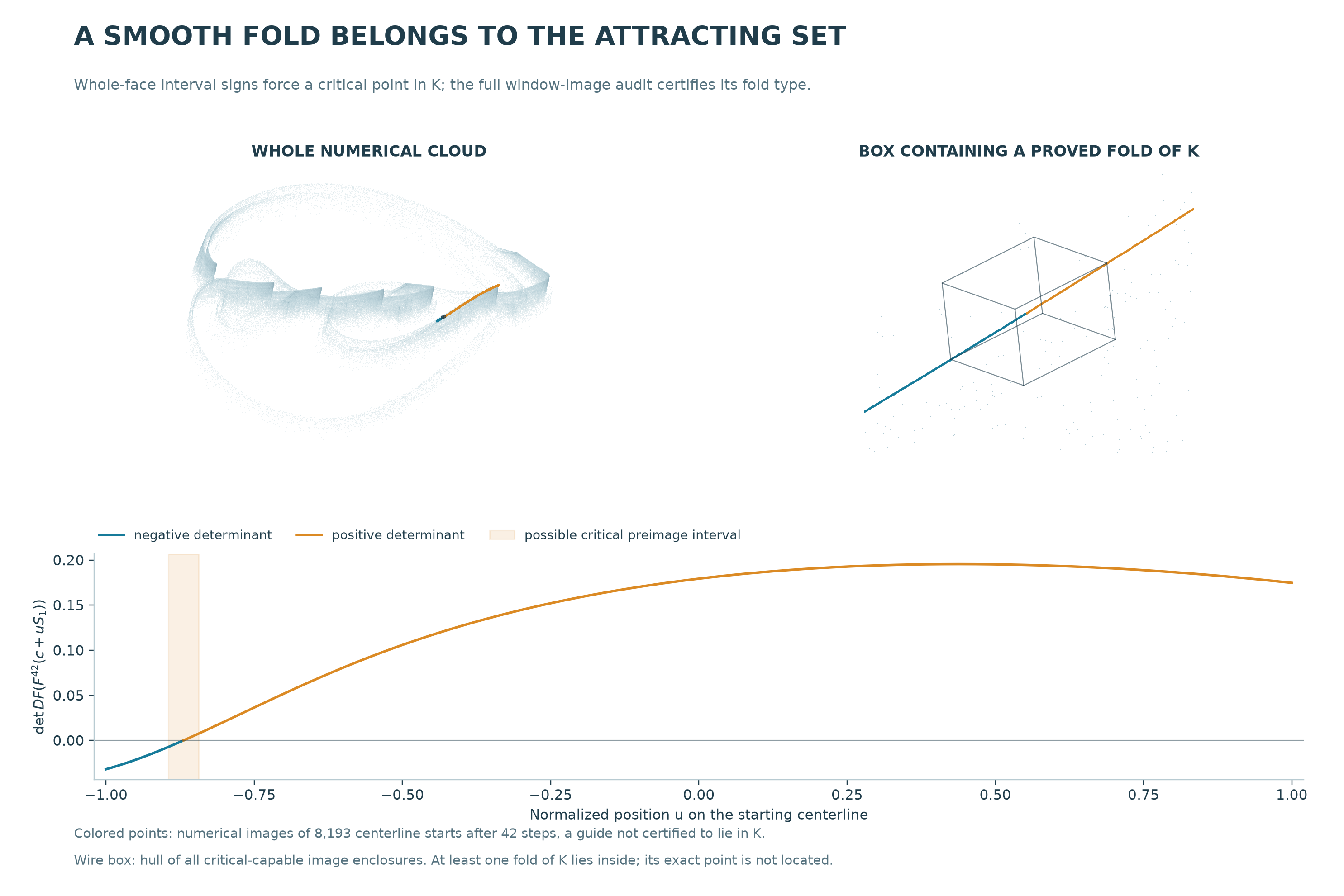
The strict trapping construction gave an attracting invariant set K with positive topological entropy. We now prove that K contains a smooth Whitney fold of the actual three-dimensional map. This closes the membership gap left by the earlier near-cloud fold certificate.
Mathematical proof · Companion article · Reproduction · Frozen evidence
The wire box contains at least one proved fold of K. The colored guide consists of 8,193 actual images of a starting centerline after 42 iterations. That centerline is not certified to lie in K; it illustrates the geometry without substituting a sampled curve for the proof.
What distinguishes this result
At a fold, the full map is noninjective on every open neighborhood of that point. Since the point belongs to K, no ambient homeomorphism can conjugate the map on an open neighborhood of K to a map locally injective throughout the image of K. This excludes local diffeomorphisms under this precise notion of equivalence, even if the coordinate change is not differentiable.
For a concrete comparison, Gierzkiewicz (2021)
studies the known three-dimensional map
H(x,y,z)=(1.76-y²-0.1z,x,y) and certifies symbolic dynamics and hyperbolicity.
Its explicit inverse is (X,Y,Z) -> (Y,Z,10(1.76-Z²-X)). Our new result
therefore excludes an ambient-neighborhood conjugacy to that particular
generalized Hénon map. The word “folded” in its portrait name is not a
singular-Jacobian certificate.
This does not prove that F|K is noninjective: the nearby pairs witnessing
the fold need not both belong to K. It does not exclude a conjugacy defined
only on the invariant sets, identify the whole sampled cloud with K, prove
transitivity, or establish a new historical attractor class.
How membership is proved
- Reduce the two stable widths of the earlier saddle window to the exact
binary64 lifts of
1e-5and1e-6. The new window N remains inside Q. - Verify that
F^7takes opposite faces past the opposite sides of N, while any image whose unstable coordinate lies in N has both stable coordinates strictly inside. Two implementations verify the whole volume and faces. - Repeatedly select crossing subpaths. A compact Hausdorff limit is a connected subset of K crossing both faces. This argument requires no certified smooth unstable-manifold chart.
- On the two whole faces,
det DF(F^42(x))has strictly opposite signs. Continuity forces a critical point in the image of the connected subset, hence in K. - Classify every 42-step window image as regular or satisfying the standard corank-one fold criterion at any critical point it contains.
| Complete check | Vector formulas, 70 digits | Scalar automatic derivatives, 100 digits |
|---|---|---|
| Self-covering volume leaves | 60 | 41 |
| Self-covering exit-face leaves | 2 | 2 |
| Opposite-sign face leaves | 2 | 2 |
| Regular image cells | 452 | 270 |
| Fold-capable image cells | 26 | 13 |
An additional unreconditioned face calculation passes with five leaves. The implementations share their interval library and subdivision infrastructure; they are not wholly independent software stacks. Separate accounting checks verify full partitions, inequalities, exact window containment and all frozen dependency hashes.
At least one fold lies in the outward box
[0.20984,0.22744] × [-2.86973,-2.84328] × [3.86195,3.88395].
The proof does not select a unique point within that box.
Prior art and remaining uniqueness question
The priority record keeps the reviewed sections, access limits and bounded queries. RAAR and projection search chaos are established prior work. The fold criterion is classical; see Montgomery, Appendix B. Garst and Sterk (2016) already describe folded strange-attractor candidates in a noninvertible planar map. Their institutional abstract was reviewed; the full paper remains a gap.
The contribution is a fold-membership certificate and a precise ambient equivalence exclusion in this exact geometric instance. It strengthens the case study without claiming that folding, algorithmic chaos, or every aspect of the attractor is new.