Yarn Stand Simulator
Part of Mathematical models, under yarn/stand-simulator/.
Run this calculator's commands from this folder. Package and CLI names remain
yarn-stand-simulator and yarnstand after the repository rename.
A small, reproducible mathematical model of a rotating yarn stand. Compare full and nearly empty round balls unwound from the outside, knitting and crochet rhythms, desk and floor placement, mass, feet, and rotational drag.
The example values are engineering assumptions pending trial prints and measurements. This is not a hand-comfort rating or a model of individual fibers. The results help identify what to change and test physically.
Interface preview · English
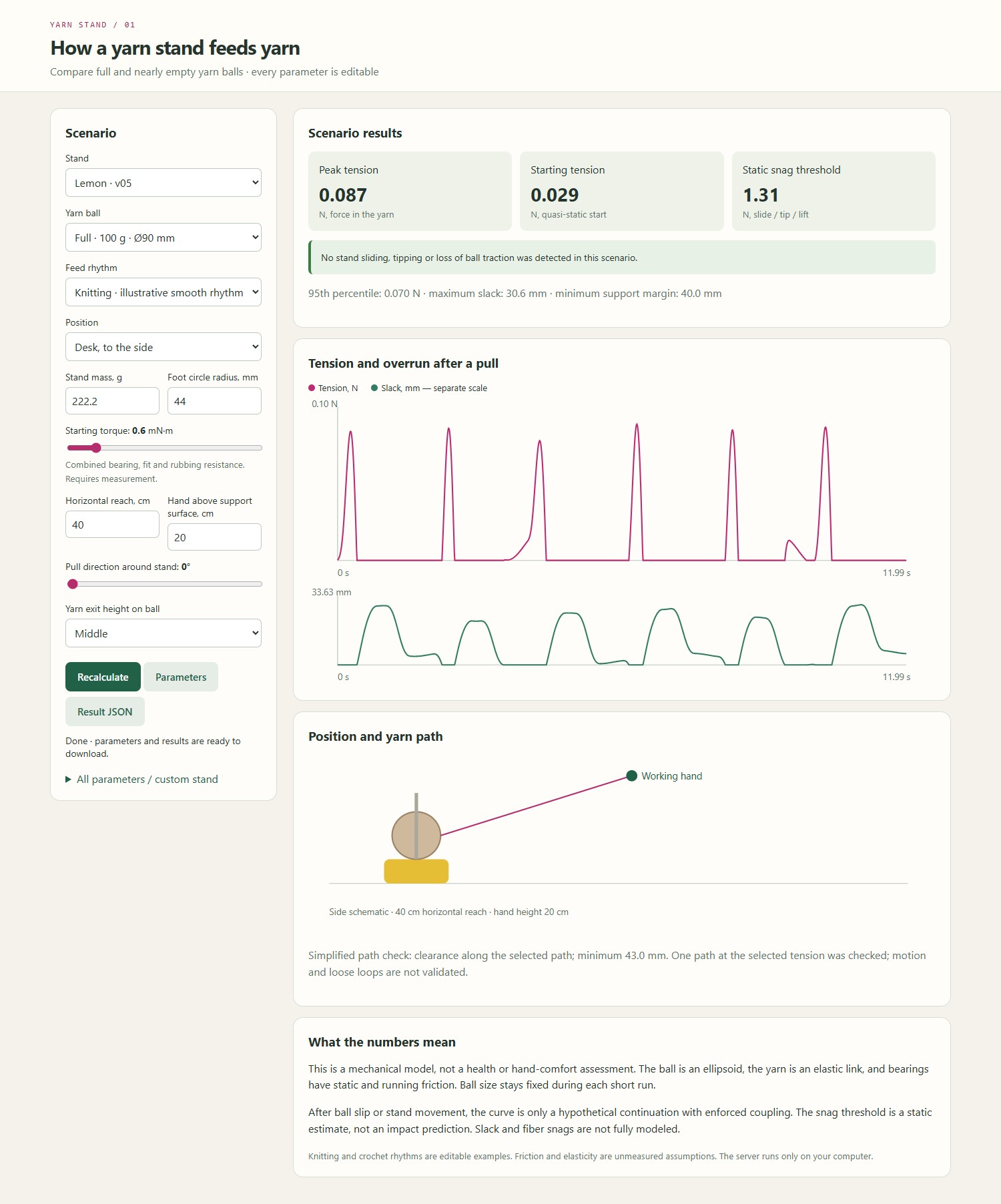
The local browser UI includes editable scenarios, tension and slack plots, a side schematic, model-validity warnings, and JSON import/export. These are screenshots of the running app with the Lemon v05 preset.
After python -m yarnstand serve, open
http://127.0.0.1:8765/?stand=lemon_v05.
The interface, documentation, and generated reports are in English.
Existing links with lang=en or lang=ru also open the English interface.
Full ball, 100 g · illustrative knitting rhythm · desk-side position
Compare: nearly empty ball, 10 g — model-validity warning
Select Nearly empty · 10 g · Ø42 mm in the Yarn ball menu. The model flags loss of ball traction at 0.14 s. The later curve and its overall peak are hypothetical; the peak before the first event is 0.026 N.
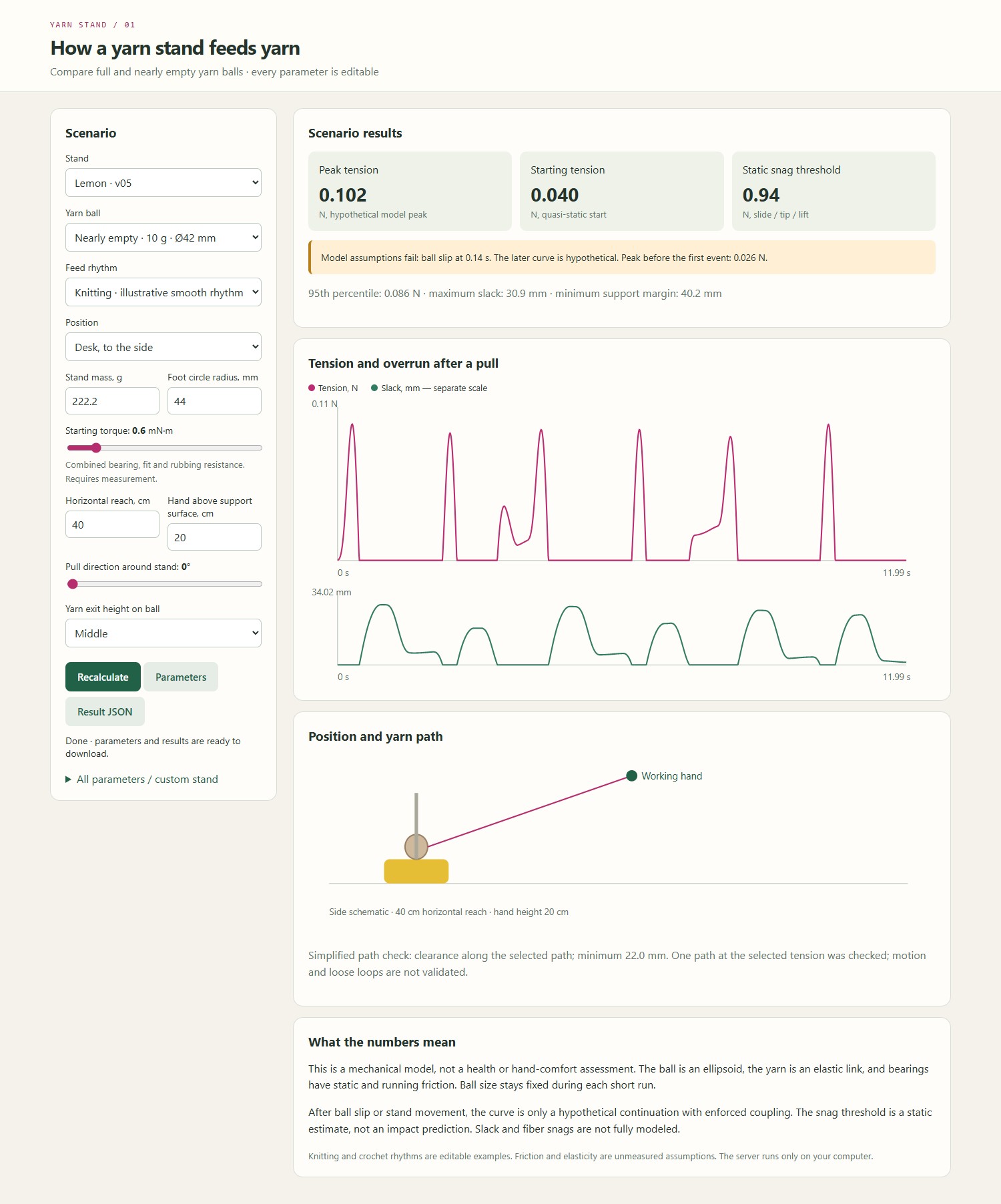
The screenshots use the saved Lemon v05 input. Mass and inertia are estimates; friction is unmeasured. The side view is a simplified schematic, and its fast path check does not replace an exact STL audit.
Running the simulator
Python 3.10 or later is required. The core calculation and interface use only
the standard library: no package installation or GPU is needed.
Run commands from this calculator's folder (yarn/stand-simulator), not the
repository root.
python -m yarnstand serve
Open http://127.0.0.1:8765. Adjust the ball, hand position, rhythm, mass, foot circle radius, and friction. All parameters / custom stand exposes the complete configuration, including a custom support polygon. Data stays on your computer. Stop the server with Ctrl+C.
Open /?stand=lemon_v05 to start with Lemon.
# Create editable parameters
python -m yarnstand preset --ball nearly_empty --motion crochet --setup high_table --out examples/my_stand.json
# Edit the JSON values, then run the calculation
python -m yarnstand run examples/my_stand.json --out results/custom.json
# Reproduce comparison tables and sensitivity analysis
python -m yarnstand suite
python -m yarnstand sensitivity
# Check physical limiting cases and numerical convergence
python -m pip install ".[mesh]"  # Full test suite, including STL checks
python -m unittest discover -s tests -v
# UI state checks (development only; Node 18+)
node --test tests/test_ui.js
Installing the package is optional: python -m pip install . adds the
yarnstand command. Report figures additionally require matplotlib:
python -m pip install matplotlib, then python tools/make_report.py.
What it calculates
- Starting, mean, 95th-percentile, and peak yarn tension.
- Acceleration, stopping, and hypothetical excess yarn feed during overrun.
- Onset of stand sliding, tipping, or lift-off.
- Whether traction is sufficient for the ball and platform to rotate together.
- A rough taut-yarn path check near the rim and decoration.
- STL snag-risk checks: prescribed loops, rotating parts, print and fuzz
allowances, CAD coordinates, and revision comparisons (
snag-audit,snag-compare). - Sensitivity to bearing friction, foot friction, and unwinding resistance.
The knitting and crochet rhythms are two editable feed examples, not results from a study of knitters. Change the draw length, period, active fraction, and hand-motion amplitude as needed. Hand height is measured relative to the surface under the feet, not the platform top. Negative heights are allowed.
Stand examples
lemon_v05 is the final leafless lemon: a Ø96 mm platform at a height of 45 mm,
with six Ø10 mm feet on a 44 mm radius. Its mass of 222.189 g, rotor inertia of
0.0000332773 kg·m², and center-of-mass height of 30.011 mm are saved estimates
from the LEMON v05 calculation, not measurements. Friction retains the
original assumed values. A conservative axisymmetric envelope is used only
for the fast path check; it does not reproduce the asymmetric lemon body.
Reproduce the parameters from examples/lemon_v05.json.
peach_v13 has a platform 70.7 mm above the table and six Ø7.9 mm feet
on a 54 mm radius. Its mass of about 300 g and inertia of 0.0000545 kg·m²
come from CAD, diagnostic slicing, and hardware assumptions, not measurements.
Choose it in the interface or open /?stand=peach_v13.
Peach leaves are not approximated by ellipsoids in the fast schematic: check
their actual STL files separately with mesh-check and mesh-sweep.
pitaya_v08 uses PITAYA v08 geometry: a Ø104 mm platform, six Ø10 mm feet
on a 52 mm radius, and a platform top about 45 mm above the table.
Its mass of 230 g and rotor inertia of 0.000065 kg·m² are estimates,
not weighed values. The feet determine the support area, not the pink body's
outer diameter.
pitaya_v09 has wide stylized leaves (about 34 mm). Mechanism parameters and
mass estimates are unchanged; the leaves use wider approximate ellipsoids.
These are not exact CAD surfaces. Example:
python -m yarnstand preset --stand pitaya_v09 --out examples/pitaya_v09.json
python -m yarnstand run examples/pitaya_v09.json --out results/pitaya_v09.json
A check of selected zero-thickness paths against the v09 STL is saved in
results/pitaya_v09_mesh_paths.json.
It does not model ball deformation or loose loops. The original
scenarios.csv and sensitivity.csv still refer to the v08 specified in them.
With the unpacked v09 CAD package, reproduce this check separately:
python -m pip install vtk, then
python tools/check_pitaya_mesh_paths.py /path/to/PITAYA_v09.
This optional script expects the PITAYA assembly coordinate system;
the core simulator still runs without VTK or CAD files.
wide_feet is a hypothetical alternative stand with feet on a 62 mm radius;
it is not a finished PITAYA body modification. light_small represents a light,
compact design. high_drag represents a stiffer rotating assembly.
Full ball: 100 g, semi-axes 45×45×44 mm. Nearly empty: 10 g, 21×21×23 mm. The fixed size in each 12-second run is a snapshot, not a simulation of an entire evening's yarn consumption. A 200 g ball is also available in the interface, with an explicit warning when it overhangs the platform.
Interpreting results
Check path_screen and nominal_path_valid first. Body contact, an exit point
inside the ball, or a yarn path entering the ball make the force calculation
conditional even when support and traction hold. The interface displays this warning.
hypotheses_valid_for_entire_run combines these checks; it does not certify
all moving or loose loops. New presets use unwind_radius_ratio=1;
an imported legacy value of 0.85 is preserved but does not establish outside unwinding.
Check first_events_s next. After slip or loss of support, the curve is a
hypothetical continuation with enforced coupling. It does not predict
the motion of a ball that has already slipped. Do not compare these peaks
as exact forces during real knitting.
valid_coupled_interval_end_s and peak_tension_before_first_event_N
identify the interval before the first violation of these conditions.
Every JSON trace point includes coupled_assumptions_valid; later peaks
must not be presented as a calculation of a slipping ball.
critical_snag_N is the quasi-static external-force threshold at which a
support condition first fails. It is not an impact calculation.
max_slack_m is excess feed with ideal unwinding during overrun; real loops
may sag, wrap around the ball, or snag. Large slack triggers a separate warning.
The model does not cover center-pull unwinding, falling stands, soft sofas, ball deformation or collapse, detailed winding structure, FDM micro-snags, changes in human posture, or tension applied by fingers after the stand. Steep pull angles receive a separate warning: yarn may come off over the top of the ball instead of driving rotation in the assumed mode.
- Equations, units, and limits
- Peach v13 review
- Peach v14: exit clearance and bearing fixes, compared with v13
- Quick calibration after printing
- PITAYA and comparison results
- PITAYA v10 review archive and unchanged CAD fits
- PITAYA v11: revised leaves, fits, and recalculation with 0.3.0
- Audit fixes and the v10 recalculation archive with 0.2.0
- Snags: reviewing CAD before printing
- Raw scenarios
- Sensitivity
All input parameters are saved with the result. JSON exports represent undefined
or infinite values as null; events and statuses retain the reasons.