What this search found
Research snapshot updated 1 November 2026. We have several independently checked numerical chaos candidates, but no established discovery of a previously unpublished attractor or a new topological attractor class. That distinction is the central result of this investigation.
A localized Gaussian-vortex flow adds a continuous three-state construction. Its three-throat image contains 4.8 million actual states; a 30,000-unit run and independent adaptive check retain positive expansion. Twelve of sixteen fresh starts remain chaotic under the finite window criterion, while four approach a numerical cycle. A 108-regime geometric audit, including general affine-coordinate controls, identifies Halvorsen as the closest reference. The equation-level distinction from polynomial flows does not establish new topology or historical priority. The audit also incorporates the known 1988 special case of our earlier twist family.
A geometry-first construction now provides two detailed three-dimensional images. The three-axis twist search selects a folded sail and a medusa-like form from 4,096 parameter rows. Each still shows eight million actual iterates; four-million-step full spectra and 70/90-digit finite separations retain positive growth. Fresh-start and nearby-parameter cohorts expose a competing three-cycle for the sail. The explicit norm and determinant identities establish a compact global attractor of zero volume, but do not prove chaos of either pictured component or historical novelty.
A new direction examines the correction algorithm itself. The scalar-quadratic AdaBelief study finds a branching three-state numerical candidate with spectrum approximately (0.20261, -0.37938, -2.37428) over two million observed iterations. Upstream-code execution and high-precision finite secants support the positive rate. A nearby apparent positive instead settles into a 54-step numerical cycle. Rectification and AMSGrad controls, exact option choices, related Adam/RMSProp precedents and the unresolved priority boundary are recorded explicitly.
The most informative observations
First recorded portrait: 2026-10-30.
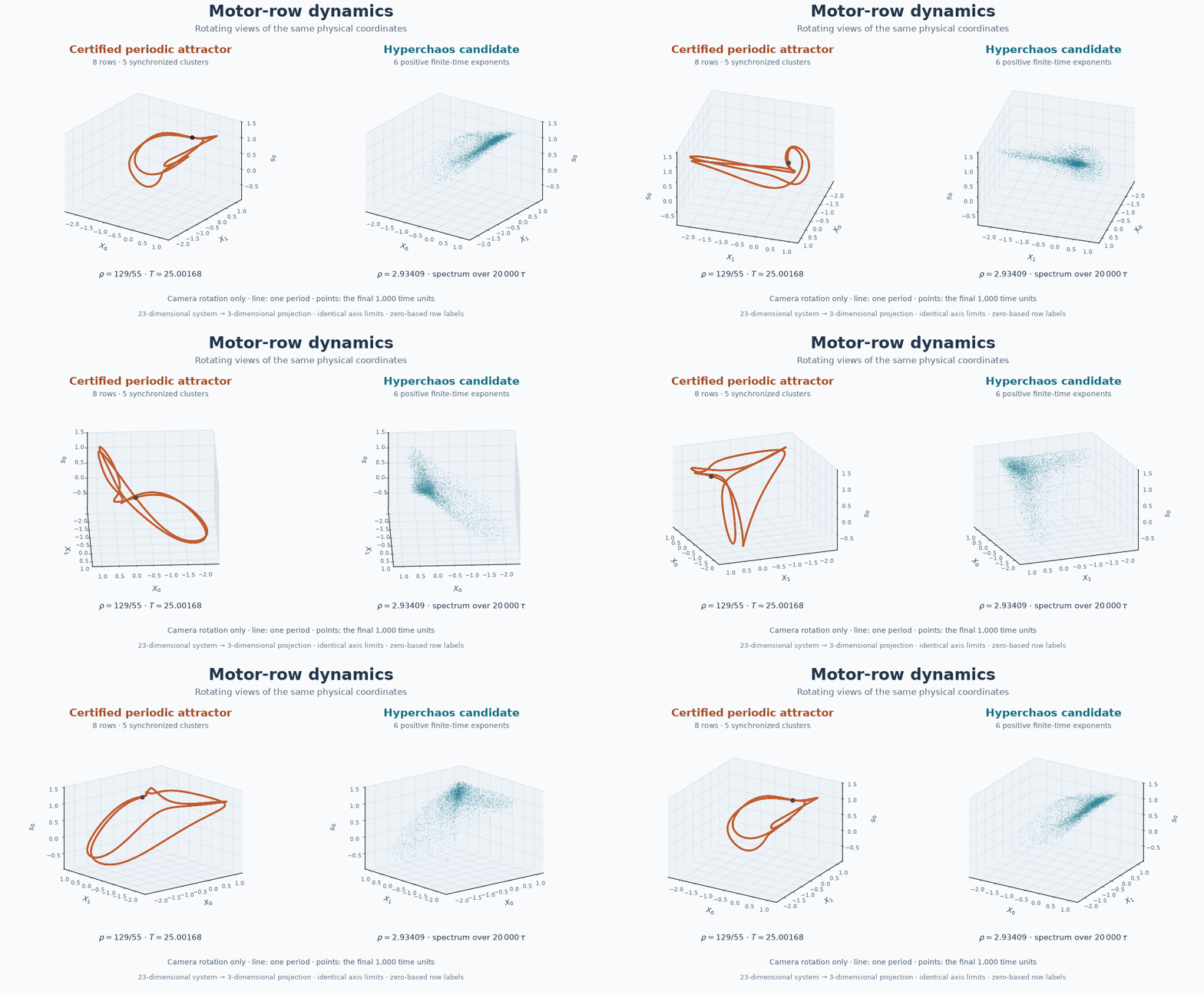
The rotating views use the same physical coordinates and scales. The periodic orbit on the left has a separate attraction certificate; the irregular trajectory on the right remains a finite-time candidate. Visualization sources and reproduction.
A five-cluster periodic attractor is now rigorously certified. At exact rho=129/55, interval multiple shooting proves an orbit with multiplicities 2+2+1+2+1, one neutral flow multiplier and twenty-two multipliers of modulus below 0.13. A recomputation at higher precision and changed discretization passes independently. Exact symmetry algebra gives 840 labeled copies of this one orbit class. The displayed positive period is about 25.0016843758970971; its minimality and historical novelty are not asserted. Theorem, archived certificates and controls.
There is a strict limit to duplicating this pattern. At unchanged normalized parameters and cluster weights, its exact N=8k copies for k>=2 have at least 2(k-1) expanding directions. The two formerly singleton clusters acquire internal contrasts with real Floquet multipliers strictly between -32 and -1. Those directions are absent at N=8, so this does not contradict the certified eight-row attraction.
The numerical periodic branch continues from the corresponding floating-point seed to the parameter of the irregular five-cluster candidate. A complex pair of quotient multipliers crosses the unit circle near rho=2.29823502; all nine internal pair-contrast directions remain stable at the sampled branch points. This supplies a specific next bifurcation problem, without proving a torus, its stability or a connection to the irregular motion.
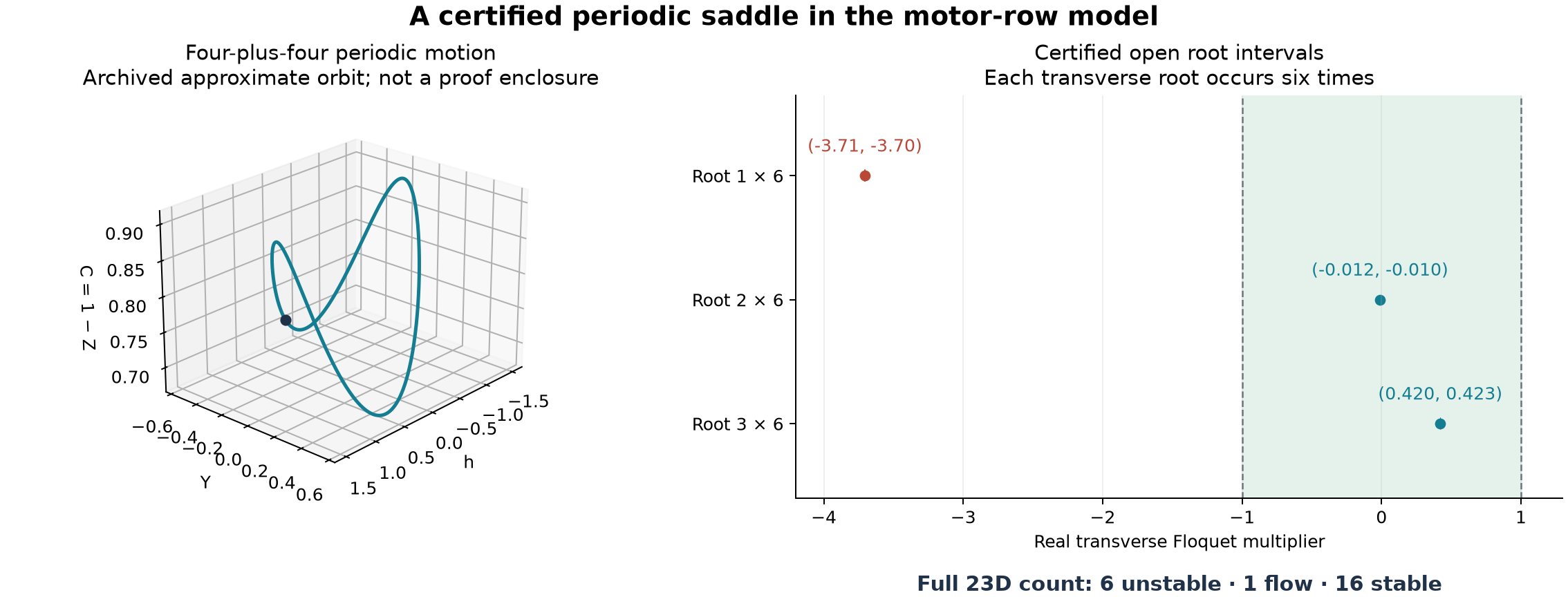
The periodic motor mechanism now has a computer-assisted local theorem. Recomputed interval certificates establish a nonconstant four-plus-four orbit, its least positive period and the full count of six unstable, one neutral and sixteen stable directions. A subsequent derivative certificate isolates a unique nearby transverse crossing, with exact multiplicity six and strictly nonzero speed. This is stronger than a floating-point cycle calculation, but it does not establish a nonlinear flip theorem or an attracting chaotic set. The base theorem, implementation and executable certificates.
The finite-dimensional result also lifts to the original density PDE under the source's sinusoidal assumptions. Mean deviations and higher Fourier modes decay exactly at unit normalized rate and do not feed back into the mechanical subsystem. They add infinitely many stable linearized directions; they cannot create additional critical directions or alter the certified crossing speed. This is an exact closure argument, not a numerical PDE truncation.
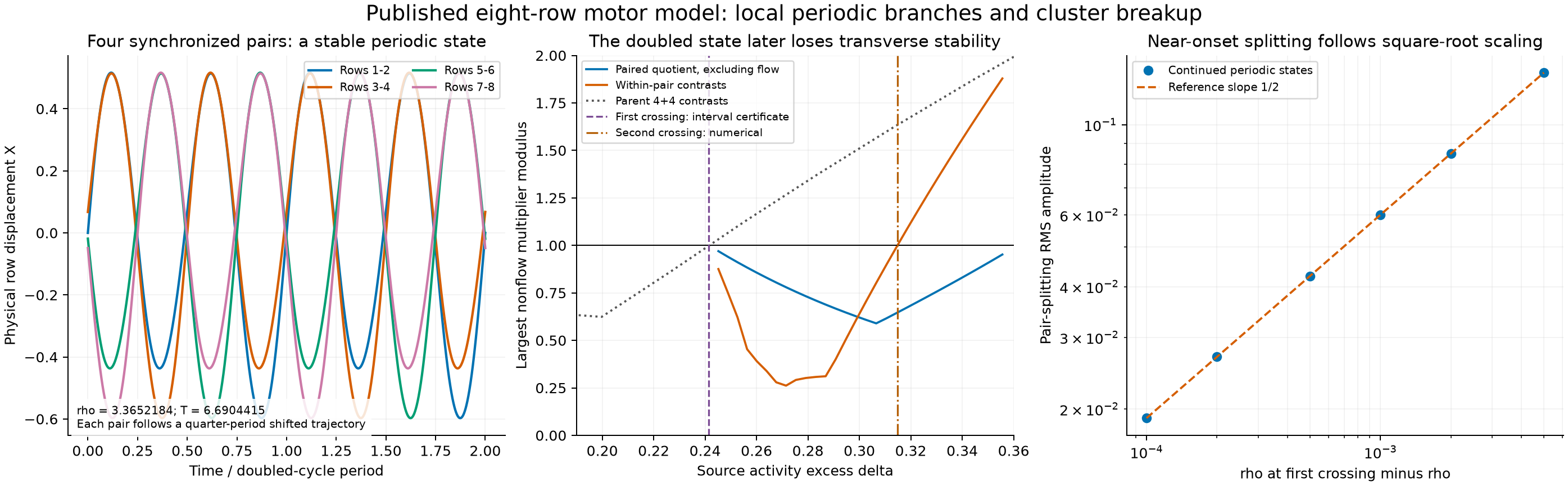
An attracting four-pair motor cycle is now rigorously certified. At the exact parameter rho=3.3652183995790423, interval shooting proves periodic motion with four distinct synchronized pairs. Every multiplier except the neutral flow multiplier lies strictly inside the unit circle in the complete 23-dimensional model. The result also replicates to any row count divisible by four and lifts to the stated density PDE. It is a periodic attractor, with no claim of a strange attractor or a proof of its nonlinear branch birth. Theorem, spectral bounds and reproduction.
A second crossing certificate proves a unique local fourfold transverse crossing near rho=3.2748747166, with strictly nonzero speed, least period and complete endpoint stability counts. A rigorous continuation linking the two certified four-pair neighborhoods and a nonlinear bifurcation theorem are still missing.
The postcritical numerical study follows this paired branch through the second instability and finds periodic saddles beyond it. Controlled departures approach permuted copies of the same saddle, with departure delays accurately predicted by the expanding Floquet exponent. This supports a heteroclinic-network hypothesis, while the infinite-time connections remain unproved. The study also exposes a numerical trap: floating-point synchronization can permanently confine a trajectory and its carried tangent to a subspace that hides an instability. Full monodromy and a same-state tangent restart detect that error.
The full-coordinate precision study then follows four departures over 40,000 time units without erasing the small contrasts. Two settings agree on the sequence and recovery times; the smallest sampled contrast is about 5e-140. The trajectory returns close to the original labeled saddle, while its next unstable contrast is regrowing. The connection-proof strategy states what would be required to turn this finite switching evidence into a theorem and explains why existing general switching literature limits the novelty claim.
The subsequent logarithmic-coordinate continuation reaches 280,000 units in two settings and reproduces seven departures. A contrast that fell below 10^-486 recovers enough to separate its pair again; the next contracting contrast reaches about 10^-911. Successive residence ratios approach the certified local contraction/expansion ratio. The archive retains pre-event predictions, all underflow diagnostics, corrected phase matching and the unchanged 150,000-unit evidence; none supplies the missing global connection theorem.
The switching state's local saddle structure is now proved. Weighted interval multiple shooting certifies six distinct clusters at rho=3.268, with least period approximately 13.63314576783 and exactly one unstable direction in the full system. Changed-precision reintegration confirms the result. Its half-period symmetry and exact group algebra identify eight distinct orbit images in the generated group; the candidate graph has sixteen directed edges. The cycle certificates establish the nodes, while the connections remain a global proof problem. Saddle theorem, group and graph.
A compact global attractor also exists analytically for the specified model. Explicit amplitude and displacement bounds give an absorbing finite set; the exact contracting residual identifies the full density-PDE attractor with the finite first-harmonic lift. This settles global dissipativity and the role of omitted modes, without deciding whether the attracting dynamics are chaotic. Theorem and exact algebra controls.
The weighted-volume identity sharpens this statement: where its stated coefficient is negative, the compact global attractor has zero phase-space volume. This includes the main hyperchaotic candidate and switching saddle, but the sufficient condition does not cover the lower-rho lane-46 and five-cluster-cycle parameters. The sum of Lyapunov rates is tied exactly to mean square mechanical speed whenever those limits exist. Separately, the saddle's full orbital symmetry gives 5,040 labeled copies, all equivalent by relabeling. Neither conclusion counts new chaotic attractors.
The global geometry argument also proves connectedness and a dimension lower bound of fourteen at the two specified eight-row points. The bound comes from the unstable manifold of the unique equilibrium, which lies in the global attractor. It concerns the full global set, rather than the dimension or chaotic character of any one local attracting regime.
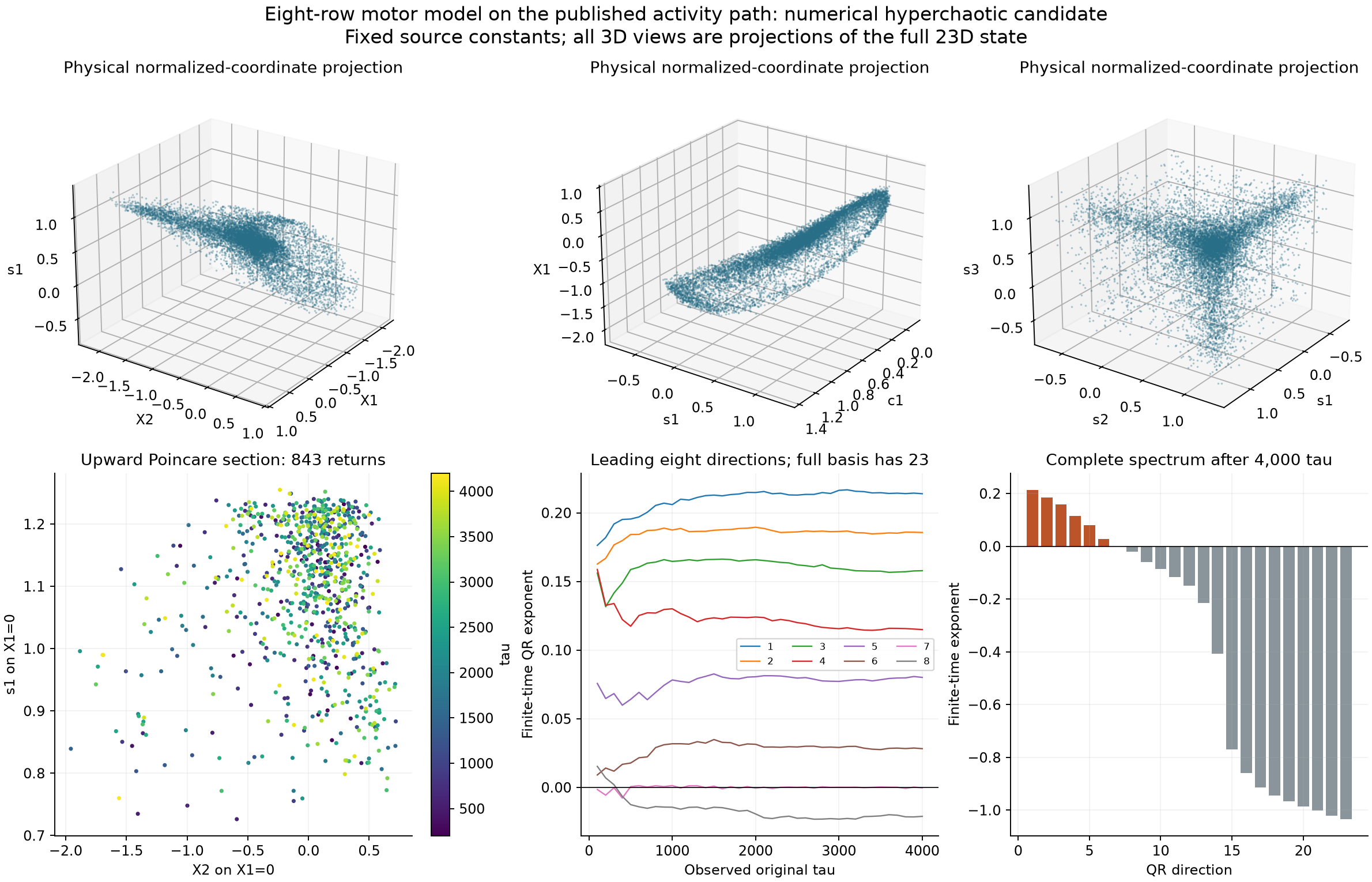
The eight-row motor model supports a numerical hyperchaotic candidate on its prescribed activity path. Holding all source constants and the transition-rate law fixed, changing chemical activity gives a regime with six positive exponents in an independent full 23-dimensional CPU calculation, now continued without resetting its tangent basis to 20,000 observed units. The sixth stays positive in every new 1,000-unit block. Flow, divergence and the weighted-volume identity are checked. The complete original GPU cohort retains the same 31 of 32 positives through another 20,000 units under both numerical settings. Its subthreshold member is independently identified as a periodic saddle; several positive members also need transverse cluster checks. These qualifications preserve the original counts while sharpening their meaning. The representative's activity is about 64% above the defined onset. Long continuation and perturbation audit, exact activity mapping and original evidence.
A separate five-cluster candidate has one positive quotient estimate and nine contracting pair-splitting directions in its complete conditional spectrum, supported by a longer strict control. Small full-space perturbations retain positive growth and return near the same pairs over the tested interval. Source-start reruns also expose numerical capture on unstable periodic states, so finite ensemble counts cannot be interpreted as physical basin fractions. A logarithmic rerun of the original start retains and recovers extremely small contrasts, but its two distant trajectories disagree; the exact start's asymptotic outcome remains unresolved. At another parameter, a physical departure from a periodic saddle supplied the seed for the separately certified attracting five-cluster cycle above. These follow-ups distinguish collective hyperchaos, possible cluster chaos and periodic capture; their numerical evidence does not prove a new strange attractor.
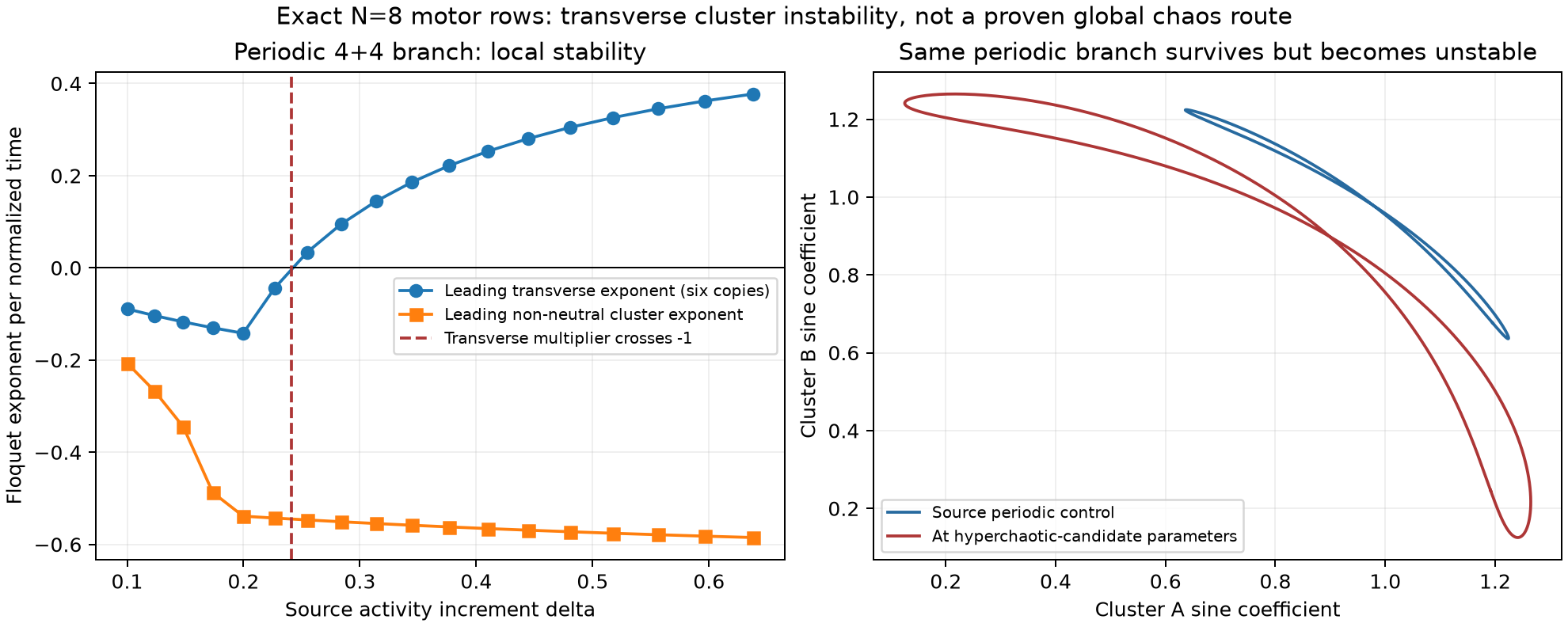
A continued periodic orbit supplies a local mechanism clue. The source's four-plus-four cluster cycle remains stable within its five-dimensional invariant subspace but loses transverse stability at activity increment about 0.24147. The crossing has six copies of a multiplier at −1 because of row symmetry. At the hyperchaotic candidate's parameter point, the continued cycle has six unstable transverse directions. These are Floquet directions of an unstable periodic orbit, distinct from the six unequal Lyapunov rates on the irregular trajectory. The matching count supports a specific cluster-breakup hypothesis; it does not prove a global transition or a new chaos mechanism. Derivation, 18-point branch and independent monodromy checks.
The three-row motor ensemble supplies another full-spectrum candidate and an interesting projection. At one declared parameter tuple, three starts retain leading exponents about 0.256–0.260 through an additional 10,000 original time units, with all 80 windows per start positive. Independent CPU integration over 2,000 observed units gives one positive exponent, one near zero and six negative exponents, with 636 section returns and checked divergence/flow identities. There is no observed fixed two-plus-one row collapse. Collective-motor report.
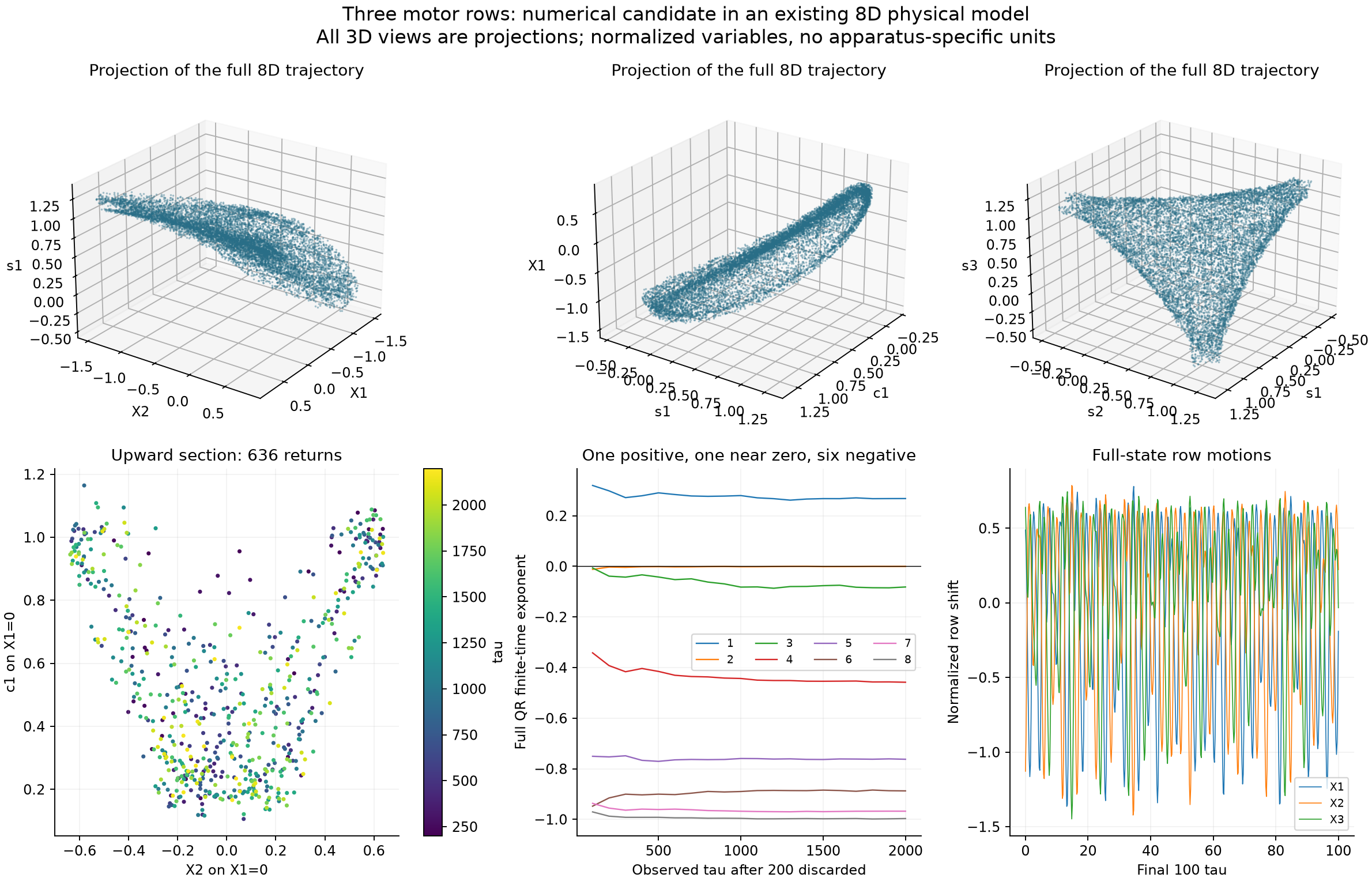
The curved triangular envelope is an eight-dimensional trajectory projected onto three physical observables. Its shape is consistent with row-permutation symmetry and a relatively quiet common mode, which is not conserved. The finite-time Kaplan–Yorke estimate is about 3.41; it is not a proof of fractal dimension or a new topological class. Of the 24 continued three-row candidates, two relax to neutral growth and another weakens late. All outcomes are archived. Four-row positives and eight-row points outside the separately checked activity study retain only screening-level evidence. Neither scientific priority nor asymptotic attraction is established.
The exact collective-motor core has acquired a new numerical lead in our search. Its 2014 authors explicitly examined chaos and reported periodic behavior in their checked cases. Our 2,880-trajectory survey leaves 252 cases unresolved, while eight candidates survive tighter and longer follow-ups with every recorded window positive through another 24,063 original time units. A 3,400-unit independent CPU check supports positive growth, although its full spectrum and neutral direction are not yet converged. This is an exact-model numerical candidate with an unresolved priority question, not a demonstrated new attractor. Motor-pair evidence and limitations.
Coupled optical material operators are the strongest current case study of persistence versus transient chaos. Each operator combines a mechanical displacement, velocity and thermal response. They control one another's illumination. We implemented a continuous-heat interpretation of the published switching equations, then separately examined an explicitly assumed smooth logistic illumination profile. The smooth profile is not a measured property of the source experiment.
In a fixed cohort of 32 initial conditions per optical width, all starts at widths 0.003 and 0.005 eventually reach independently checked periodic cycles. The last capture first qualifies at time 73,500. Before capture, that trajectory had 583 consecutive positive-exponent windows spanning 72,875 time units. At width 0.04, 26 starts instead remain irregular through time 100,000; every one of their 800 recorded windows has a positive estimate. Six other starts at that width approach a coexisting cycle early. These counts describe this cohort, not basin probabilities or a proof of asymptotic attraction. Full lifetime experiment.
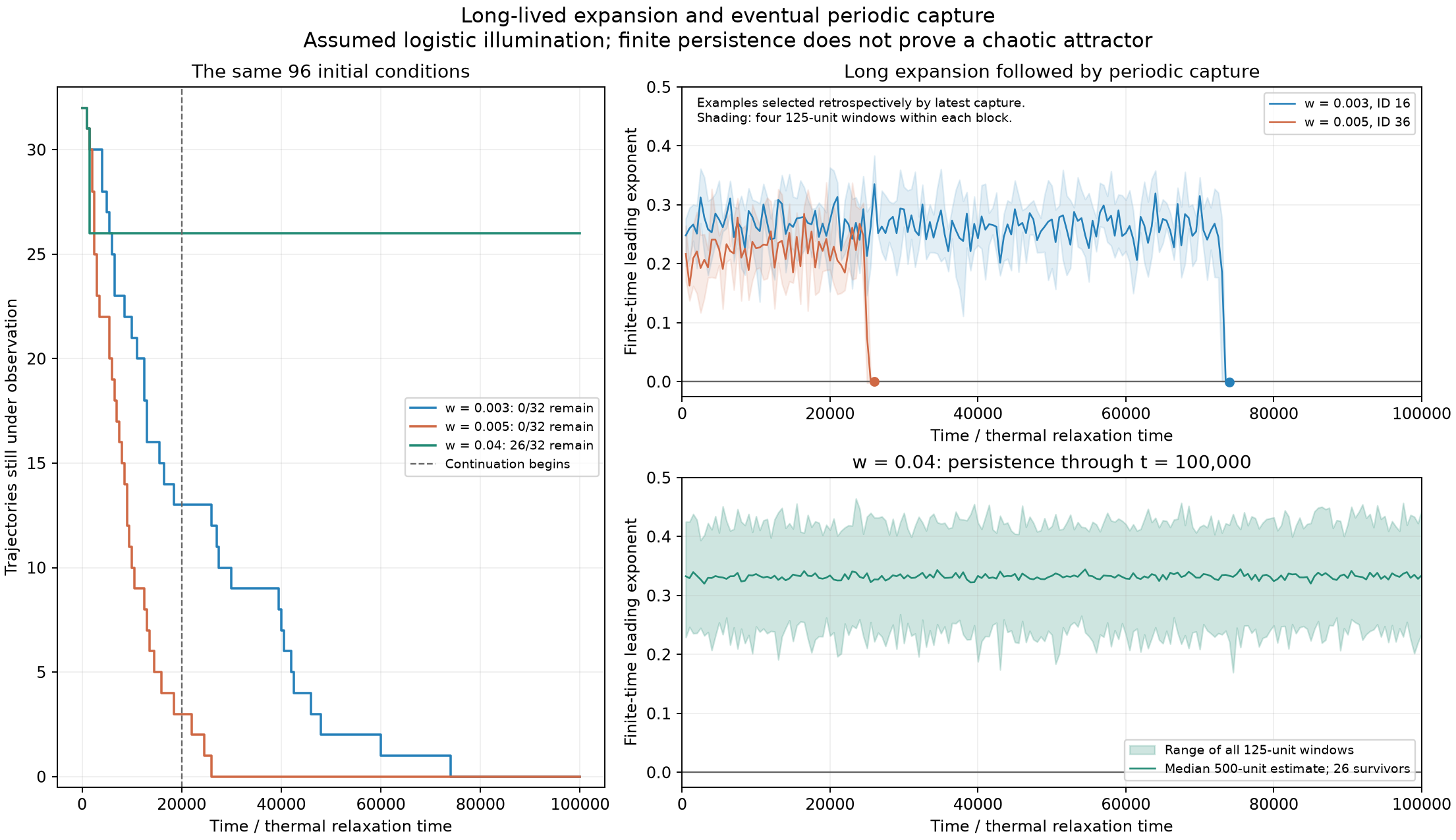
The capture cycles at all three widths lie on the same continued periodic branch. It loses and regains stability between them. A separately checked unstable doubled branch approaches the first stability crossing, supporting a local subcritical period-doubling picture. This describes part of the model's organization; it does not establish the global route to chaos or identify the set responsible for long transients. Periodic-orbit study.
Following the branch through a numerically resolved fold finds a second, unstable periodic orbit at the same broad width 0.04. Stable and saddle cycles meet at width 0.0404788044. Independent Radau calculations confirm both cycles and the unit-multiplier crossing. This supplies a concrete target for basin-boundary work, without yet identifying that boundary or a chaotic crisis.
The first departure test takes four small perturbations near that saddle: two signs at two amplitudes. One sign reaches the known cycle; the other retains positive finite-time expansion and irregular returns through 500 units. Two independent long Radau runs confirm the first amplitude's cycle-proximity outcomes, while one smaller-amplitude run is incomplete and another unstarted. This supports a specific boundary hypothesis. The four new trajectories are distinct from the earlier 100,000-unit cohort, and the test is not a global basin computation.
Four coupled synchronematic colloid oscillators remain a promising collective-chaos candidate. The published phase-and-orientation approximation has seven effective angular states after removing its common phase. A long independent CPU spectrum, GPU step checks, different initial states and coefficient variants retain positive leading exponents. We found a sign discrepancy between the printed paper and author code; both variants were tested and remain separate in the archive. The simpler two-oscillator case admits a first-integral restriction. Single-particle Quincke chaos and chaos in other four-oscillator networks are already known, so a priority claim would have to concern this precise collective model. Model and evidence, symmetry and priority.
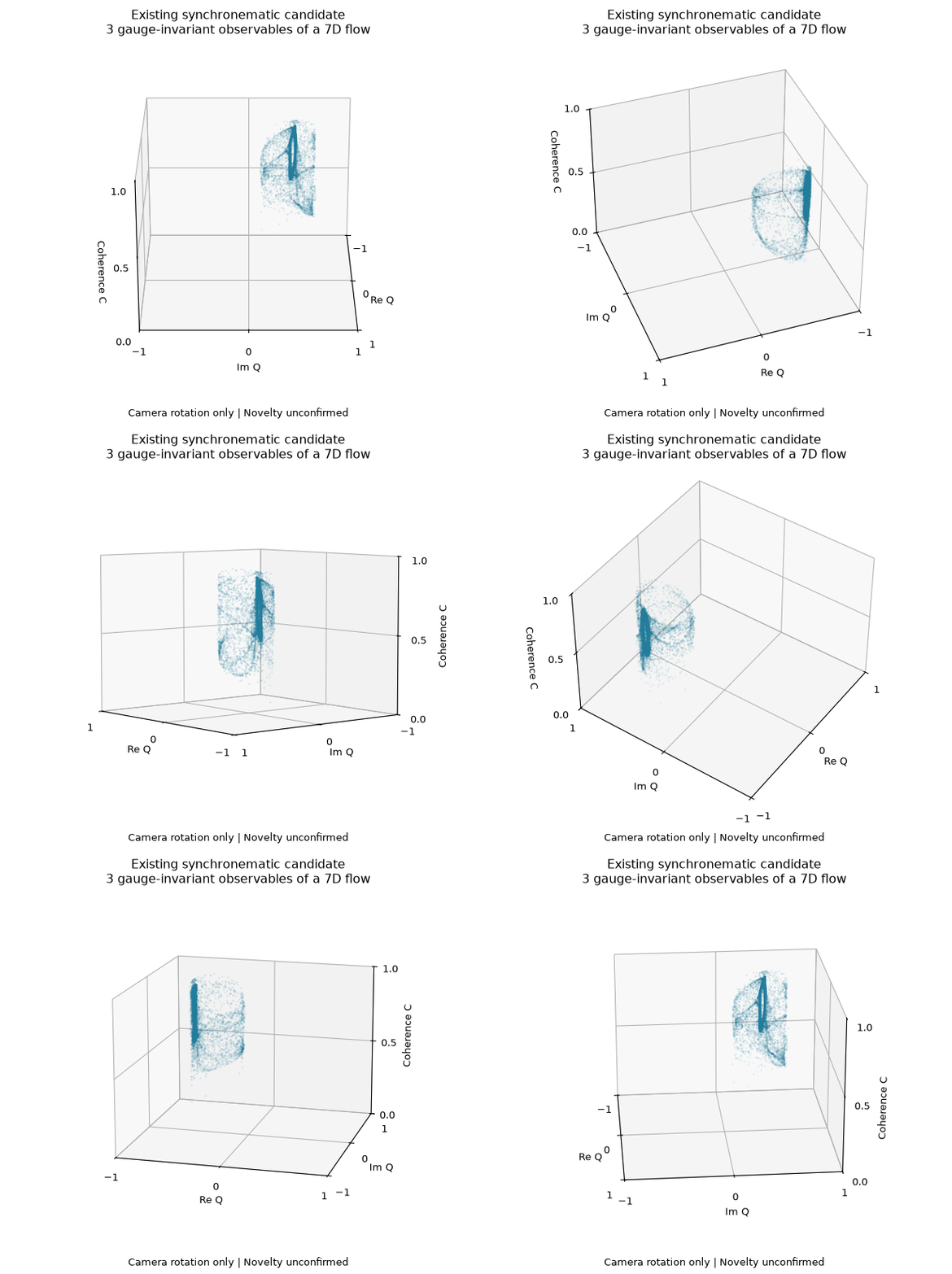
First recorded portrait: 2026-10-29.
This rotating picture is a projection of a seven-dimensional flow. Its physical observables respect the particle symmetries. The appearance does not demonstrate a new three-dimensional topology. Geometry comparison.
Two other candidates have especially important scope limits. The three-state LCE slider retains event-resolved chaos candidates at stiffness and damping outside the source's numerical range; older relay chaos is close prior art. The five-state two-strain model retains long numerical candidates, but the source already discusses possible aperiodicity, and extremely small prevalence limits a finite-population interpretation. Slider report, two-strain report.
Useful negative and mathematical results
| Outcome | What was actually established | Scope |
|---|---|---|
| Quantum memristive neuron | 36,864 trajectories and 58 selected rechecks did not confirm chaos | The tested model and parameter search; not a global exclusion. Report |
| Collective motor energy structure | An exact finite-memory representation and energy balance give a sufficient convergence-to-rest region | The strict region applies in the stated invariant population disks and does not contain the positive candidates. No sharp chaos boundary or mathematical priority is claimed. Derivation |
| Reciprocal physical meminductor under constant drive | An energy argument excludes recurrent chaos for the stated reciprocal model | The source's printed force/flux pair and optical-feedback closure need separate resolution. Audit |
| Smooth optical pair with real mechanical poles | An exact coordinate change gives a cyclic order structure; a known theorem excludes compact equilibrium-free chaotic limit sets | Explicit smooth law and overdamped/critical mechanics; not the underdamped candidates or a global theorem about equilibrium-containing sets. Derivation |
| Long/stiff numerical false positives | Several preliminary signals approach stable cycles, including an independently checked stiff-gel endpoint | An unresolved integration remains unresolved; checking its endpoint does not complete its missing interval. Gel case, candidate queue |
| Source-definition gates | The printed microfluidic periodic control was not recovered; strict motor-contact rules have a continuation ambiguity | No coefficients were silently fitted and no contact regularization was substituted. Microfluidics, rotors |
Negative searches, failed source controls and mathematical exclusions are retained because they explain why a promising-looking signal was rejected or left open.
What is known, observed and still hypothetical?
Known literature: chaos in molecular-motor/sarcomere models, Quincke rotation, relay feedback, coupled nonlinear oscillators and multi-strain epidemic models predates this work. The motor priority audit identifies a 2010 precedent and material unread-source gaps. The monotone-feedback theorem used above is an existing result. Renaming an equivalent response law or rotating a projection does not establish novelty.
The follow-up audit adds a precise cluster-breakup comparison, a coefficient-level distinction from a 2026 cubic approximation and a second unread author thesis. It also proves how balanced and unequal cluster restrictions contribute their separate Floquet blocks. In particular, an orbit can attract inside a cluster restriction while remaining a saddle in the full system.
Our reproducible observations: the specified model implementations, positive finite-time spectra with independent numerical checks, the optical capture lifetimes and periodic branches, source discrepancies, structural calculations and negative search archives. Each report records its exact equation interpretation and numerical settings.
Open hypotheses: whether the motor-row and motor-pair candidates are asymptotically attracting chaotic sets and lack an earlier exact or equivalent demonstration; whether the broad optical regime is an asymptotically attracting chaotic set; which nonattracting invariant structures organize its long transients; and whether their dynamical organization differs from known attractor classes. A bounded literature search cannot settle absence of prior publication.
The next useful work would target these questions with continuation of relevant invariant solutions, basin-boundary analysis, stronger numerical or computer-assisted validation, source-model clarification and a focused equation-level priority review. Another striking image or larger grid alone would not resolve them.
Selected references
- Leyva, S. G., Zhang, Z., Olvera de la Cruz, M., and Bishop, K. J. M. (2026). Self-oscillating synchronematic colloids. Nature Communications 17, 1841. doi:10.1038/s41467-026-68552-8.
- Guo, H., et al. (2025). Light-mediated communication in responsive materials ranging from individual self-oscillators to feedback-driven network. Nature Communications 16, 11315. doi:10.1038/s41467-025-66395-3.
- Ge, D., Hong, Q., Liu, X., and Liang, H. (2024). Self-Oscillation of Liquid Crystal Elastomer Fiber-Slide System Driven by Self-Flickering Light Source. Polymers 16, 3298. doi:10.3390/polym16233298.
- Potter, F., Zagoskin, A., Savel'ev, S., and Balanov, A. G. (2024). Hysteresis and self-oscillations in an artificial memristive quantum neuron. Physical Review A 110, 042604. doi:10.1103/PhysRevA.110.042604.
- Weiss, E., and Margaliot, M. (2021). A Generalization of Linear Positive Systems with Applications to Nonlinear Systems: Invariant Sets and the Poincare–Bendixson Property. Automatica 123, 109358. doi:10.1016/j.automatica.2020.109358.
- Letellier, C., and Aguirre, L. A. (2012). Required criteria for recognizing new types of chaos: Application to the “cord” attractor. Physical Review E 85, 036204. doi:10.1103/PhysRevE.85.036204. Its publisher abstract informed the scope; a full topology comparison remains open.
- Alouges, F., Anello, I., DeSimone, A., Lefebvre-Lepot, A., and Levillain, J. (2025). Some mathematical models for flagellar activation mechanisms. Mathematical Models and Methods in Applied Sciences 35, 2395–2424. doi:10.1142/S0218202525500423.
The linked model reports provide complete source trails, access limitations and precise prior-art comparisons. Source papers retain their own licenses.